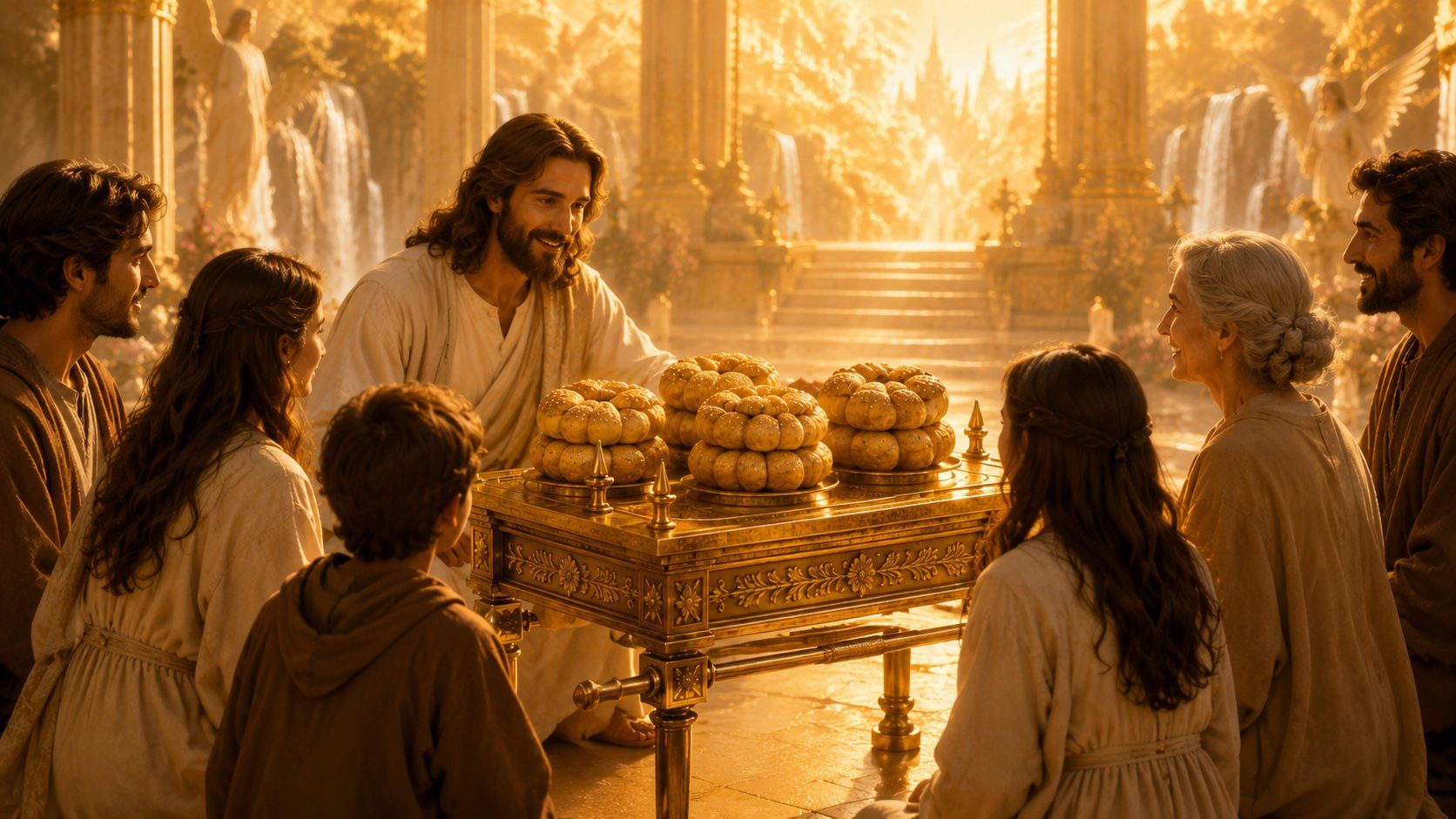
The Table of Showbread held twelve loaves of fresh bread, replaced every week, that the priests ate as a reminder of God’s presence. It is one of the most ordinary items in the whole Tabernacle — a table with bread on it — precisely so that anyone, in any culture, in any era, could understand it.
How to use this guide: Study the biblical pattern, respond honestly to the questions, and then walk through the prayer practice. This is not a script to repeat mechanically. It is a pathway for letting the Holy Spirit lead you into worship through Jesus.
Central truth: “Man shall not live by bread alone, but by every word that proceeds from the mouth of God” (Matthew 4:4). Jesus quoted this from Deuteronomy 8 while being tempted in the wilderness — proving that knowing and speaking the Word is how every test, His and ours, gets answered.
Temple Prayer
Bible Study
Logos and Rhema
The Table of Showbread teaches a distinction that changes how you read Scripture: the Logos is the whole written Word of God, and the Rhema is a specific word the Holy Spirit makes alive for you, personally, today.
John 1:1
“In the beginning was the Word (Logos), and the Word was with God, and the Word was God” — the entire body of Scripture, and Jesus Himself.
Romans 10:17
“Faith comes by hearing, and hearing by the Rhema word of God” — a specific, spoken word, not just information.
Exodus 25:23-30
God gave detailed instructions for the table and the bread “to be before Me at all times” — a permanent reminder of His presence, not an occasional one.
John 6:51
“I am the living bread that came down from heaven... the bread that I will give for the life of the world is My flesh” — Jesus as the true fulfillment of the manna and the showbread.
1God uses ordinary things to teach eternal truth.
A table and bread — items every culture in every era can understand — carry the same weight as the most dramatic parts of the pattern.
2The bread represents daily dependence.
Just as manna couldn’t be stockpiled, the Table teaches you to seek fresh bread — a fresh word — every single day.
3Jesus fought temptation with Scripture He knew.
In the wilderness, He answered every test by quoting Deuteronomy from memory — proof that knowing the Word in advance matters.
4Communion makes it physical.
“This is My body... this cup is the new covenant in My blood” (1 Corinthians 11:23-29) — you don’t just believe the Word, you ingest it.
Important distinction: Logos is not replaced by Rhema — it’s activated by it. You need the whole counsel of Scripture (Logos) as the foundation; the Rhema word is the Spirit taking a piece of that foundation and making it burn for you today.
Temple Prayer
Understanding the Station
What Happens at the Table
1
You remember the bread is a discipline, not magic.
God doesn’t drop a loaf on your table daily — He gives the grain, the seed, the seasons, and you do the work of turning it into bread.
2
You ask for a Rhema word.
Come expecting God to highlight something specific for your actual day, not just general encouragement.
3
You declare Scripture out loud.
Faith comes by hearing — there is something powerful about speaking the Word into the atmosphere of your home, not just thinking it.
4
You take your priestly responsibility seriously.
“The lips of a priest should preserve knowledge” (Malachi 2:7) — knowing the Word is part of your job, not extra credit.
5
You let the Word get inside you.
Praying Scripture, not just reading it, is what allows it to “come out” naturally when you need it later.
Jesus at the Table
The Living Bread
John 6:51
Gives life to the world.
The True Manna
John 6:32-33
The real bread from heaven.
The Word made flesh
John 1:14
Logos Himself, dwelling among us.
Further study: Read and mark: Deuteronomy 8:3; Matthew 6:11; Psalm 119:105; Malachi 2:7.
Temple Prayer connection: Come to the Table after welcoming the Spirit at the Lampstand — He is the one who takes what you read here and makes it alive.
Temple Prayer
Study, Understand & Respond
Personal Worksheet
When was the last time you asked God specifically for a Rhema word for your day?
Jesus fought temptation by quoting Scripture He already knew by heart. How much Scripture do you currently have memorized and ready to use that way?
The bread represented daily dependence — no stockpiling. Where in your life are you trying to stockpile instead of depending on God daily?
Malachi 2:7 says a priest’s job is to preserve and share knowledge of God. How seriously do you take that as your own responsibility, not just your pastor’s?
What is one passage of Scripture you want to intentionally memorize this week?
Have you ever experienced a verse suddenly feeling like it was “in bold letters” for you? Describe it.
What would it look like to take communion this week as a deliberate act of remembrance rather than a routine?
Temple Prayer
Prayer Practice
Praying at the Table of Showbread
Move slowly. Pause after each step. Let the Holy Spirit bring specific people, memories, Scriptures, and responses to mind.
1
Thank God for the Word.
Thank Him for both the Logos, the whole of Scripture, and His willingness to give you Rhema, a specific word.
2
Ask for today’s bread.
“Give me this day my daily bread” — ask for exactly what you need for today, not more, not less.
3
Speak Scripture out loud.
Choose one verse and declare it into the room, not just in your mind.
4
Ask for memory and retention.
Ask the Spirit to help Scripture stay with you so it’s ready when you need it.
5
Take communion if you are able.
Physically eat and drink, remembering His body and blood as an act of worship, not habit.
6
Thank Him for feeding you.
Close by simply thanking God that you do not have to live on bread alone.
What I sensed the Holy Spirit emphasizing:
My Table declaration for this week: Because Jesus is the Bread of Life, I will
Seven-day practice:
Read Deuteronomy 8 in full once this week.
Ask for a Rhema word each morning before your day starts.
Memorize one verse this week and say it out loud daily.
Take communion once this week with your family or on your own.
Next Station: The Altar of Incense — Priestly Intercession.