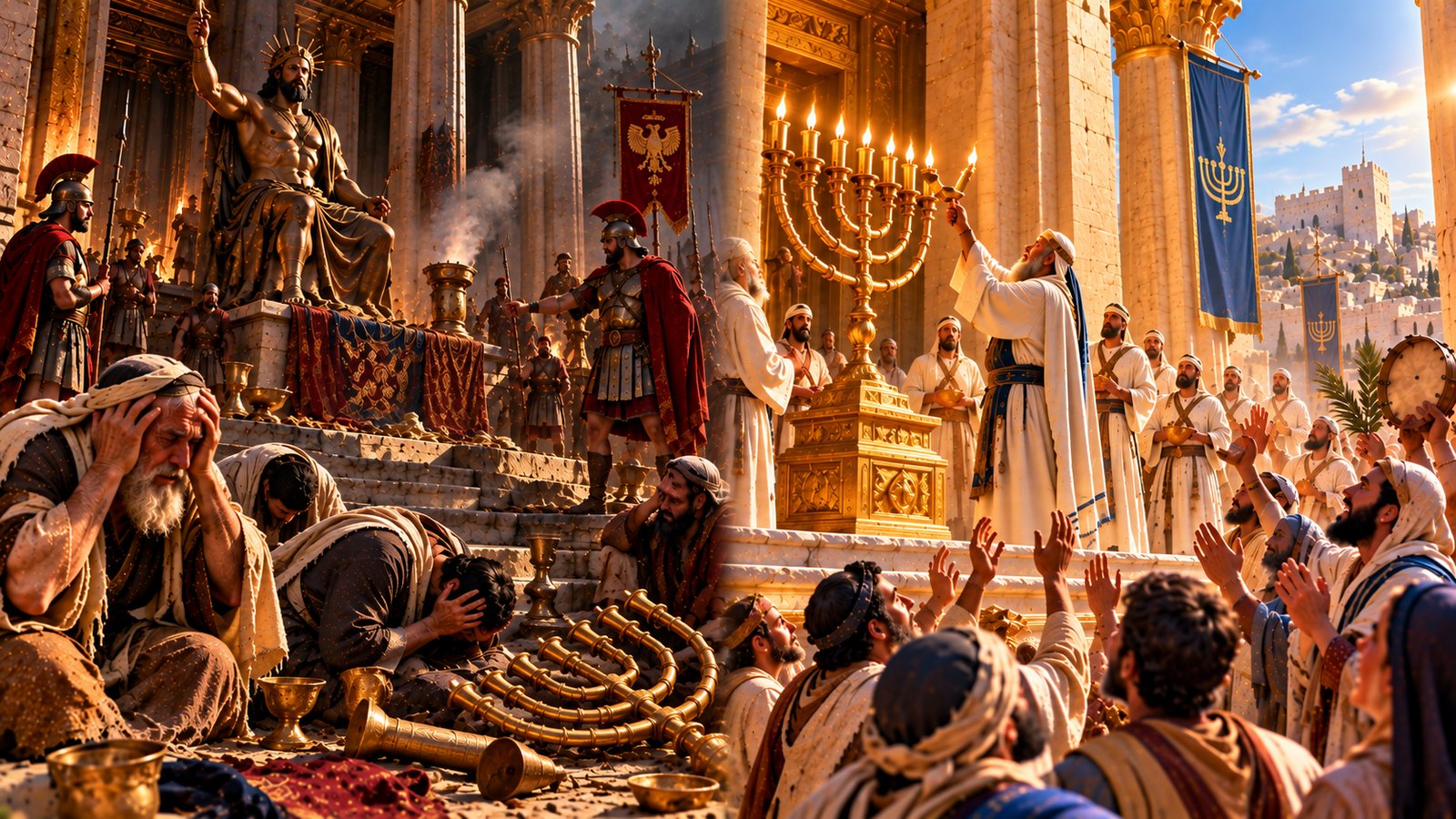
Setting: Jerusalem under the Seleucid ruler Antiochus IV Epiphanes in the second century BC, followed by the Temple's rededication under Judas Maccabeus in 164 BC. Primary historical account: 1 Maccabees 1 and 4. Biblical connections: Daniel 11:31–33; John 10:22–30; Romans 12:1–2.
Nehemiah's generation rebuilt Jerusalem's walls and gathered to hear God's word. Generations later, the Temple would face another crisis. A foreign ruler would suppress Israel's covenant practices and profane the sanctuary. Some would cooperate; others would remain faithful at terrible cost. Eventually, the house would be cleansed and its worship restored. This chapter closes our section on return and restoration by following that history into the background of the Gospels. We use 1 Maccabees as an ancient historical source. Catholics and Orthodox Christians receive it within their Old Testament traditions; Protestant Bibles do not include it in the inspired canon. Its historical testimony is useful, while our doctrine rests on canonical Scripture.
Daniel Describes an Assault on the Sanctuary
31“Forces from him will profane the sanctuary, even the fortress, and will take away the continual burnt offering. Then they will set up the abomination that makes desolate.
32He will corrupt those who do wickedly against the covenant by flatteries; but the people who know their God will be strong and take action.
33“Those who are wise among the people will instruct many; yet they will fall by the sword and by flame, by captivity and by plunder, many days.
The attack reaches into the sanctuary and interrupts the offering God had appointed. The pressure also reaches people through flattery and corruption. The issue is authority over worship and covenant loyalty.
Many Christian interpreters connect this part of Daniel 11 with Antiochus IV and the persecution that followed. Daniel 8 is also frequently discussed in that connection. Christians differ about how these passages relate to later events and final fulfillment. We can recognize the historical connection without declaring every prophetic question settled.
One sobering detail is clear in the passage itself: faithful people can suffer. Knowing God gives strength for loyalty, yet some who instruct others fall under persecution. Trust is deeper than an expectation that obedience will always preserve our comfort or safety.
A King Tries to Rewrite the People's Worship
44The king sent letters by the hand of messengers to Jerusalem and the cities of Judah, that they should follow laws strange to the land,
45and should forbid whole burnt offerings and sacrifice and drink offerings in the sanctuary; and should profane the Sabbaths and feasts,
46and pollute the sanctuary and those who were holy;
47that they should build altars, and temples, and shrines for idols, and should sacrifice swine’s flesh and unclean animals;
48and that they should leave their sons uncircumcised, that they should make their souls abominable with all manner of uncleanness and profanation;
49so that they might forget the law, and change all the ordinances.
Antiochus IV ruled within the Seleucid kingdom, one of the successor powers to Alexander's empire. According to 1 Maccabees, his decrees sought to suppress sacrifices, Sabbaths, festivals, and circumcision while requiring practices forbidden by Israel's law. The following verse threatens death for disobedience.
The same account describes willing compromise among some Israelites before and during the coercion. The crisis involved both pressure from outside and accommodation within. We should not retell it as though everyone responded alike.
The Temple stood at the center because Israel's worship expressed belonging to the Lord. Altering its service was an attack on that covenant life. The account also records people who chose death rather than violate the covenant (1 Maccabees 1:62–63). Their suffering deserves sober attention, not a romantic picture of easy courage.
The Lie and the Truth: Is Compromise Inevitable?
The lie is that survival requires surrendering whatever God has made clear. God's truth is that worship belongs to Him, and His people are called to remain faithful under pressure.
Faith is fundamentally trusting our good Father. That trust may require costly obedience. The Father remains good when loyalty brings loss, and the Spirit can strengthen us to endure. We should pray for deliverance while refusing to make immediate escape the measure of God's faithfulness.
For Christians, this history calls us to loyalty to Jesus, not imitation of an ancient armed revolt. The New Testament directs us to bless persecutors, refuse revenge, and overcome evil with good (Romans 12:14–21). Courage and love must remain together.
The Sanctuary Is Cleansed for Its Appointed Service
42He chose blameless priests who were devoted to the law;
43and they cleansed the holy place and carried the defiled stones out to an unclean place.
After victories under Judas Maccabeus, the people return to the sanctuary. They find desolation and mourn before beginning the cleansing (4:36–40). Recovery includes grief over what has happened and care about what must now be restored.
Judas chooses priests devoted to the law. The profaned altar is dismantled, and a new altar is built with whole stones according to the law. The old stones are set aside until a prophet can give an answer about them (4:44–47). The account acknowledges a question the people cannot yet resolve.
New vessels are made. The lampstand, incense altar, and table are brought into the Temple; the lamps are lit, incense is offered, and bread is set out (4:49–51). Restoration concerns the worship God ordained, including the ordinary service of His house.
A Dedication Remembered Year after Year
52They rose up early in the morning, on the twenty-fifth day of the ninth month, which is the month Chislev, in the one hundred forty eighth year,
53and offered sacrifice according to the law on the new altar of burnt offerings which they had made.
54At the time and day the Gentiles had profaned it, even then it was dedicated with songs, harps, lutes, and with cymbals.
55All the people fell on their faces, worshiped, and gave praise toward heaven, which had given them good success.
56They celebrated the dedication of the altar eight days, and offered burnt offerings with gladness, and sacrificed a sacrifice of deliverance and praise.
The rededication takes place on the twenty-fifth of Chislev, in the year commonly identified as 164 BC. The altar's renewed service answers its earlier profanation. Songs, instruments, worship, and gladness mark the occasion.
The account goes on to establish an annual eight-day remembrance beginning on that date (4:59). This is the historical setting of Hanukkah, the Feast of Dedication. The name carries the memory of worship restored after desecration.
First Maccabees describes the eight-day dedication without recounting the familiar oil miracle. We should let the historical account say what it says. The emphasis here falls on cleansing the sanctuary, restoring its appointed service, and giving thanks for deliverance.
Jesus Walks in the Temple at Dedication
22It was the Feast of the Dedication at Jerusalem.
23It was winter, and Jesus was walking in the temple, in Solomon’s porch.
24The Jews therefore came around him and said to him, “How long will you hold us in suspense? If you are the Christ, tell us plainly.”
25Jesus answered them, “I told you, and you don’t believe. The works that I do in my Father’s name, these testify about me.
John places Jesus in the Temple during the Feast of Dedication. The history we have been studying is part of the world in which this conversation occurs. A sanctuary once reclaimed for worship now becomes the setting for an urgent question about the Messiah.
Jesus directs His questioners to the works He does in His Father's name. The conversation moves from the identity of the place to the identity of the Son who stands within it. The Father's work is being revealed through Him.
John records Jesus' presence at the feast; this passage does not describe Him leading its ceremonies or endorsing every later tradition associated with it. We can recognize the connection without adding details. The greater revelation is Jesus Himself.
The Son Brings His Sheep into the Father's Care
27My sheep hear my voice, and I know them, and they follow me.
28I give eternal life to them. They will never perish, and no one will snatch them out of my hand.
29My Father who has given them to me is greater than all. No one is able to snatch them out of my Father’s hand.
30I and the Father are one.”
Jesus speaks of sheep who hear His voice, are known by Him, and follow Him. He gives them eternal life and assures them of His care and the Father's care. Their deepest security rests in the One to whom they belong.
That promise reaches beyond the security of any earthly building or ruler. Jesus will Himself suffer, die, and rise. Through Him, His people receive life that persecution cannot finally destroy. His words give strong ground for trust when outward circumstances are unstable.
The Temple story is carrying us toward this personal access to the Father through the Son. God's desire for a people who know Him reaches its fullest revelation in Jesus. Our response is to hear and follow Him.
A Life Offered to God
1Therefore I urge you, brothers, by the mercies of God, to present your bodies a living sacrifice, holy, acceptable to God, which is your spiritual service.
2Don’t be conformed to this world, but be transformed by the renewing of your mind, so that you may prove what is the good, well-pleasing, and perfect will of God.
Paul grounds our response in God's mercies. Christian dedication begins with what God has done for us through Jesus. We receive His welcome as sons and daughters, then offer our lives in grateful service.
The application reaches our bodies, choices, and minds. We can ask where conformity has made disobedience feel normal and where the Spirit is calling us to change. Repentance becomes practical as we turn from sin and learn a faithful way of living.
Jesus' sacrifice is sufficient; our dedication adds nothing to its saving power. We offer ourselves because we belong to Him. Temple Prayer helps us express that belonging through thanksgiving, trust, repentance, fellowship, and willing service.
A People Preserved under Foreign Rule
This crisis belongs to the Jewish people's history under foreign rule. The Temple's rededication preserves the memory of a community resisting the destruction of its covenant worship. Jesus later walks within that same continuing history. Gentile believers are welcomed through Israel's Messiah and grafted into God's covenant blessings; they do not replace Israel (Romans 11:17–29).
Holiness and Fellowship
The place of worship matters because it belongs to the Lord. Its purpose is holy fellowship governed by His word. Desecration violates that purpose; restoration returns the house to its appointed service.
Through Jesus, we draw near to the Father and become His dwelling by the Spirit. The journey will eventually reach the New Jerusalem, where God and the Lamb are its temple. Here we learn to honor His presence by giving Him our wholehearted loyalty.
Temple Prayer Response: My Worship Belongs to You
Here is a sample prayer. Make it your own, and continue in your own words.
Father, thank You for Your mercy and for the place You have given me in Your family through Jesus. Forgive me for treating compromise as unavoidable. Jesus, help me hear Your voice and follow You. Holy Spirit, expose what has taken a place in my life that belongs to God. Strengthen me to repent, remain faithful under pressure, and love those who oppose me. My worship and my life belong to You. Amen.
Name one area where pressure has weakened your obedience. Read Romans 12:1–2 again, ask for the Spirit's help, and choose a concrete act of repentance or faithfulness.
Daniel 8; 11:21–35; John 10:22–30; Romans 11:17–29; 12:1–21. Historical reading: 1 Maccabees 1; 4:36–61; Josephus, Antiquities 12.7.6–7 (§§316–325).
Direct quotations of Scripture use the World English Bible (WEB), public domain (ebible.org/eng-web), and were checked against that text (Daniel 11, John 10, and Romans 12). The 1 Maccabees passages are explicitly labeled historical readings because this Protestant study does not treat them as canonical Scripture. They are quoted from the WEB's full ecumenical book set and checked against it. The identification of Daniel's descriptions with Antiochus is an interpretation; the relationship to later or final fulfillment remains debated among Christians. The rededication is conventionally dated 164 BC. First Maccabees 4 records an eight-day dedication but does not recount the oil miracle. John 10 records Jesus at the feast without detailing His participation in its observances. The illustration is a montage, not an architectural reconstruction or a literal depiction of simultaneous events. The lie/truth framing is editorial.