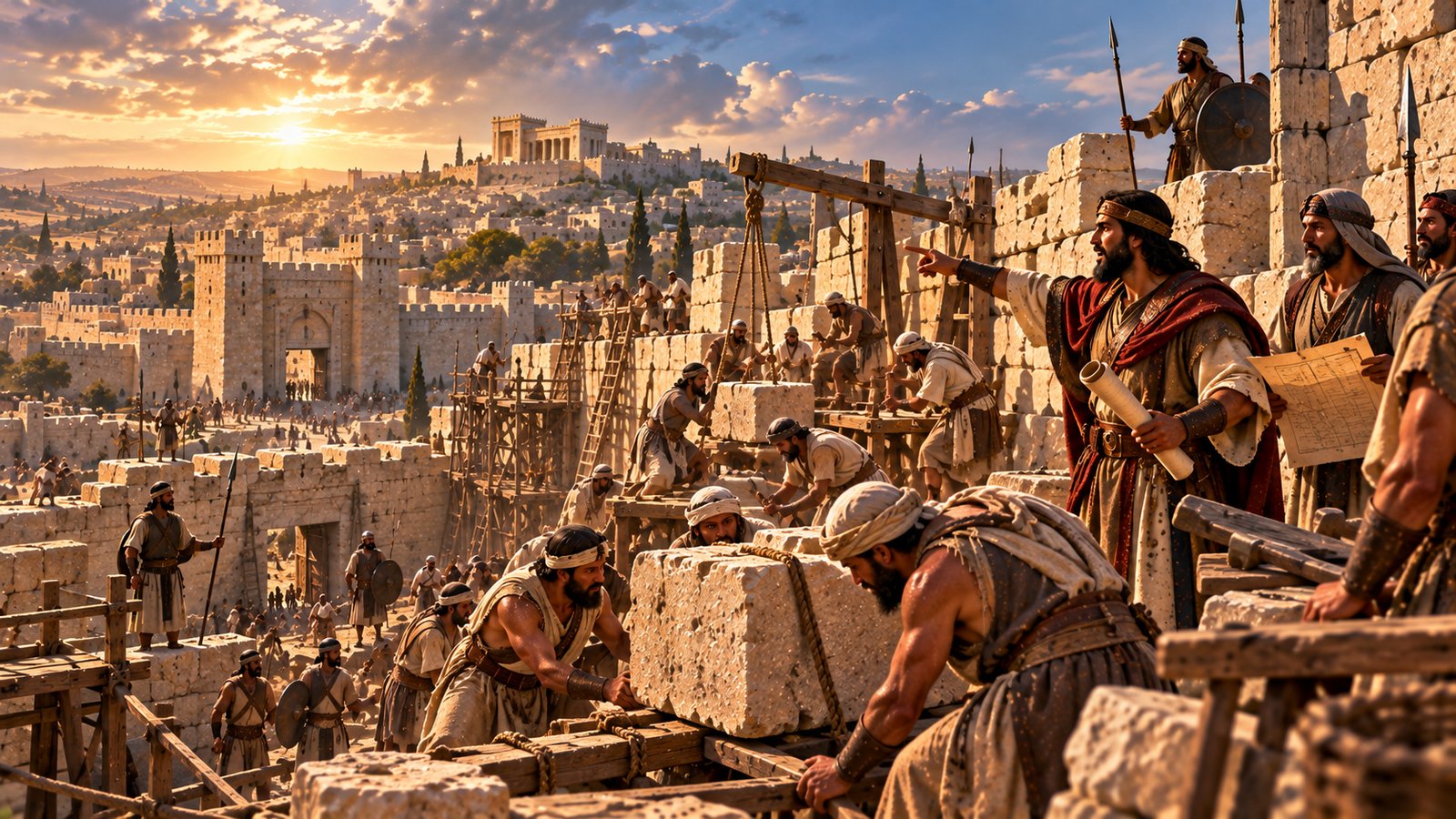
Setting: Jerusalem under Persian rule during the reign of Artaxerxes. This chapter returns to events before the public reading studied in Chapter 29. Principal figures: Nehemiah, the king, Jerusalem's builders, and their opponents. Primary passages: Nehemiah 1–6.
The Temple has been rebuilt, yet Jerusalem's broken wall and burned gates leave the community in distress and disgrace. Far away in the Persian court, Nehemiah receives the news. He cannot repair the city from where he stands, but he can bring its condition before God. His story joins prayer to responsibility. He grieves, confesses, asks for help, makes a careful request, examines the damage, and gathers the people to work. As we return to these events before Ezra's public reading, we watch trust become patient, courageous action.
He Lets the News Reach His Heart
3They said to me, “The remnant who are left of the captivity there in the province are in great affliction and reproach. The wall of Jerusalem is also broken down, and its gates are burned with fire.”
4When I heard these words, I sat down and wept, and mourned several days; and I fasted and prayed before the God of heaven,
Nehemiah does not treat Jerusalem's condition as distant information. He sits down, weeps, mourns, fasts, and prays. The suffering of his people matters to him even while his own position is inside the palace.
Compassion often begins when we allow a need to interrupt our comfort. We cannot take personal responsibility for every problem we hear about. We can ask the Father which burdens He is inviting us to carry in prayer and which responsibilities belong to our calling.
Nehemiah's grief also takes time. The narrative does not demand an immediate public initiative to prove that his concern is real. He turns toward God before he can see the whole assignment. That is a sound beginning when the damage seems larger than our ability.
His Prayer Includes Confession
5and said, “I beg you, Yahweh, the God of heaven, the great and awesome God who keeps covenant and loving kindness with those who love him and keep his commandments,
6let your ear now be attentive and your eyes open, that you may listen to the prayer of your servant which I pray before you at this time, day and night, for the children of Israel your servants, while I confess the sins of the children of Israel which we have sinned against you. Yes, I and my father’s house have sinned.
7We have dealt very corruptly against you, and have not kept the commandments, nor the statutes, nor the ordinances, which you commanded your servant Moses.
Nehemiah addresses the great God who keeps covenant and loving kindness. His prayer begins with God's character, then includes confession for Israel and for himself and his father's house. He does not stand at a distance and speak only about the failures of other people.
That humility matters for anyone who wants to help repair a community. We can accurately name wrong without placing ourselves beyond God's searching word. Confession keeps concern from hardening into superiority.
Faith is fundamentally trusting our good Father. We can bring sin into His light because we trust His mercy. Nehemiah appeals to God's promises and asks for favor before the king. Prayer receives both the seriousness of disobedience and the possibility of restoration.
He Prays and Makes a Specific Request
4Then the king said to me, “What is your request?” So I prayed to the God of heaven.
5I said to the king, “If it pleases the king, and if your servant has found favor in your sight, I ask that you would send me to Judah, to the city of my fathers’ tombs, that I may build it.”
When the king asks what he wants, Nehemiah prays and answers. The brief prayer in the royal conversation grows out of the longer prayerful season that preceded it. Dependence has become the posture from which he speaks.
His request is concrete: send him to Judah so he can rebuild the city. He also asks for letters providing passage and timber (2:7–8). He has considered what the work requires. Prayer has not made preparation unnecessary.
We can learn to ask clearly and responsibly. If a burden requires permission, resources, or cooperation, name the actual need. Trust the Father with the answer while doing the thinking your responsibility requires. Spiritual language should help us act truthfully, not hide an unformed plan.
He Examines the Damage and Invites Others
17Then I said to them, “You see the bad situation that we are in, how Jerusalem lies waste, and its gates are burned with fire. Come, let’s build up the wall of Jerusalem, that we won’t be disgraced.”
18I told them about the hand of my God which was good on me, and also about the king’s words that he had spoken to me. They said, “Let’s rise up and build.” So they strengthened their hands for the good work.
Before this invitation, Nehemiah inspects the damaged wall at night (2:11–16). He looks at what is actually there. Then he speaks to the people about their shared distress and tells them of God's good hand and the king's response.
The invitation joins honesty to hope. The broken condition is real, and so is the help they have received. The people answer by strengthening their hands for the work. They are participants in the restoration, not an audience for Nehemiah's personal achievement.
Nehemiah 3 records the many people who take responsibility for different sections. Names, families, trades, and locations matter. Shared work becomes possible when a large need is divided into responsibilities people can actually carry. Each faithful section contributes to the whole.
The Lie and the Truth: Does Opposition Mean Stop?
The lie is that resistance proves God has abandoned the work, so ridicule or fear must decide what happens next. God's truth is that His people can seek His help, discern their responsibility, and continue faithfully amid opposition.
That is not permission to label everyone who questions us an enemy. Nehemiah's narrative identifies particular threats. In our own work, some criticism exposes a real weakness or warns us away from a poor decision. We need the Spirit's wisdom to distinguish a necessary correction from pressure intended to derail obedience.
Trust keeps us from both paralysis and stubbornness. We remain teachable before the Father while refusing to let intimidation become our guide.
They Pray and Set a Watch
8and they all conspired together to come and fight against Jerusalem, and to cause confusion among us.
9But we made our prayer to our God, and set a watch against them day and night because of them.
The threats become serious, and the response includes both prayer and a guard. Seeking God's protection does not make watchfulness unspiritual. The builders continue under arrangements that take the danger seriously.
The chapter describes workers, weapons, and a trumpet signal. These details belong to the defense of a vulnerable city in its historical setting. They are not an instruction for Christians to use violence against people who oppose their ministry. Our application is faithful dependence joined to responsible care.
For a household or congregation, such care might include wise supervision, clear boundaries, shared responsibility, or practical safeguards. We can pray sincerely and still attend to the needs within our control. The Father is honored by stewardship as well as by asking.
The Community Must Address Its Own Injustice
9Also I said, “The thing that you do is not good. Shouldn’t you walk in the fear of our God because of the reproach of the nations, our enemies?
10I likewise, my brothers and my servants, lend them money and grain. Please let us stop this usury.
11Please restore to them, even today, their fields, their vineyards, their olive groves, and their houses, also the hundredth part of the money, and of the grain, the new wine, and the oil, that you are charging them.”
The danger is not only outside the walls. Nehemiah hears the outcry of families under economic pressure, including complaints about interest, pledged property, and children reduced to servitude. He confronts the nobles and rulers and calls for restitution.
This interruption belongs at the heart of the rebuilding story. A protected city would still be deeply wounded if its stronger members exploited the vulnerable. Progress on a public project cannot excuse injustice inside the community.
Nehemiah also describes his own restraint in using the governor's provisions (5:14–19). Leadership bears a personal cost. As we ask God to restore a church, household, or ministry, we should be willing for Him to examine how power, money, and obligations are handled among us.
The Wall Is Completed
15So the wall was finished in the twenty-fifth day of Elul, in fifty-two days.
16When all our enemies heard of it, all the nations that were around us were afraid, and they lost their confidence; for they perceived that this work was done by our God.
The wall is finished in fifty-two days. The surrounding nations recognize God's help in the accomplishment. The narrative gathers together answered prayer, courageous leadership, organized labor, and perseverance.
Those fifty-two days describe this wall project. They are not a universal deadline for restoration. Nehemiah had prayed and prepared before the work began, and the people would still need instruction, reform, and continued faithfulness afterward.
Completion is a gift to celebrate without pretending it finishes the whole story. The gathered reading in Nehemiah 8, studied in our previous chapter, follows these events. The repaired city makes room for life together; God's word must continue to shape the people who live within it.
A Community Ready to Serve
The walls do not replace the Temple, and masonry cannot produce a holy heart. They help restore the civic setting around God's appointed house and the people gathered to worship Him. Israel's restoration concerns both worship and ordinary life.
Through Jesus, believing Jews and Gentiles belong together in the Father's household. Gentile inclusion does not cancel Israel's place in the story. We receive this witness as people learning to live by the same faithful God's mercy.
In Temple Prayer, bring the real condition of your community before the Father. Come as His child, ask for the Spirit's wisdom, and listen for your share of the work. Prayer can lead to confession, an honest conversation, practical preparation, or a task done alongside others.
Temple Prayer Response: Let What Burdens Me Lead Me to You
Here is a sample prayer. Make it your own, and continue in your own words.
Father, let the needs You place before me lead me toward You. Forgive my indifference, pride, and unfair treatment of others. Jesus, thank You for giving me a place in the Father's family. Holy Spirit, teach me to pray, prepare, and act with courage. Help me receive correction, resist intimidation, and serve without exploiting anyone. Strengthen Your people to build together with clean hands and trusting hearts. Amen.
Name one concern in your household, church, or community. Pray honestly about it, examine your own responsibility, and choose one practical act of service to do with others.
Nehemiah 1–6; Nehemiah 8; Ephesians 2:18–22.
Quotations are from the World English Bible (WEB), public domain (ebible.org/eng-web), and were checked against that text (Nehemiah 1, 2, 4, 5, and 6). This chapter intentionally returns to events before the public reading covered in Chapter 29. The fifty-two days refer to the wall construction reported in Nehemiah 6:15, not to the entire restoration period. Defensive measures are read in their ancient civic setting, without turning them into instructions for violence by the Church. The illustration is interpretive. The lie/truth framing is editorial.