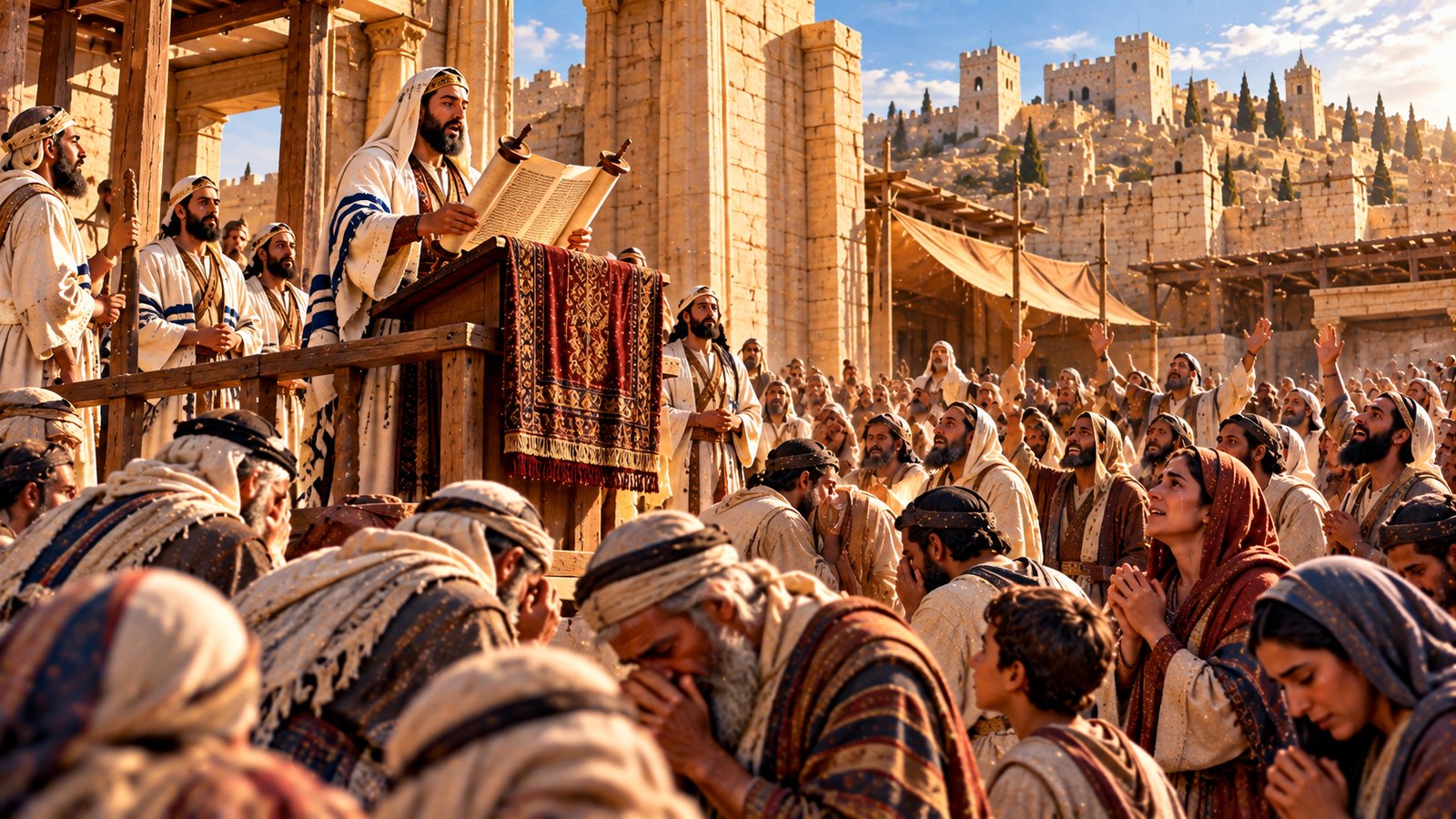
Setting: Ezra's ministry under Artaxerxes and the later public reading in Nehemiah 8, after Jerusalem's wall has been completed. Principal figures: Ezra, the Levites, Nehemiah, and the gathered people. Primary passages: Ezra 7–8; Nehemiah 8.
The Temple is standing again, but a building cannot listen, repent, or obey for the people who gather around it. Restoration must reach their understanding and conduct. Ezra enters the story as a priest and skilled scribe who has devoted his heart to God's word. This chapter follows his teaching ministry through the great public reading in Nehemiah 8. That gathering takes place after the wall is completed. Our next chapter steps back to follow Nehemiah's prayer and the construction itself. Here we focus on the people learning to hear and respond to the Lord.
A Teacher Who First Sets His Own Heart
10For Ezra had set his heart to seek Yahweh’s law, and to do it, and to teach statutes and ordinances in Israel.
The order is worth slowing down to notice. Ezra sets his heart to seek God's law, to do it, and to teach it. His calling includes careful study and personal obedience before public instruction. Knowledge is intended to become a faithful life.
This does not mean a teacher must achieve perfection before speaking. It means the teacher remains under the word being taught. Scripture is not merely material for the next lesson or a way to direct other people's behavior. It first addresses the person holding the scroll.
For anyone who leads a family, group, or congregation, Ezra offers a searching example. Ask what the passage reveals about God, what it actually says, and what response it requires of you. The Spirit helps us become teachable people who can then help others hear.
Grace Leads to Courage
27Blessed be Yahweh, the God of our fathers, who has put such a thing as this in the king’s heart, to beautify Yahweh’s house which is in Jerusalem;
28and has extended loving kindness to me before the king and his counselors, and before all the king’s mighty princes. I was strengthened according to Yahweh my God’s hand on me, and I gathered together chief men out of Israel to go up with me.
Ezra blesses the Lord for moving the king's heart toward the house in Jerusalem and extending loving kindness to him. His courage grows from recognizing God's good hand upon him. Gratitude becomes strength for gathering others to go.
Royal permission matters, and Ezra gives God the glory for the opportunity. He does not make the king the source of Israel's calling or treat favorable policy as a substitute for obedience. Help from an authority becomes a gift to steward.
Ezra 8 also records fasting and prayer for the journey. The people humble themselves and seek a safe way for their families and possessions. Their dependence is practical and specific. We can bring the actual needs of our households before the Father, rather than assume spiritual maturity means we no longer need to ask for help.
The People Ask to Hear the Book
1All the people gathered themselves together as one man into the wide place that was in front of the water gate; and they spoke to Ezra the scribe to bring the book of the law of Moses, which Yahweh had commanded to Israel.
2Ezra the priest brought the law before the assembly, both men and women, and all who could hear with understanding, on the first day of the seventh month.
3He read from it before the wide place that was in front of the water gate from early morning until midday, in the presence of the men and the women, and of those who could understand. The ears of all the people were attentive to the book of the law.
The setting is the open place before the Water Gate. The people ask Ezra to bring the book of the law of Moses that the Lord commanded Israel. Men, women, and all who can understand gather to hear. The desire for God's word belongs to the community, not only to its leaders.
Their attention extends through a substantial reading. We do not need to turn the length of this gathering into a rule for every modern service. We should receive its evidence of hunger: God's people want to understand the word that orders their life together.
There is a place for asking the Father to renew that desire in us. Distraction and familiarity can make Scripture feel distant. We can come honestly, trusting that His word is given for our good and asking the Spirit to help us attend.
The Lie and the Truth: Is Hearing Enough?
The lie is that access to religious information is the same as a heart formed by God. God's truth calls His people to understand His word and respond to it. A scroll can be present, a teacher gifted, and a gathering impressive while obedience is still needed.
Faith is fundamentally trusting our good Father. That trust makes us willing to hear both His comfort and His correction. We do not have to defend ourselves from every searching passage. The One who exposes sin also provides mercy and leads us toward life.
The answer is neither careless listening nor anxious performance. In Christ, we belong to the Father's family. From that welcome, we can receive instruction and learn to do what He says. Sonship gives security for growth; it does not remove the need to grow.
Understanding Is Part of the Ministry
7Also Jeshua, Bani, Sherebiah, Jamin, Akkub, Shabbethai, Hodiah, Maaseiah, Kelita, Azariah, Jozabad, Hanan, Pelaiah, and the Levites, caused the people to understand the law; and the people stayed in their place.
8They read in the book, in the law of God, distinctly; and they gave the sense, so that they understood the reading.
The Levites help the people understand the law. The reading is accompanied by explanation so that its meaning can be received. Ezra's ministry is not presented as a lone voice producing an emotional moment; others share the work of instruction.
This gives teachers a clear responsibility. Read accurately, attend to context, explain unfamiliar words and customs, and distinguish what the passage states from an application or interpretation. A confident delivery cannot replace a faithful explanation.
For listeners, understanding may require patient questions. Asking what a verse means is not a failure of faith. It can be an act of respect for the God who has spoken. We ask the Holy Spirit to illuminate Scripture while also giving the careful attention its words deserve.
The Word Leads from Weeping to Shared Joy
9Nehemiah, who was the governor, Ezra the priest and scribe, and the Levites who taught the people said to all the people, “Today is holy to Yahweh your God. Don’t mourn, nor weep.” For all the people wept when they heard the words of the law.
10Then he said to them, “Go your way. Eat the fat, drink the sweet, and send portions to him for whom nothing is prepared, for today is holy to our Lord. Don’t be grieved, for the joy of Yahweh is your strength.”
The people weep as they hear the law. Nehemiah, Ezra, and the Levites then instruct them to receive the holiness of the day with joy. They are to eat, drink, and send portions to those who have nothing prepared.
Conviction has a place, but the leaders do not leave the people in undirected sorrow. God's word also teaches them how to receive His goodness and care for one another. Joy becomes visible in shared provision. Someone without a prepared meal is to be included in the celebration.
This helps us recognize healthy spiritual ministry. We do not measure it only by the intensity of emotion. Understanding, repentance, gratitude, generosity, and obedience all matter. The Father's correction is directed toward restored fellowship, and His joy strengthens people to live within it.
They Act on What They Discover
16So the people went out and brought them, and made themselves temporary shelters, everyone on the roof of his house, in their courts, in the courts of God’s house, in the wide place of the water gate, and in the wide place of Ephraim’s gate.
17All the assembly of those who had come back out of the captivity made temporary shelters and lived in the temporary shelters, for since the days of Joshua the son of Nun to that day the children of Israel had not done so. There was very great gladness.
18Also day by day, from the first day to the last day, he read in the book of the law of God. They kept the feast seven days; and on the eighth day was a solemn assembly, according to the ordinance.
The leaders have discovered the instruction concerning booths, and the people put it into practice. Homes, courtyards, the courts of God's house, and public places become part of the response. They keep the feast with great gladness and continue hearing the law each day.
Nehemiah 8:17 describes this celebration as exceptional since the days of Joshua. Ezra 3:4 already records an earlier keeping of the Feast of Booths, so we should not paraphrase Nehemiah as though no one had observed the feast at all in the intervening centuries. The text emphasizes the extraordinary character of this observance.
The movement is clear: hear, understand, and respond. Knowledge becomes a lived act of trust. Ask what response belongs to the passage you are reading today, and let the Spirit help you carry it into ordinary life.
Worship Shaped by His Word
The restored Temple and the public reading serve the same covenant purpose: a people living before their God. The account remains Israel's story, grounded in the law given through Moses. We honor it by understanding that setting.
Christians read these Scriptures through Jesus, who brings believing Jews and Gentiles near to the Father. Gentile believers share in God's grace without replacing Israel. We learn from this restoration while recognizing that our access and priestly service rest on Christ's sufficient sacrifice.
Temple Prayer gives room for listening as well as speaking. Bring a passage before the Father, ask for the Spirit's help, and allow the word to shape your thanksgiving, repentance, and next action. A deeper relationship with Jesus includes learning to hear Him faithfully.
Temple Prayer Response: Open My Ears to Your Word
Here is a sample prayer. Make it your own, and continue in your own words.
Father, thank You for speaking to Your people. Give me a heart that seeks Your word, practices it, and helps others understand it. Jesus, thank You for bringing me into the Father's family. Holy Spirit, uncover what I have misunderstood and help me receive correction without hiding. Turn understanding into obedience, and let Your joy become generosity toward others. Amen.
Read a short passage slowly. Write down what it says, one question about its meaning, and one faithful response. Pray over that response and act on it.
Ezra 7–8; Nehemiah 8; Ezra 3:4; Ephesians 2:18–22; James 1:22–25.
Quotations are from the World English Bible (WEB), public domain (ebible.org/eng-web), and were checked against that text (Ezra 7 and Nehemiah 8). Nehemiah 8 follows the wall's completion in Nehemiah 6; Chapter 30 of this series returns to the earlier construction narrative. Nehemiah 8:17 is read alongside Ezra 3:4 rather than treated as a denial of every earlier feast observance. Teaching applications are distinguished from the commands given to Israel under the Mosaic covenant. The illustration is interpretive. The lie/truth framing is editorial.