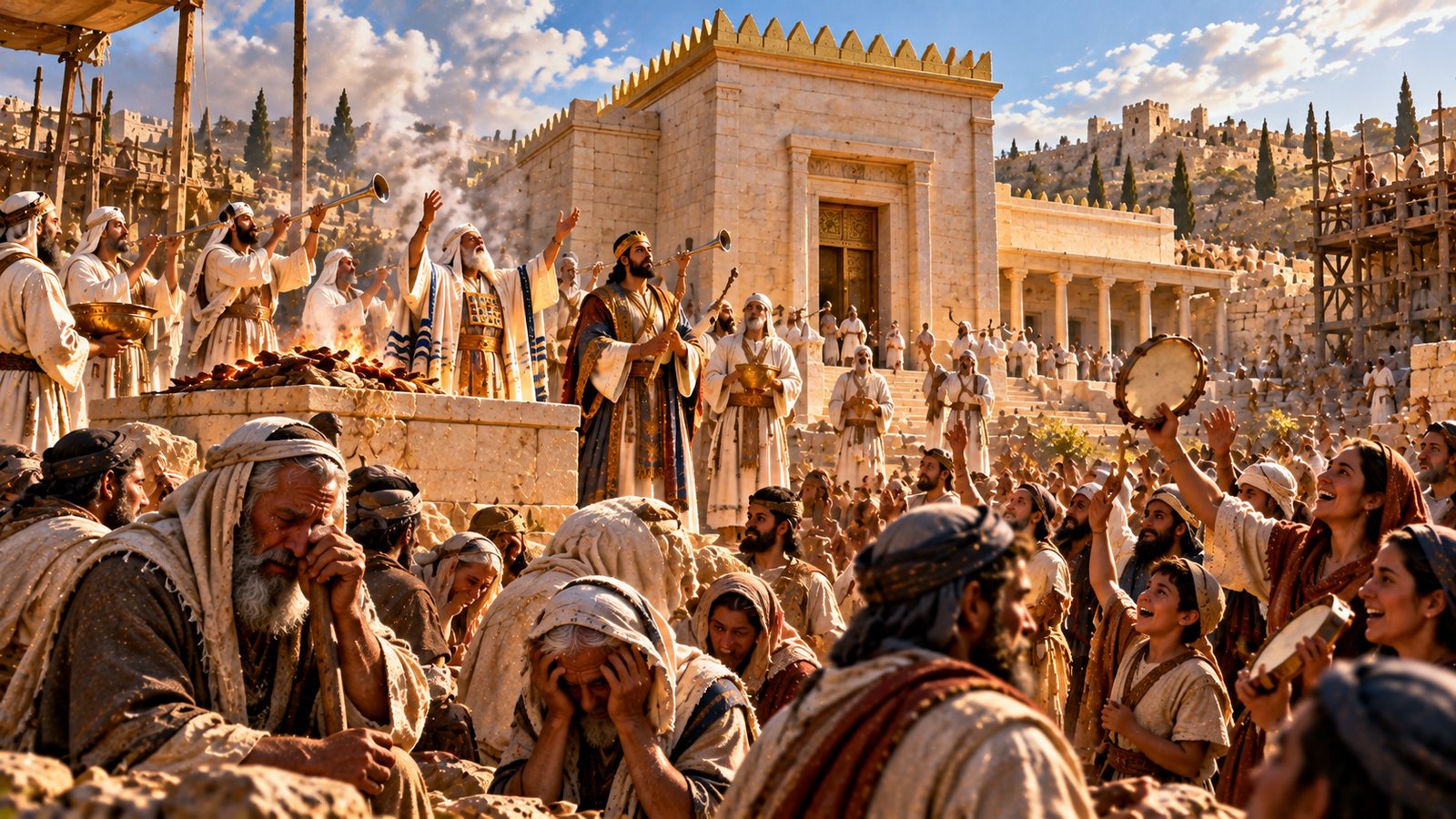
Setting: The rebuilding of the Jerusalem Temple after the return from exile; completed in the sixth year of Darius, commonly dated 516/515 BC. Principal figures: Zerubbabel, Jeshua, Haggai, Zechariah, and the returned community. Primary passages: Ezra 3–6; Haggai 1–2; Zechariah 4.
The altar has been rebuilt, and the returning people have resumed the worship God appointed. Now they turn toward the house itself. The foundation will bring praise, memories, and tears. The work will also encounter resistance, delay, and a loss of urgency among the people. God does more than give them a project. He speaks into their discouragement, confronts their priorities, and promises His presence. The restored Temple becomes a testimony to His faithfulness and to the Spirit who sustains work human strength cannot carry alone.
The Foundation Brings Praise and Tears
10When the builders laid the foundation of Yahweh’s temple, they set the priests in their vestments with trumpets, with the Levites the sons of Asaph with cymbals, to praise Yahweh, according to the directions of David king of Israel.
11They sang to one another in praising and giving thanks to Yahweh, “For he is good, for his loving kindness endures forever toward Israel.” All the people shouted with a great shout, when they praised Yahweh, because the foundation of Yahweh’s house had been laid.
12But many of the priests and Levites and heads of fathers’ households, the old men who had seen the first house, when the foundation of this house was laid before their eyes, wept with a loud voice. Many also shouted aloud for joy,
13so that the people could not discern the noise of the shout of joy from the noise of the weeping of the people; for the people shouted with a loud shout, and the noise was heard far away.
The priests and Levites praise the Lord as the foundation is laid. Their thanksgiving rests on His goodness and enduring loving kindness toward Israel. Before they can point to a finished building, they can point to the faithful God who has brought them this far.
Older people who remember the first house weep, while others shout for joy. Ezra records the mixed sound without explaining every person's motive. We should not confidently diagnose every tear as unbelief or every shout as mature faith. Memory, grief, gratitude, and hope can share the same gathering.
There is room for pastoral tenderness here. A new beginning may awaken the ache of what was lost. We can honor that sorrow while helping one another recognize what God is doing now. Gratitude does not require the erasure of memory.
God Confronts Misplaced Priorities
7“This is what Yahweh of Armies says: ‘Consider your ways.
8Go up to the mountain, bring wood, and build the house. I will take pleasure in it, and I will be glorified,” says Yahweh.
Ezra 4 describes opposition that discouraged the people and frustrated the work. Its account also surveys later opposition under other Persian kings before returning to the Temple work under Darius in verse 24. We should follow those shifts rather than read every incident as one uninterrupted sequence.
Haggai then confronts the returned community's own priorities. They had given attention to their houses while God's house remained in ruins. External resistance was real, and so was the need for an inward response. God's correction does not let them explain the whole delay by blaming their opponents.
The Lord tells them to consider their ways and gives practical instructions: go, bring wood, and build. The assignment becomes concrete again. When the Spirit exposes a neglected responsibility, repentance can begin with a simple act of obedience. Honest correction is one way our good Father helps His children move forward.
The Lord Stirs Them to Work
13Then Haggai, Yahweh’s messenger, spoke Yahweh’s message to the people, saying, “I am with you,” says Yahweh.
14Yahweh stirred up the spirit of Zerubbabel the son of Shealtiel, governor of Judah, and the spirit of Joshua the son of Jehozadak, the high priest, and the spirit of all the remnant of the people; and they came and worked on the house of Yahweh of Armies, their God,
The Lord's message includes the assurance of His presence. He stirs the spirit of Zerubbabel, Joshua the high priest, and the remnant of the people. Leadership and community are drawn into the same renewed response.
Notice the relationship between His action and theirs. God stirs them, and they come and work. Dependence on the Spirit produces participation. We do not need to choose between praying for God to move and putting our hands to the responsibility He has given.
Our starting place is the Father's love. In Christ, we are received as sons and daughters; we do not use ministry achievement to negotiate our adoption. From that place of belonging, the Spirit can awaken willing service and strengthen tired hearts.
The Lie and the Truth: Is a Small Beginning Worth Anything?
The lie is that a work with fewer resources and less visible glory cannot matter to God. God's truth is that His presence and purpose give value to the work He assigns. Comparisons cannot decide whether obedience is worthwhile.
That does not mean every small project has a divine mandate. We still need Scripture, wisdom, and honest discernment. Zerubbabel had a particular calling confirmed by God's word. The lesson for us is to be faithful to what God has actually entrusted to us, rather than measure it only against someone else's visible success.
Faith is fundamentally trusting our good Father. He can strengthen us to keep building when the work looks ordinary and progress feels slow. We can ask for His help without inflating the assignment or pretending our limitations do not exist.
His Spirit Remains among Them
4Yet now be strong, Zerubbabel,’ says Yahweh. ‘Be strong, Joshua son of Jehozadak, the high priest. Be strong, all you people of the land,’ says Yahweh, ‘and work, for I am with you,’ says Yahweh of Armies.
5This is the word that I covenanted with you when you came out of Egypt, and my Spirit lived among you. ‘Don’t be afraid.’
God calls Zerubbabel, Joshua, and the people to be strong and work because He is with them. He connects that assurance to His covenant when Israel came out of Egypt. The returned community stands within the continuing story of His faithfulness.
His Spirit remains among them. Their courage is grounded in His presence, not in an assurance that construction will be easy. The God who formed a people in the Exodus has not abandoned them after exile.
Haggai also announces coming glory and peace (2:6–9). Christians understand that hope within the larger story leading to Messiah, while differing about some details of its fulfillment. We should not reduce it to a promise that every present building campaign will exceed the last one. God's word concerns His holy purpose for His house and His people.
The Word to Zerubbabel
6Then he answered and spoke to me, saying, “This is Yahweh’s word to Zerubbabel, saying, ‘Not by might, nor by power, but by my Spirit,’ says Yahweh of Armies.
7Who are you, great mountain? Before Zerubbabel you are a plain; and he will bring out the capstone with shouts of ‘Grace, grace, to it!’ ”
8Moreover Yahweh’s word came to me, saying,
9“The hands of Zerubbabel have laid the foundation of this house. His hands shall also finish it; and you will know that Yahweh of Armies has sent me to you.
10Indeed, who despises the day of small things? For these seven shall rejoice, and shall see the plumb line in the hand of Zerubbabel. These are Yahweh’s eyes, which run back and forth through the whole earth.”
Zechariah's vision joins the completion of the house to the Lord's Spirit. Zerubbabel has laid the foundation, and his hands will finish it. The apparent mountain before him will not have the final word over God's assignment.
This is a specific promise to Zerubbabel before it becomes a familiar encouragement to us. We receive its revelation of God's power without making it a guarantee that every plan we begin must succeed. The Spirit sustains the purpose of the Lord.
The warning against despising small things also addresses the way we look at progress. A foundation is not a finished house, but it is worth honoring when it belongs to God's work. Thank Him for the next faithful step, and seek the grace to continue.
The House Is Finished and Dedicated
14The elders of the Jews built and prospered, through the prophesying of Haggai the prophet and Zechariah the son of Iddo. They built and finished it, according to the commandment of the God of Israel, and according to the decree of Cyrus, Darius, and Artaxerxes king of Persia.
15This house was finished on the third day of the month Adar, which was in the sixth year of the reign of Darius the king.
16The children of Israel, the priests, the Levites, and the rest of the children of the captivity, kept the dedication of this house of God with joy.
The elders build under the encouragement of Haggai and Zechariah, and the house is completed under Darius. Prophetic ministry, royal decisions, and the people's labor all appear in the account. God works through a history filled with real human actions.
At the dedication, offerings are made for all Israel, including twelve male goats corresponding to the tribes (Ezra 6:17). The returned community's worship reaches beyond a narrow memory of Judah alone. They understand themselves within the larger people God called.
Ezra describes a joyful dedication and the keeping of Passover. It does not describe a fresh cloud of glory filling this house as at Solomon's dedication. We can celebrate what the text gives us without supplying an unrecorded event. God has brought His people to a genuine restoration of worship.
Strength for Faithful Service
The Temple is rebuilt so that the people can live around the worship God ordained. The building serves fellowship, holiness, thanksgiving, and covenant obedience. Finishing the structure matters because of that purpose.
Through Jesus, believing Jews and Gentiles are being built together as God's dwelling in the Spirit (Ephesians 2:18–22). Gentile inclusion does not erase Israel's history or make the Church its replacement. It draws us into gratitude for the same faithful Lord.
In Temple Prayer, ask the Father for the Spirit's strength to serve from love. Then listen for the particular responsibility He places before you. He knows how to encourage the weary, correct priorities, and help His people keep working.
Temple Prayer Response: Strengthen My Hands
Here is a sample prayer. Make it your own, and continue in your own words.
Father, thank You for remaining faithful through loss and delay. Forgive me for despising small beginnings or letting comparison govern my heart. Jesus, thank You that I belong to the Father's household through You. Holy Spirit, renew my courage, correct my priorities, and strengthen my hands for the work You have given. Help me honor both the joy and the grief of others as we serve You together. Amen.
Identify one neglected responsibility and one small sign of grace. Thank God for the grace, then take a practical step in the responsibility.
Ezra 3–6; Haggai 1–2; Zechariah 4; Ephesians 2:18–22.
Quotations are from the World English Bible (WEB), public domain (ebible.org/eng-web), and were checked against that text (Ezra 3 and 6, Haggai 1 and 2, and Zechariah 4). Ezra 4:6–23 surveys later opposition before 4:24 resumes the Temple-rebuilding setting under Darius. The foundation scene and the dedication are distinct events. The completion is commonly dated 516/515 BC. Haggai's future-glory language is not treated as a guarantee for present construction projects. The image is an artistic interpretation. The lie/truth framing is editorial.