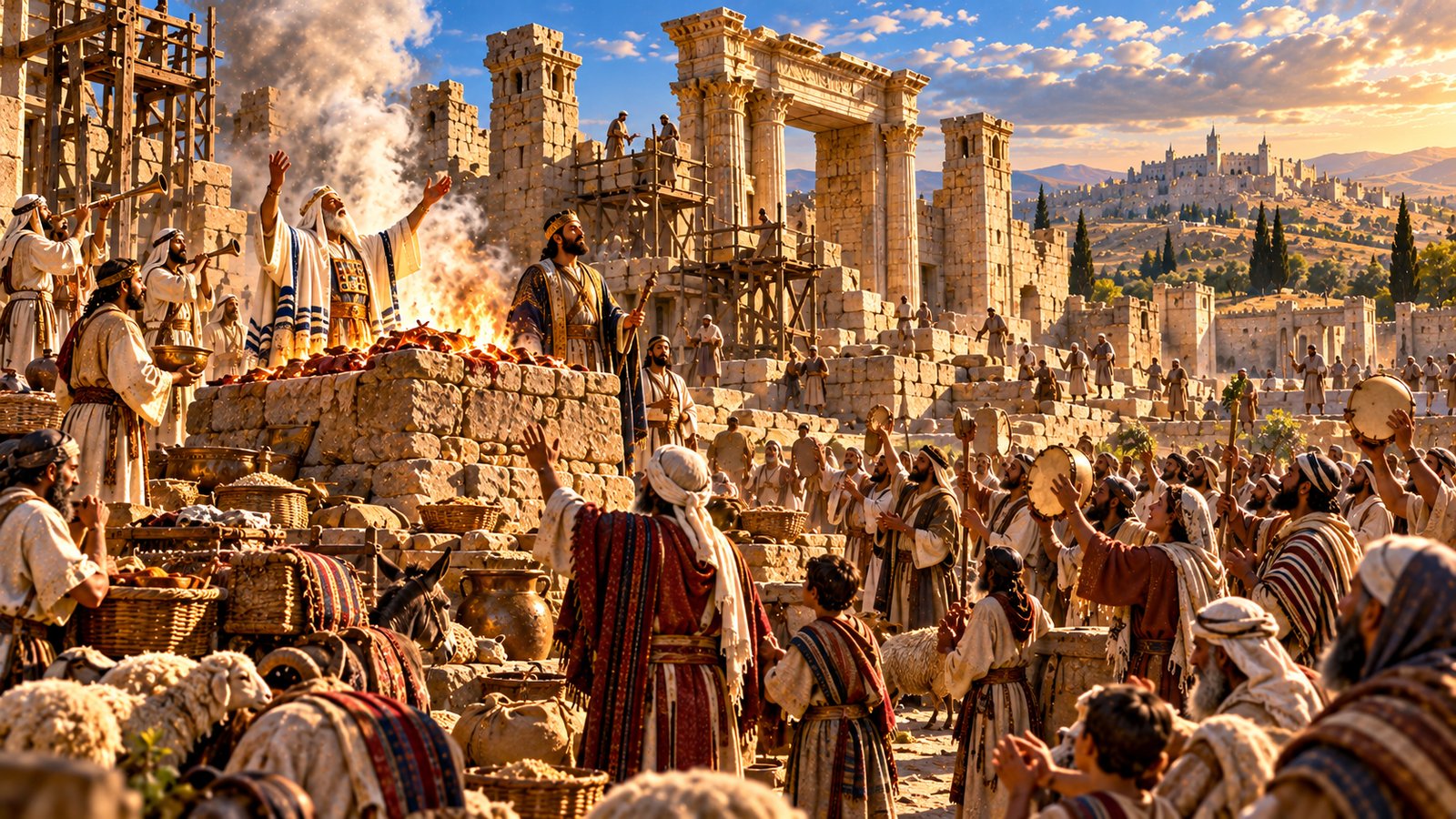
Setting: Jerusalem after the first return from exile, in the seventh month. Principal figures: Jeshua son of Jozadak, Zerubbabel son of Shealtiel, the priests, and the returning people. Primary passage: Ezra 3:1–7.
Coming home did not mean finding everything ready. The returning families had to settle in towns, recover ordinary life, and face the reality of a damaged city. The Temple was still a future building project. Yet Ezra 3 describes a beginning they did not postpone: they gathered and rebuilt the altar. This is a lesson for any season when life feels unfinished. God had given these people a clear way to respond to Him, and they began there. Their worship would be shaped by His instructions, even while their circumstances remained unsettled.
The People Gather Together
1When the seventh month had come, and the children of Israel were in the cities, the people gathered themselves together as one man to Jerusalem.
The people gather in Jerusalem as one community. They are living in different towns, carrying different memories, and facing different needs, yet they share a calling before the God of Israel. Returning to the land is being joined to returning to worship.
This gathering matters because covenant life cannot be reduced to the recovery of private households. The Lord has called a people to belong to Him together. The place He appointed for worship draws them beyond the boundaries of their individual concerns.
We also need more than private spiritual intentions. Through Jesus, our Father brings us into His household. Personal prayer grows alongside life with His people, where we listen, give thanks, serve, and learn to love. Shared worship reminds us that the Father we approach is gathering a family.
An Altar According to God's Word
2Then Jeshua the son of Jozadak stood up with his brothers the priests and Zerubbabel the son of Shealtiel and his relatives, and built the altar of the God of Israel, to offer burnt offerings on it, as it is written in the law of Moses the man of God.
Jeshua and the priests act with Zerubbabel and his relatives. Priestly and civil leadership cooperate in restoring the altar of the God of Israel. Ezra identifies the governing instruction: the law of Moses, the man of God.
This continues a pattern we have followed from the Tabernacle onward. God's people do not invent the terms on which a holy God receives them. They respond to His revelation. Their sincerity matters, and it is expressed through obedience to what He has made known.
The burnt offerings belonged to the worship God appointed for Israel under the Mosaic covenant. We should understand them in that setting before applying the story to ourselves. Christians do not rebuild a sacrificial altar to gain acceptance. Jesus has offered Himself once for all, and through Him we offer praise, generosity, and lives yielded to God (Hebrews 10:10–14; 13:15–16).
They Worship While They Are Afraid
3In spite of their fear because of the peoples of the surrounding lands, they set the altar on its base; and they offered burnt offerings on it to Yahweh, even burnt offerings morning and evening.
Fear is present when the altar is restored. The surrounding peoples feel threatening to this vulnerable community, but the returnees begin the morning and evening offerings. They do not wait for their emotions to become calm before doing what God has told them.
Faith is fundamentally trusting our good Father. Sometimes that trust is expressed while our hands still shake. The point is not that fear becomes a virtue, or that danger is imaginary. It is that fear does not have to become the voice that governs our response.
Notice also what the verse does not promise. It does not say their neighbors immediately become friendly or all opposition disappears. The people are strengthened to worship within a difficult setting. We can ask the Spirit for that same courage: a steady, obedient heart before the outcome is settled.
The Lie and the Truth: Must Everything Be Fixed First?
The lie is that meaningful worship must wait until the surroundings are secure, the resources abundant, and the project complete. God's truth is that His people can respond faithfully to the light they have already received.
For Israel, this meant beginning the offerings God had commanded at the appointed altar. For us, it may mean returning to honest prayer, opening Scripture, reconciling with someone, or gathering with the Church while other problems remain unresolved. The application grows from the pattern of obedient trust, not from copying Israel's sacrificial arrangements.
Worship also does not excuse neglected responsibilities. The people will still need to build. Putting God first means receiving our work from Him and doing it in fellowship with Him, rather than using religious activity to avoid the next practical duty.
They Recover the Rhythm of Worship
4They kept the feast of booths, as it is written, and offered the daily burnt offerings by number, according to the ordinance, as the duty of every day required;
5and afterward the continual burnt offering, the offerings of the new moons, of all the set feasts of Yahweh that were consecrated, and of everyone who willingly offered a free will offering to Yahweh.
The Feast of Booths, the daily offerings, the new moons, and the appointed feasts return to the community's life. God is teaching His people to order their days around His faithfulness. They are recovering a shared rhythm that exile had disrupted.
The Feast of Booths recalled Israel's wilderness life and the Lord's provision (Leviticus 23:39–43). Returned families could remember that their ancestors had also depended on God while living with temporary surroundings. The Father had sustained His people before, and they could trust Him again.
Alongside the appointed offerings, Ezra mentions freewill gifts. Ordered worship and willing generosity belong together. We can learn to make room for daily prayer and regular gathering while also responding freely to needs the Spirit brings before us. A rhythm supports relationship when we keep its purpose in view.
The Foundation Is Not Yet Laid
6From the first day of the seventh month, they began to offer burnt offerings to Yahweh; but the foundation of Yahweh’s temple was not yet laid.
Ezra makes the unfinished condition unmistakable. The offerings begin before the Temple foundation has been laid. There is no completed sanctuary behind this moment, and no reason to imagine that the whole restoration has already occurred.
Yet the altar is a real beginning. God has provided a way for the returned people to resume the worship He commanded. They honor His mercy by taking that step rather than despising it because larger work remains.
Many of us can identify with that tension. Something important has begun, while much still needs healing or rebuilding. Give thanks for the grace already present. The Father does not require us to pretend that everything is finished before we can receive His help and offer an honest response.
Worship Leads into Practical Preparation
7They also gave money to the masons and to the carpenters. They also gave food, drink, and oil to the people of Sidon and Tyre to bring cedar trees from Lebanon to the sea, to Joppa, according to the grant that they had from Cyrus King of Persia.
The chapter moves directly into money for craftsmen and supplies for timber. Masons, carpenters, food, drink, oil, transport, and royal authorization all matter. The people who worship at the altar also prepare to rebuild the house.
There is a useful balance here. Trusting God includes the practical care required by a real assignment. Planning and provision do not compete with dependence on the Spirit. They become expressions of stewardship when they serve His purpose.
Ask what the next ordinary act of faithfulness looks like. A conversation, a budget, a work schedule, a contribution, or an offer of help may be part of the answer. The Lord receives worship from His people and teaches those same people how to put their hands to the work.
An Altar in Israel's Restored Worship
The altar belongs to Israel's restored worship in Jerusalem. The same covenant history links this scene to Moses, the Tabernacle, and the former Temple. God has preserved a people through judgment and opened a way for their worship to resume.
The Church receives this account through Israel's Messiah. Believing Jews and Gentiles draw near through the one Lord Jesus, without making Gentile inclusion a claim that Israel has been replaced. The story teaches us gratitude for the faithful God who gathers and sustains His people.
Begin with His Provision
Here the altar stands at the center of the returning community's approach to God. They come by the provision He appointed. For Christians, that focus directs us to Jesus and His sufficient sacrifice.
Temple Prayer begins with the Father's welcome through His Son. We come as sons and daughters, then learn to serve as a holy priesthood. We do not need to earn a place in His family by getting every part of life repaired first. We draw near and let His presence reorder the work before us.
Temple Prayer Response: Begin Where I Am
Here is a sample prayer. Make it your own, and continue in your own words.
Father, thank You for welcoming me through Jesus. Forgive me for postponing prayer until life feels manageable. Jesus, thank You for Your complete sacrifice. Holy Spirit, help me worship with an honest heart, even when I feel afraid. Restore the rhythm of Scripture, thanksgiving, and fellowship in my life. Show me the practical work that belongs to this season, and help me do it with You. Amen.
Choose one simple act of worship to restore today. Then identify one practical responsibility you can carry out in the same spirit of trust.
Ezra 3:1–7; Leviticus 23:39–43; Hebrews 10:10–22; 13:15–16; 1 Peter 2:4–5.
Quotations are from the World English Bible (WEB), public domain (ebible.org/eng-web), and were checked against that text (Ezra 3). The first altar restoration precedes the laying of the Temple foundation. Jeshua is also called Joshua in related prophetic books. The Christian application rests on Christ's finished sacrifice; it does not instruct believers to resume Mosaic animal offerings. The illustration is interpretive. The lie/truth framing is editorial.