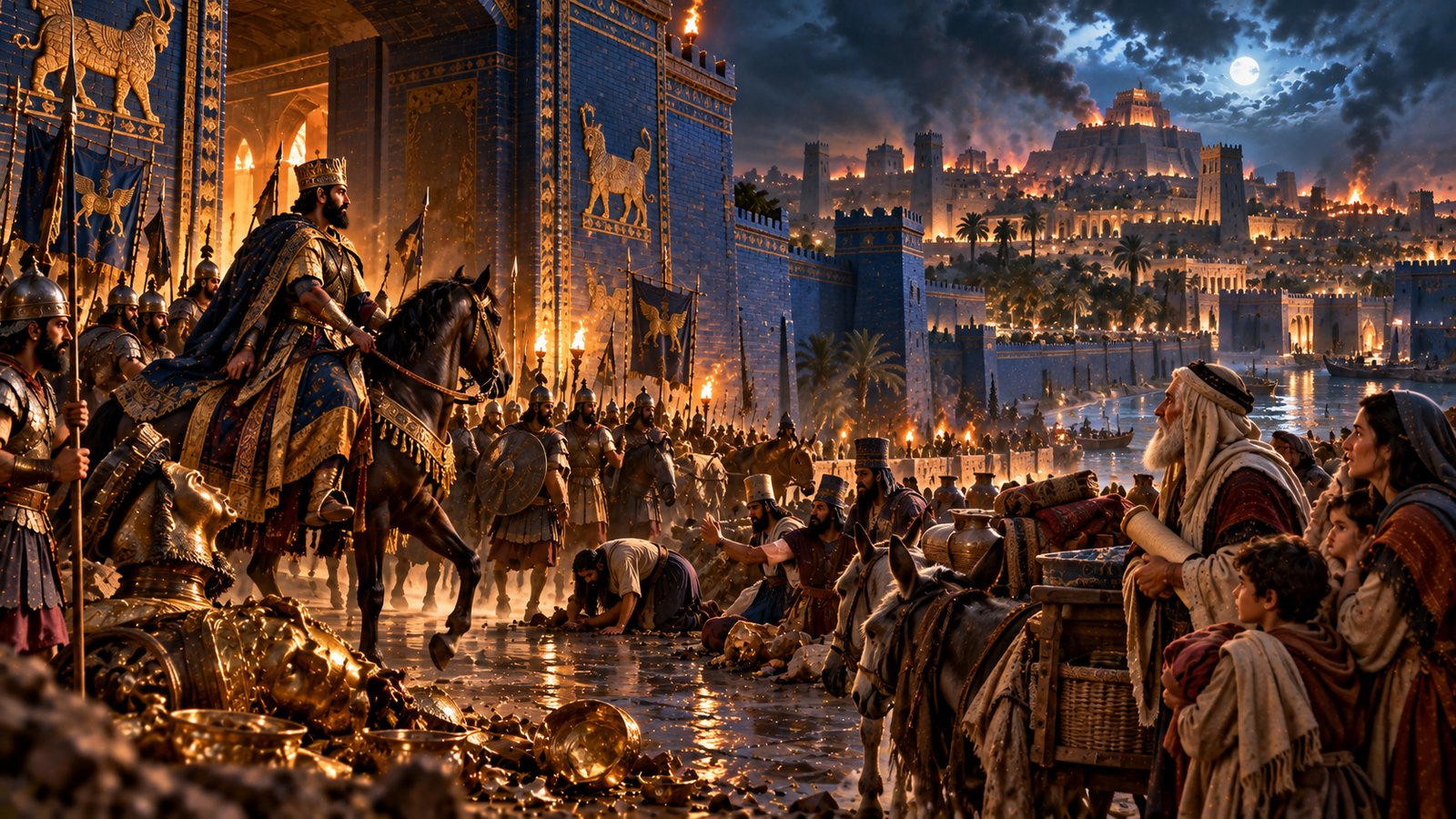
Setting: Babylon falls to Cyrus of Persia in 539 BC; Ezra 1 records his authorization for the return and Temple rebuilding. Principal figures: Cyrus, the returning exiles, and Sheshbazzar. Primary passages: Isaiah 44:24–28; 45:1–7; Ezra 1.
Last chapter, Ezekiel saw a future shaped by God's returning presence. Now the story moves from a prophetic vision to an imperial announcement. Babylon, which had carried Judah into exile and plundered the Temple, loses its rule. Cyrus authorizes a return to Jerusalem and the rebuilding of God's house. For families who had learned to live far from home, permission to return raised a real question: would they trust God enough to begin again? The opening door was God's mercy. Walking through it would require a response.
The Lord Names the Builder
24Yahweh, your Redeemer, and he who formed you from the womb says: “I am Yahweh, who makes all things; who alone stretches out the heavens; who spreads out the earth by myself;
28who says of Cyrus, ‘He is my shepherd, and shall perform all my pleasure,’ even saying of Jerusalem, ‘She will be built;’ and of the temple, ‘Your foundation will be laid.’ ”
God introduces Himself as Israel's Redeemer and the Maker of all things. His authority reaches beyond Judah's borders because His creation does. Babylon's success never made its gods sovereign, and Judah's defeat never removed the Lord from His throne.
Near the end of this oracle, the Lord names Cyrus as the ruler through whom Jerusalem and the Temple will be rebuilt. Notice how particular the promise becomes. The hope concerns a city, a people, and a sanctuary in a real place. Israel's future has not dissolved into an inspiring idea.
A Ruler Who Does Not Yet Know Him
4For Jacob my servant’s sake, and Israel my chosen, I have called you by your name. I have given you a title, though you have not known me.
5I am Yahweh, and there is no one else. Besides me, there is no God. I will strengthen you, though you have not known me,
6that they may know from the rising of the sun, and from the west, that there is no one besides me. I am Yahweh, and there is no one else.
7I form the light and create darkness. I make peace and create calamity. I am Yahweh, who does all these things.
The reason given is deeply personal: Jacob, God's servant, and Israel, His chosen. The Lord's care for His people stands behind His dealings with a foreign ruler. Cyrus is not the author of Israel's calling. He serves a purpose that began long before his empire.
Isaiah 45:1 calls Cyrus God's anointed, a ruler appointed for this task. That title does not make him the promised Savior or establish that he has come to saving faith. These verses say that he has not known the Lord. God's ability to use someone is greater than that person's understanding of God.
Nor does the passage give us permission to call every favored political leader another Cyrus. We have an explicit prophetic word here. Applying that designation to a present ruler would be our interpretation, requiring humility. The clear lesson is that our Father's reach extends into places where His people have no control.
God Stirs the King
1Now in the first year of Cyrus king of Persia, that Yahweh’s word by Jeremiah’s mouth might be accomplished, Yahweh stirred up the spirit of Cyrus king of Persia, so that he made a proclamation throughout all his kingdom, and put it also in writing, saying,
2“Cyrus king of Persia says, ‘Yahweh, the God of heaven, has given me all the kingdoms of the earth; and he has commanded me to build him a house in Jerusalem, which is in Judah.
3Whoever there is among you of all his people, may his God be with him, and let him go up to Jerusalem, which is in Judah, and build the house of Yahweh, the God of Israel (he is God), which is in Jerusalem.
4Whoever is left, in any place where he lives, let the men of his place help him with silver, with gold, with goods, and with animals, in addition to the free will offering for God’s house which is in Jerusalem.’ ”
Ezra describes the proclamation as the fulfillment of the Lord's word through Jeremiah. The exile had not escaped God's knowledge, and its ending does not depend on Babylon voluntarily becoming merciful. The Lord stirs Cyrus to act.
The authorization centers on rebuilding the house of the God of Israel in Jerusalem. Return is more than release from an unpleasant location. The people are being gathered toward covenant life and worship. The sanctuary will again mark the place where God has appointed His people to meet Him according to His word.
Cyrus's proclamation uses language honoring Israel's God. We can receive Ezra's account without adding a conversion story it does not tell. The emphasis falls on the Lord's faithfulness, expressed through a royal decision that makes obedience possible.
The Lie and the Truth: Who Controls the Future?
The lie is that the strongest human power owns the final outcome, so God's people can only surrender to whatever that power decides. God's truth is that no empire can cancel His covenant purpose. Kings and policies matter, but they do not occupy His throne.
Faith is fundamentally trusting our good Father. That trust does not promise an immediate political reversal whenever we suffer. Some exiles died before the return. It teaches us to locate our hope in God's character and word rather than in the apparent permanence of the present arrangement.
We can pray for rulers, receive genuine opportunities, and act responsibly without confusing an empire with God's kingdom. The Father remains the One we worship, whether He opens a door through someone we expected or through someone we would never have chosen.
God Stirs the People Too
5Then the heads of fathers’ households of Judah and Benjamin, the priests and the Levites, all whose spirit God had stirred to go up, rose up to build Yahweh’s house which is in Jerusalem.
6All those who were around them strengthened their hands with vessels of silver, with gold, with goods, with animals, and with precious things, in addition to all that was willingly offered.
The same chapter that describes God stirring the king describes Him stirring the returning households. Divine initiative reaches both the public decision and the private willingness to respond. A decree alone cannot build a worshiping community.
Judah, Benjamin, priests, and Levites rise to go. Neighbors contribute resources. Some take the journey, while others strengthen their hands through giving. Restoration includes people, materials, leadership, and shared responsibility. God works through these ordinary means without becoming less present in the work.
We should not make the journey sound effortless. Leaving an established life meant uncertainty, distance, and hard labor among ruins. An open door does not remove the cost of obedience. It gives God's people an opportunity to trust Him with that cost.
The Vessels Come Out of Captivity
7Also Cyrus the king brought out the vessels of Yahweh’s house, which Nebuchadnezzar had brought out of Jerusalem, and had put in the house of his gods;
8even those, Cyrus king of Persia brought out by the hand of Mithredath the treasurer, and counted them out to Sheshbazzar the prince of Judah.
Nebuchadnezzar had carried the Temple vessels into the house of his gods. Cyrus brings them out and entrusts them to Sheshbazzar. What had appeared to advertise Babylon's victory now becomes part of the return.
These objects were made for the service of the Lord's house. Their restoration points beyond recovered wealth to recovered worship. The God who judged His people's unfaithfulness has not forgotten the purpose for which He called them.
There is comfort here for anyone who has seen a season of loss define their identity. We cannot promise that every possession or circumstance will return. We can say that our Father remains able to restore meaningful service. Yesterday's devastation does not put us beyond His mercy.
The Return Belongs to Israel's History
This return belongs to the history of Israel. The people, Jerusalem, and the Temple remain central to the account. Christians honor that history when we see God's faithfulness here. Gentile believers are welcomed through Israel's Messiah and grafted into the cultivated olive tree; we do not become a reason to erase the people whose story we are reading (Romans 11:17–24).
The return also prepares the setting into which Jesus will later come. It is an important act of restoration, while the need for a deeper deliverance from sin remains. A changed government can authorize a sanctuary. Only God can reconcile hearts to Himself.
A Way Back to Worship
The opening of the road leads toward God's house. In Temple Prayer, we follow the greater access Jesus gives us to the Father. We come as beloved sons and daughters before we speak about priestly service. Our service grows out of belonging.
Receive the opportunity God places before you, and ask how it can lead toward faithful worship. A new beginning becomes fruitful as we draw near, hear His word, and offer ourselves for the work He actually gives us.
Temple Prayer Response: A Door God Has Opened
Here is a sample prayer. Make it your own, and continue in your own words.
Father, thank You that no power is greater than Your faithfulness. Forgive me for letting fear of people decide the limits of my hope. Jesus, thank You for bringing me near to the Father. Holy Spirit, stir my heart to respond when You open the way. Teach me to receive help gratefully, give generously, and begin again with trust. Bless Israel, and make Your people faithful in the places You have given us. Amen.
Name one door God has already opened. Ask what faithful response is possible today, then take one practical step toward it.
Isaiah 44:24–28; 45:1–7; Ezra 1; Jeremiah 29:10–14; Romans 11:17–24.
Quotations are from the World English Bible (WEB), public domain (ebible.org/eng-web), and were checked against that text (Isaiah 44 and 45, and Ezra 1). Cyrus took Babylon in 539 BC. Ezra 1 dates the proclamation to his first year as ruler in the relevant Babylonian setting, commonly dated 538 BC. The Cyrus Cylinder supplies context for Persian restoration policies; it does not name the Jews or reproduce Ezra's decree. The illustration combines themes artistically and should not be used to reconstruct the capture of Babylon. The lie/truth framing is editorial.