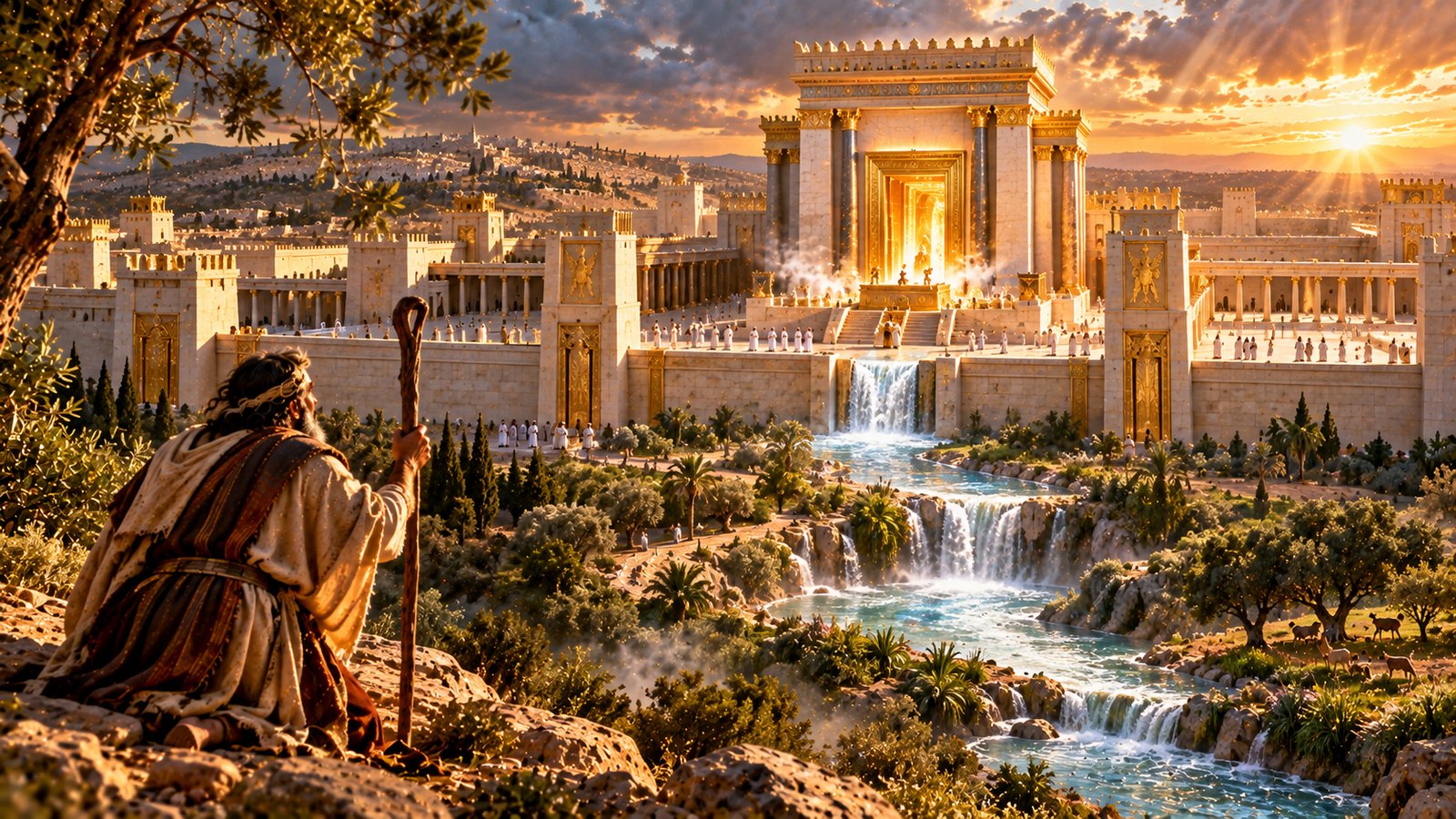
Setting: A vision given in the twenty-fifth year of the captivity, fourteen years after Jerusalem was struck. Principal figures: Ezekiel, the bronze-like guide, and the Lord whose glory returns. Primary passages: Ezekiel 40–48, especially chapters 40, 43, 47, and 48.
Jerusalem's Temple has burned, its furnishings have been plundered, and the people are living with the consequences of exile. Yet the story does not stop with ruins. Years after the catastrophe, God gives Ezekiel an extended vision of a sanctuary, ordered worship, renewed land, and a city named for the Lord's presence. This chapter opens our part on return and restoration. We first hear the vision as a word to Israel in exile. We then consider its place in the wider biblical story, acknowledging that faithful Christians differ about the exact form and timing of its fulfillment.
A Vision Given after the City's Fall
1In the twenty-fifth year of our captivity, in the beginning of the year, in the tenth day of the month, in the fourteenth year after the city was struck, in the same day, Yahweh’s hand was on me, and he brought me there.
2In the visions of God he brought me into the land of Israel, and set me down on a very high mountain, on which was something like the frame of a city to the south.
3He brought me there; and, behold, there was a man whose appearance was like the appearance of bronze, with a line of flax in his hand and a measuring reed; and he stood in the gate.
4The man said to me, “Son of man, see with your eyes, and hear with your ears, and set your heart on all that I will show you; for you have been brought here so that I may show them to you. Declare all that you see to the house of Israel.”
The date anchors hope within a real history of loss. The city has been struck, and the exiles have waited years. Ezekiel is now told to see, hear, take the vision to heart, and declare it to Israel.
The guide carries measuring tools. Gates, courts, rooms, walls, and the sanctuary receive detailed attention. Restoration is not presented as a vague wish that people will feel better. The vision gives an ordered picture of life centered on God's holiness.
The setting is explicitly visionary. We should neither dismiss its detail nor treat every interpretive question as already settled by the existence of measurements. The first responsibility is to attend carefully to what Ezekiel is shown.
The Glory Comes from the East
1Afterward he brought me to the gate, even the gate that looks toward the east.
2Behold, the glory of the God of Israel came from the way of the east. His voice was like the sound of many waters; and the earth was illuminated with his glory.
3It was like the appearance of the vision which I saw, even according to the vision that I saw when I came to destroy the city; and the visions were like the vision that I saw by the river Chebar; and I fell on my face.
4Yahweh’s glory came into the house by the way of the gate which faces toward the east.
5The Spirit took me up and brought me into the inner court; and behold, Yahweh’s glory filled the house.
The movement answers the earlier departure. Ezekiel had watched the glory leave toward the east; now he sees the glory come from the east and fill the house. He recognizes its relationship to the visions by the river and concerning Jerusalem.
The return of glory is the heart of restoration. A completed structure without God's presence would not fulfill the purpose of a sanctuary. The Lord identifies the place with His throne and His dwelling among Israel, while confronting the defilement that had marked the former life (Ezekiel 43:6–9).
The language about Ezekiel coming to destroy the city belongs to his prophetic role and the earlier vision of judgment. It should not be rewritten as a claim that he personally led the Babylonian army. Here the prophet falls before the same holy glory and is brought inward by the Spirit.
The Pattern Calls the People to Repentance
10“You, son of man, show the house to the house of Israel, that they may be ashamed of their iniquities; and let them measure the pattern.
11If they are ashamed of all that they have done, make known to them the form of the house, its fashion, its exits, its entrances, its structure, all its ordinances, all its forms, and all its laws; and write it in their sight, that they may keep the whole form of it, and all its ordinances, and do them.
12“This is the law of the house. On the top of the mountain the whole limit around it shall be most holy. Behold, this is the law of the house.
The vision is meant to affect Israel's conscience and conduct. Seeing the house should expose their wrongdoing and teach them the order of life before a holy God.
This continues the thread we have followed from the Tabernacle onward: God governs His people's approach through His word. The pattern is connected with repentance, service, and obedience. Its purpose reaches deeper than an interest in impressive architecture.
Later chapters of the vision address priests, offerings, festivals, leadership, justice, and land. Restoration concerns a whole community living before the Lord. It cannot be reduced to a building project separated from the people's treatment of God and one another.
The Lie and the Truth: Has Exile Ended God's Purpose?
The lie is that devastation has made God's dwelling with His people impossible, leaving only nostalgia for what was lost. God's truth is that He can reveal a future of holy presence, renewed life, and restored belonging beyond judgment.
Faith is fundamentally trusting our good Father. The exiles are invited to take His word seriously before they can see the restoration it announces. Hope receives His promise while repentance receives His correction.
Water Flows from the Sanctuary
1He brought me back to the door of the temple; and behold, waters flowed out from under the threshold of the temple eastward, for the front of the temple faced toward the east. The waters came down from underneath, from the right side of the temple, on the south of the altar.
2Then he brought me out by the way of the gate northward, and led me around by the way outside to the outer gate, by the way of the gate that looks toward the east. Behold, waters ran out on the right side.
The place of God's presence becomes a source of life moving outward. The guide measures successive distances, and the water deepens from ankles to knees to waist, finally becoming a river Ezekiel cannot cross on foot (Ezekiel 47:3–5).
The vision itself describes increasing depth. A devotional application may invite us to deeper surrender, but the passage does not prescribe four mandatory levels of prayer or a technique for spiritual advancement. Its central picture is life flowing from God's sanctuary.
8Then he said to me, “These waters flow out toward the eastern region and will go down into the Arabah. Then they will go toward the sea and flow into the sea which will be made to flow out; and the waters will be healed.
9It will happen that every living creature which swarms, in every place where the rivers come, will live. Then there will be a very great multitude of fish; for these waters have come there, and the waters of the sea will be healed, and everything will live wherever the river comes.
10It will happen that fishermen will stand by it. From En Gedi even to En Eglaim will be a place for the spreading of nets. Their fish will be after their kinds, as the fish of the great sea, exceedingly many.
11But its swamps and marshes will not be healed. They will be given up to salt.
12By the river banks, on both sides, will grow every tree for food, whose leaf won’t wither, neither will its fruit fail. It will produce new fruit every month, because its waters issue out of the sanctuary. Its fruit will be for food, and its leaf for healing.”
The waters bring an astonishing transformation: living creatures, fish, fruitful trees, food, and healing. The named places locate the vision in Israel's landscape, while its life-giving power directs attention to the Lord.
The detail about unhealed marshes should also remain in our reading. The vision is more particular than a slogan that every place has already been transformed. We honor its hope by listening to the whole description.
A Vision Declared to the House of Israel
Ezekiel is instructed to declare this vision to the house of Israel. It includes tribal inheritance, the land, a sanctuary, and a renewed city; Israel is not merely a symbol to be discarded. Foreigners dwelling among the people are also given an inheritance within the tribes (Ezekiel 47:21–23). Christians may differ about fulfillment while agreeing that God's faithfulness, Israel's place in His purposes, and the welcome of people beyond Israel belong within the larger biblical story.
Reading the Vision Faithfully through Jesus
Some Christians understand these chapters as describing a future earthly Temple associated with Messiah's kingdom. Others emphasize an ideal sanctuary vision for restored Israel, or its symbolic and typological fulfillment through Christ, the Church, and the new creation. These approaches differ over the measurements, sacrifices, land arrangements, and relationship to later prophecy. This chapter does not present one disputed construction schedule as an established fact.
The sacrifices and atonement language in the vision deserve careful attention, not omission. Hebrews teaches the sufficiency of Jesus' once-for-all offering (Hebrews 10:10–18). Future-Temple interpreters often explain the sacrifices as memorial or ceremonial; other interpreters read them within the vision's old-covenant imagery of restored holiness. Those explanations are interpretations, not explicit labels supplied by Ezekiel.
What Christians can confess clearly is that Jesus brings us to the Father and that His sacrifice needs no supplement. Through Him, believing Jews and Gentiles become a dwelling for God in the Spirit (Ephesians 2:18–22). The future-Temple discussion will receive fuller treatment in Chapter 39; here we receive the vision's call to holy hope.
The Name That States the Destination
35“It shall be eighteen thousand reeds in circumference; and the name of the city from that day shall be, ‘Yahweh is there.’
The vision closes by naming what makes the city truly restored: the Lord is there. His presence is the treasure toward which the measurements, ordered service, and renewed land have been directing us.
Revelation's final vision shares the imagery of a river of life, fruitful trees, and healing, yet declares that the Lord God Almighty and the Lamb are the city's temple (Revelation 21:22; 22:1–3). We should recognize the biblical connections without pretending Ezekiel's and John's descriptions are identical in every detail.
Presence That Gives Life
Here God shows a sanctuary filled again with His glory, governing holy worship and sending life outward. Restoration is fellowship with the Lord expressed in the ordered life of His people.
Temple Prayer invites us to receive that emphasis through Christ: draw near with repentance and trust, welcome the Spirit's transforming work, and let renewed fellowship shape our service to others. The purpose is communion with the Father, sustained by the Savior He has provided.
Temple Prayer Response: Restore What Only You Can Restore
Here is a sample prayer. Make it your own, and continue in your own words.
Father, thank You that loss does not exhaust Your purposes. Forgive me for wanting restored circumstances without a restored heart. Jesus, thank You for Your sufficient sacrifice and the way You open to the Father. Holy Spirit, renew my hope, teach me holiness, and make my life fruitful in service to others. Keep me humble where interpretation is difficult and faithful to what Your word makes clear. Let Your presence be my deepest desire. Amen.
Pause and name the area where hope has weakened. Ask what repentance and trust look like there, then thank God for His purpose to dwell with His people.
Ezekiel 40–48; Ephesians 2:18–22; Hebrews 10:10–22; Revelation 21:22; 22:1–5.
Quotations are from the World English Bible (WEB), public domain (ebible.org/eng-web), and were checked against that text (Ezekiel 40, 43, 47, and 48). The guide is described as having a bronze-like appearance; the text here calls him a man, so an angelic identity is not asserted as an explicit designation. The vision's fulfillment is disputed among faithful Christians; interpretations of future sacrifices are identified as such and distinguished from Christ's sufficient offering. The illustration is an artistic interpretation, not a scale model, proof of a future design, or a guarantee of a particular timeline. The lie/truth framing is editorial.