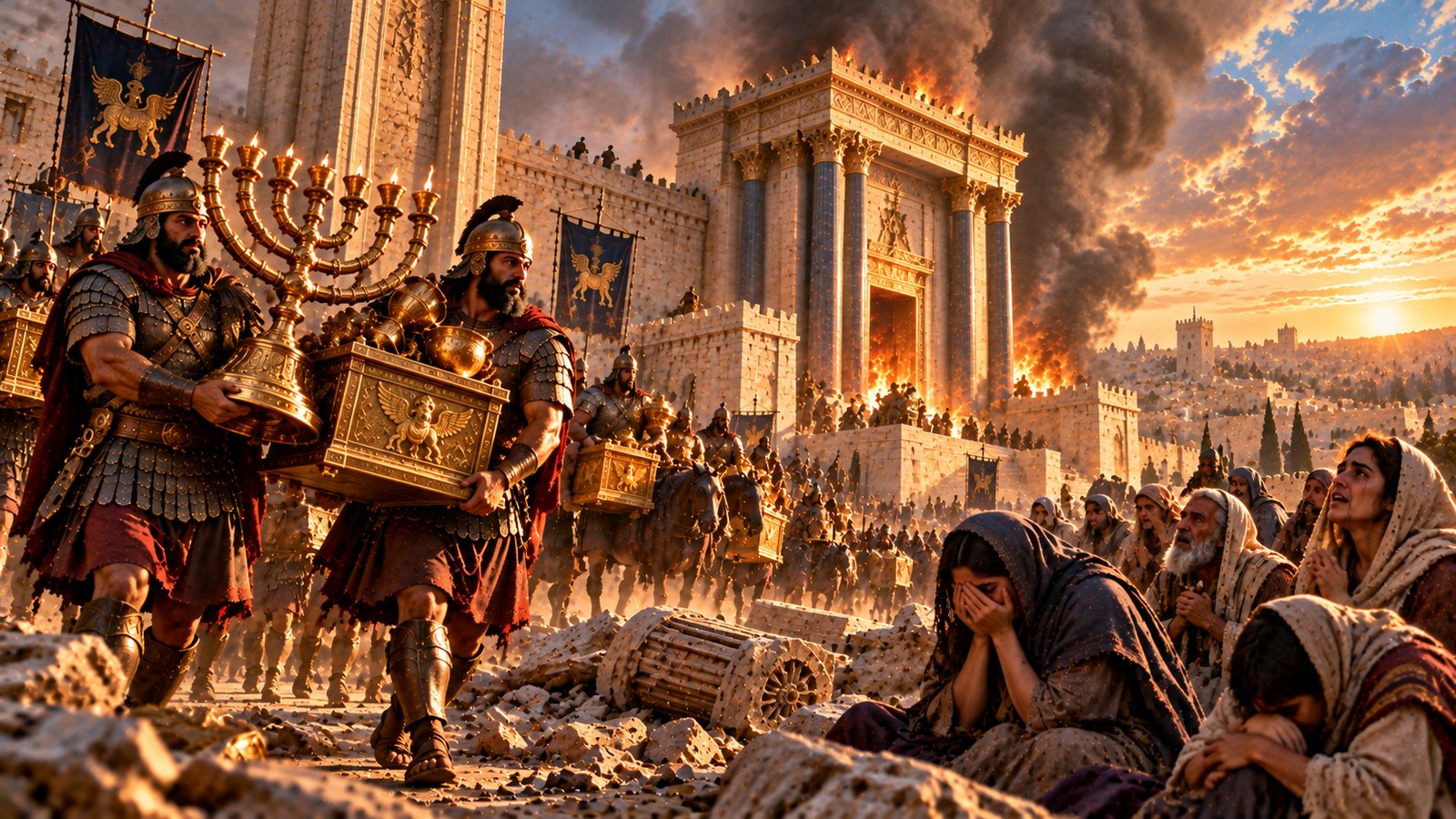
Setting: Jerusalem's final Babylonian siege and destruction under Zedekiah, commonly dated to 587–586 BC, followed by the aftermath in Judah and exile. Principal figures: Zedekiah, Nebuchadnezzar, Nebuzaradan, the priests, and the suffering people of Judah. Primary passages: 2 Kings 25; Lamentations 3. Parallel account: Jeremiah 52.
Ezekiel's vision showed God's glory departing from the sanctuary. Now we face the historical catastrophe toward which the warnings had pointed. Babylon surrounds Jerusalem, famine deepens, and the city's defenses finally fail. The Temple that Solomon dedicated, Hezekiah reopened, and Josiah repaired is burned. This is a turning point in the sanctuary story. God's people lose the place that had organized their public worship and expressed His covenant presence among them. The devastation must be understood with grief and with attention to the word they repeatedly refused.
The Siege Reaches the Households of Jerusalem
1In the ninth year of his reign, in the tenth month, in the tenth day of the month, Nebuchadnezzar king of Babylon came, he and all his army, against Jerusalem, and encamped against it; and they built forts against it around it.
2So the city was besieged until the eleventh year of King Zedekiah.
3On the ninth day of the fourth month, the famine was severe in the city, so that there was no bread for the people of the land.
The account begins with dates and then speaks of hunger. The siege is not merely a change in political leadership. It enters the lives of people who cannot find bread.
When a breach is made, Zedekiah and his soldiers flee. He is captured, his sons are killed before him, and he is blinded and taken to Babylon (2 Kings 25:4–7). The royal house is brought to humiliation. Scripture does not disguise how terrible the collapse becomes.
We should not hurry from these events to a lesson that makes suffering feel tidy. The Bible gives us both the revealed judgment and the language of lament. God's people are invited to tell Him the truth about devastating loss.
The Lord's House Is Burned
8Now in the fifth month, on the seventh day of the month, which was the nineteenth year of King Nebuchadnezzar king of Babylon, Nebuzaradan the captain of the guard, a servant of the king of Babylon, came to Jerusalem.
9He burned Yahweh’s house, the king’s house, and all the houses of Jerusalem. He burned every great house with fire.
10All the army of the Chaldeans, who were with the captain of the guard, broke down the walls around Jerusalem.
11Nebuzaradan the captain of the guard carried away captive the rest of the people who were left in the city and those who had deserted to the king of Babylon—all the rest of the multitude.
12But the captain of the guard left some of the poorest of the land to work the vineyards and fields.
The Temple, palace, houses, and walls all fall within the destruction. Sacred and civic life are shattered together. Some of the poorest remain, while many others are carried into captivity.
The text calls the building Yahweh's house even as it records its burning. Its true identity never meant it was immune to covenant judgment. God had already warned that persistent unfaithfulness would bring loss even to the chosen city and house (2 Kings 23:26–27).
Jerusalem's earlier rescue from Assyria was real. Treating that rescue as a permanent guarantee independent of obedience would have been false. A remembered act of mercy must lead to continuing trust, not presumption.
The Furnishings Become Plunder
13The Chaldeans broke up the pillars of bronze that were in Yahweh’s house and the bases and the bronze sea that were in Yahweh’s house, and carried the bronze pieces to Babylon.
14They took away the pots, the shovels, the snuffers, the spoons, and all the vessels of bronze with which they ministered.
15The captain of the guard took away the fire pans, the basins, that which was of gold, for gold, and that which was of silver, for silver.
Earlier chapters introduced the sanctuary's ordered service. Now its tools are removed and its bronze pillars and Sea are broken apart. Objects once used in ministry are treated as valuable material for an empire.
The account does not tell us what happened to the Ark of the Covenant. We should neither claim it was carried to Babylon nor invent a hiding place as though Scripture established one. What is explicit is the dismantling and plundering of the Temple's furnishings.
The losses reveal the seriousness of what has happened. An appointed place of meeting has been destroyed, and its public ministry interrupted. Yet the God who gave that worship has already shown Ezekiel that His throne remains beyond Babylon's control.
The Lie and the Truth: Does Possessing the Building Make Us Untouchable?
The lie is that a sacred building, a history of miracles, or a religious identity makes persistent rebellion safe. God's truth is that His word governs His people, and He will not turn His sanctuary into a guarantee against the consequences He has announced.
This does not make buildings or shared worship unimportant. It puts them in their proper place: gifts for faithful relationship, not substitutes for it. Faith is fundamentally trusting our good Father, including receiving the correction that calls us back to Him.
A Broken Land and an Unfinished Story
The devastation continues after the burning. Priests and officials are executed, and Judah is carried away. Gedaliah is appointed governor over those left in the land, then murdered. Fear drives another group toward Egypt (2 Kings 25:18–26).
No simple political solution restores what has been lost. The remaining people must live within the consequences of a history larger than any one household. Later restoration will require God's initiative, not merely a change in administration.
27In the thirty-seventh year of the captivity of Jehoiachin king of Judah, in the twelfth month, on the twenty-seventh day of the month, Evilmerodach king of Babylon, in the year that he began to reign, released Jehoiachin king of Judah out of prison,
28and he spoke kindly to him and set his throne above the throne of the kings who were with him in Babylon,
29and changed his prison garments. Jehoiachin ate bread before him continually all the days of his life;
30and for his allowance, there was a continual allowance given him from the king, every day a portion, all the days of his life.
Kings ends with a surprising change in the circumstances of an exiled Davidic king. Jehoiachin's release does not rebuild the Temple or restore Judah's monarchy. It does mean the narrative closes with a surviving royal descendant receiving kindness rather than with the complete disappearance of David's line.
Readers following God's promises can recognize a reason to keep listening. Judgment has changed the nation's circumstances, but it has not finished the biblical story.
Hope That Speaks from within Grief
19Remember my affliction and my misery, the wormwood and the bitterness.
20My soul still remembers them, and is bowed down within me.
21This I recall to my mind; therefore I have hope.
22It is because of Yahweh’s loving kindnesses that we are not consumed, because his mercies don’t fail.
23They are new every morning. Great is your faithfulness.
24“Yahweh is my portion,” says my soul. “Therefore I will hope in him.”
Lamentations gives a voice to anguish over Jerusalem. Hope does not require the speaker to deny bitterness or forget the loss. It arises as God's mercy and faithfulness are brought to mind within the grief.
The Lord Himself remains the portion of His people. When the visible center of worship has been lost, they can still seek the One whose mercy gives a future beyond what they can presently see.
40Let us search and try our ways, and turn again to Yahweh.
41Let’s lift up our heart with our hands to God in the heavens.
Lament and repentance belong together. The response is to examine the way, return to the Lord, and lift the heart toward Him. Words of hope never make the refusal to repent harmless.
Judah Carried Away, a Remnant Remaining
Judah now experiences the national catastrophe that earlier overtook the northern kingdom. Deportation does not mean every Judean was removed, as the account explicitly records people remaining in the land. Nor does it mean God has abandoned His covenant purposes for Israel. The surviving Davidic line, prophetic promises of gathering, and the coming return from exile will carry this people's story forward.
Through Jesus, Access That Ruin Cannot Destroy
The later biblical story will reveal Jesus as the living Temple and the mediator who opens access to the Father through His death and resurrection (John 2:19–22; Hebrews 10:19–22). That fuller revelation does not make the burning of Solomon's Temple insignificant. It shows how deep the need for lasting reconciliation and restored fellowship truly is.
Through Christ, believing Jews and Gentiles become God's dwelling by the Spirit (Ephesians 2:18–22). His children can bring grief and repentance to Him wherever they are. We should not use this ancient judgment to claim we know the divine explanation for every modern catastrophe. Here Scripture supplies a particular covenant interpretation; our own suffering calls for prayer, care, and humble discernment.
Prayer after the House Is Gone
The appointed earthly house has burned. The God whose glory Ezekiel saw still reigns, hears lament, and promises restoration. The loss exposes false security while directing His people back to Himself.
The journey ends in the New Jerusalem, where God and the Lamb are the temple and mourning and death are gone (Revelation 21:4, 22). Jerusalem's ashes are a terrible chapter on that road; they do not determine its final destination.
Temple Prayer Response: Be My Portion in the Loss
Here is a sample prayer. Make it your own, and continue in your own words.
Father, You know the losses I cannot repair. Help me bring You grief honestly and receive Your correction humbly. Forgive the false securities I have trusted. Jesus, thank You for opening lasting access to the Father. Holy Spirit, sustain my hope in God's mercy and guide me in the next faithful step. Let repentance, compassion, and trust grow where despair has taken root. Amen.
Pause and name what you are grieving. Read the words of hope again without rushing past the pain. Ask what returning to the Lord looks like in your present circumstances.
2 Kings 25; Jeremiah 52; Lamentations 3; Ezekiel 11:14–20; John 2:19–22; Ephesians 2:18–22; Hebrews 10:19–22; Revelation 21:4, 22.
Quotations are from the World English Bible (WEB), public domain (ebible.org/eng-web), and were checked against that text (2 Kings 25 and Lamentations 3). The destruction is commonly dated to 587–586 BC; chronological reconstructions and the day notices in Kings and Jeremiah require care. Quotations follow Kings without silently combining parallel wording. The Ark's fate is not stated here. The illustration is artistic: its soldiers' dress, architectural details, and particular sacred objects are not a documented inventory or reconstruction; no Ark-like object in it establishes the fate of the Ark. Lamentations is used as Scripture expressing grief and hope, without requiring a particular conclusion about its human authorship. The lie/truth framing is editorial.