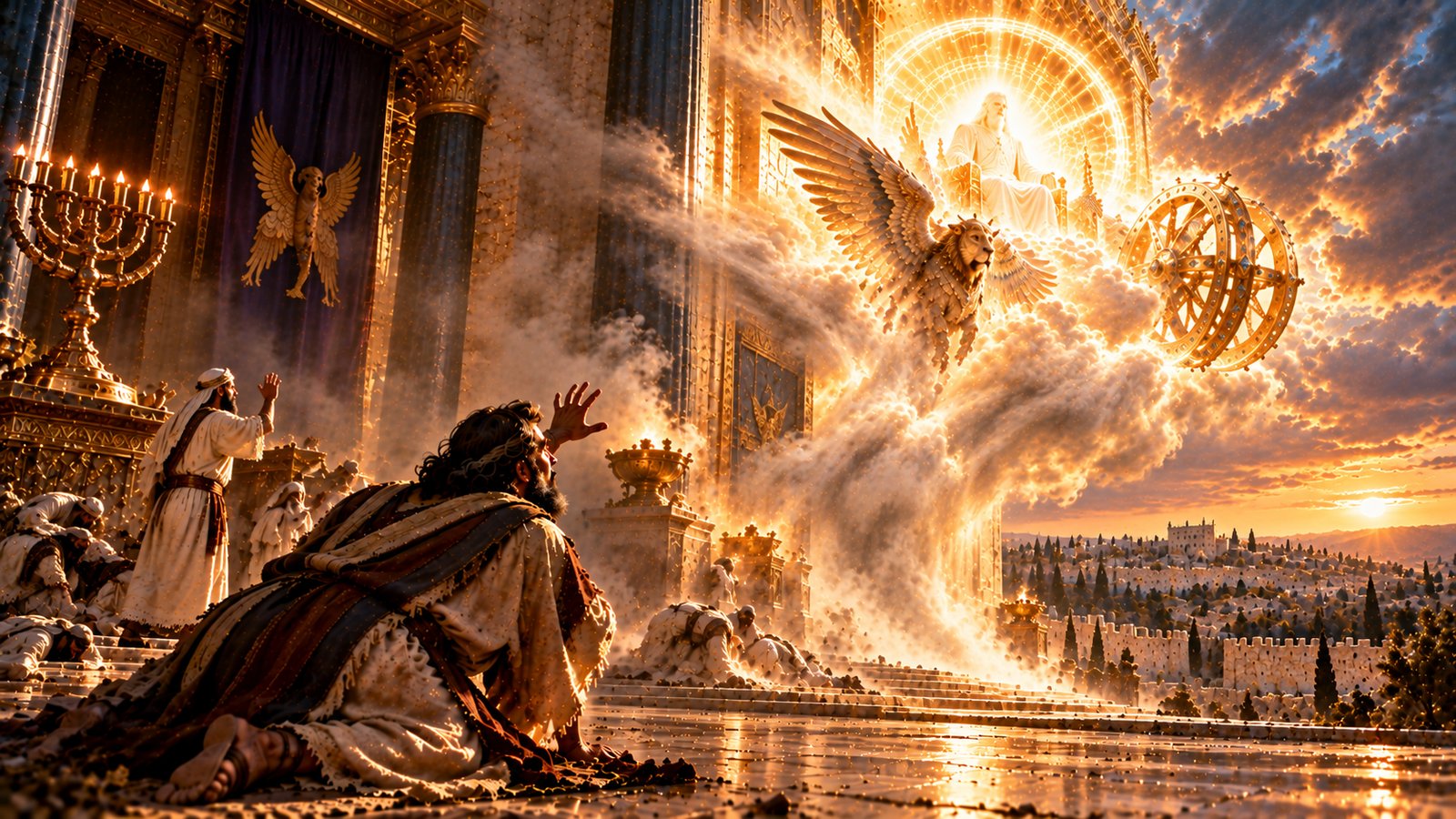
Setting: A vision given to Ezekiel among the exiles, taking him to Jerusalem before the city's final destruction. Principal figures: Ezekiel, the Lord, the cherubim, and the people and leaders shown in the sanctuary. Primary passages: Ezekiel 8–11.
Ezekiel first saw God's glory beside the river Chebar. Now the Spirit brings him, in a vision, to Jerusalem. The same glory is there, but so is a shocking corruption of the place appointed for worship. This vision explains why the Temple's continued existence cannot guarantee Jerusalem's safety. God's departure is not evidence that Babylon has overcome Him. The vision reveals His holy judgment on a sanctuary and community persistently turned toward other gods. It also reveals His continuing care for people far from the city.
The Vision Brings the Prophet to the Sanctuary
3He stretched out the form of a hand, and took me by a lock of my head; and the Spirit lifted me up between earth and the sky, and brought me in the visions of God to Jerusalem, to the door of the gate of the inner court that looks toward the north, where there was the seat of the image of jealousy, which provokes to jealousy.
4Behold, the glory of the God of Israel was there, according to the appearance that I saw in the plain.
Ezekiel describes a visionary journey. We should not rewrite it as an ordinary physical visit. The elders are sitting with him in exile when the encounter begins (Ezekiel 8:1), and he later tells the captives what he has seen (Ezekiel 11:24–25).
The image at the gate stands in direct conflict with the God whose glory fills the sanctuary. The Lord's jealousy expresses His claim to the exclusive devotion of His covenant people. A place dedicated to Him has been given over to rival allegiance.
The Claim That God Does Not See
10So I went in and looked, and saw every form of creeping things, abominable animals, and all the idols of the house of Israel, portrayed around on the wall.
11Seventy men of the elders of the house of Israel stood before them. In the middle of them Jaazaniah the son of Shaphan stood, every man with his censer in his hand; and the smell of the cloud of incense went up.
12Then he said to me, “Son of man, have you seen what the elders of the house of Israel do in the dark, every man in his rooms of imagery? For they say, ‘Yahweh doesn’t see us. Yahweh has forsaken the land.’ ”
The elders' hidden worship rests on a false understanding of God. They act as though He does not see and has abandoned the land. Yet the vision exposes what they think is concealed.
Incense remains in their hands, but its religious appearance cannot make their worship faithful. Here the question from earlier chapters becomes painfully concrete: who is actually receiving the devotion practiced in God's house?
The lie is that hidden idolatry is harmless because God is absent or unaware. God's truth is that He sees, and His sanctuary cannot be used to legitimize competing worship. The same honesty is required of us when private loyalties contradict public professions.
Turned Backs, Rival Worship, and a Violent Land
16He brought me into the inner court of Yahweh’s house; and I saw at the door of Yahweh’s temple, between the porch and the altar, there were about twenty-five men with their backs toward Yahweh’s temple and their faces toward the east. They were worshiping the sun toward the east.
17Then he said to me, “Have you seen this, son of man? Is it a light thing to the house of Judah that they commit the abominations which they commit here? For they have filled the land with violence, and have turned again to provoke me to anger. Behold, they put the branch to their nose.
18Therefore I will also deal in wrath. My eye won’t spare, neither will I have pity. Though they cry in my ears with a loud voice, yet I will not hear them.”
The men's physical posture expresses their spiritual direction: their backs are toward the Lord's Temple while they worship the sun. Earlier Ezekiel also sees women mourning for Tammuz (Ezekiel 8:14). The sanctuary has become a setting for devotion God did not ordain.
The Lord joins these practices with violence in the land. False worship and the destruction of community life belong to the same indictment. The meaning of the branch gesture is debated; the clear charge does not depend on solving that detail.
The warning about unheard cries is severe. It confronts persistent rebellion, not a sincere person turning toward God in repentance. Religious noise cannot replace a changed direction.
Judgment Distinguishes Hearts
3The glory of the God of Israel went up from the cherub, whereupon it was, to the threshold of the house; and he called to the man clothed in linen, who had the writer’s inkhorn by his side.
4Yahweh said to him, “Go through the middle of the city, through the middle of Jerusalem, and set a mark on the foreheads of the men that sigh and that cry over all the abominations that are done within it.”
The vision of judgment is devastating, and it begins at the sanctuary (Ezekiel 9:5–7). Yet the Lord distinguishes those who grieve over the city's evil. Not every person within a judged community shares the same response to its sin.
Ezekiel falls on his face and intercedes as he witnesses the judgment (Ezekiel 9:8). His response gives no room for delight in destruction. Seeing the seriousness of sin should deepen repentance and prayer for people.
The Glory Moves toward the East Gate
18Yahweh’s glory went out from over the threshold of the house and stood over the cherubim.
19The cherubim lifted up their wings and mounted up from the earth in my sight when they went out, with the wheels beside them. Then they stood at the door of the east gate of Yahweh’s house; and the glory of the God of Israel was over them above.
The movement is deliberate: from the sanctuary's threshold to the cherubim and the east gate. The glory Ezekiel saw by the river is the glory now departing the house. These are connected visions of the same holy God (Ezekiel 10:20–22).
We should not invent motives for every pause. The text gives a movement with enormous significance: God is not obliged to maintain His manifested covenant presence in a place used to defy Him. The building cannot hold Him captive.
Mercy for the Scattered and a Promise of New Hearts
19I will give them one heart, and I will put a new spirit within them. I will take the stony heart out of their flesh, and will give them a heart of flesh,
20that they may walk in my statutes, and keep my ordinances, and do them. They will be my people, and I will be their God.
The surrounding promise is addressed to scattered people whom Jerusalem's inhabitants have treated as far from the Lord. God promises to be a sanctuary to them in the countries where they have gone and to gather them again (Ezekiel 11:14–18).
Restoration requires more than a return to familiar streets. The people need hearts capable of responding to God. His promise joins renewed belonging with actual obedience.
Faith is fundamentally trusting our good Father. Here that includes believing He sees our sin and receiving the transforming mercy He promises. The answer to a hardened heart is neither concealment nor despair; it is surrender to His work.
The Glory Leaves the City
22Then the cherubim lifted up their wings, and the wheels were beside them. The glory of the God of Israel was over them above.
23Yahweh’s glory went up from the middle of the city, and stood on the mountain which is on the east side of the city.
24The Spirit lifted me up, and brought me in the vision by the Spirit of God into Chaldea, to the captives. So the vision that I had seen went up from me.
25Then I spoke to the captives all the things that Yahweh had shown me.
The vision ends with glory east of the city and the prophet again among the captives. Jerusalem has not yet been burned, but its coming loss has been given a spiritual explanation. The decisive issue is the people's relationship to the Lord.
Judgment in the City, Hope for the Scattered
The vision confronts Jerusalem and Judah while speaking hope to scattered Israelites. Those still in the land cannot assume that possession proves faithfulness, and those in exile are not beyond God's reach. Judgment exposes covenant rebellion, while the promise of gathering and renewed hearts keeps Israel's future in view. The later inclusion of Gentiles through Jesus does not erase the people to whom these promises were first spoken.
Through Jesus, Holiness within God's Living Temple
Jesus brings believers near to the Father, and the Holy Spirit forms a dwelling of believing Jews and Gentiles together (Ephesians 2:18–22). God's promise of inward renewal comes into fuller view in this new-covenant life. His children are called to worship in truth and put away what grieves the Spirit (Ephesians 4:25–32).
We must apply this vision faithfully. It is not a rule that the Holy Spirit automatically leaves a believer whenever that person sins. It is a particular revelation concerning Jerusalem's sanctuary, calling us to take holiness seriously and return through Christ with honest repentance.
A Place Appointed, a Presence That Exceeds It
The earthly sanctuary remains standing, but the vision exposes how its worship has been corrupted. At the same time, God promises to be a sanctuary for His scattered people. The place matters because He appoints it; His presence and authority always exceed it.
Later Ezekiel will see glory returning. The wider story leads toward the New Jerusalem, where God dwells with His people and nothing unclean enters (Revelation 21:3, 27). Holiness and everlasting fellowship belong together.
Temple Prayer Response: Search What I Have Hidden
Here is a sample prayer. Make it your own, and continue in your own words.
Father, You see what I hide and know what receives my real devotion. Forgive my divided loyalties. Jesus, thank You for cleansing me and bringing me near. Holy Spirit, soften my heart and teach me to obey. Give me grief over sin without pride toward others, and help me intercede with compassion. Let my private life agree with the worship I offer You. Amen.
Be still and ask what you have excused because no one else sees it. Bring it into the light of Scripture and respond with a concrete act of repentance.
Ezekiel 8–11; 36:25–27; Ephesians 2:18–22; 4:25–32; Revelation 21:3, 27.
Quotations are from the World English Bible (WEB), public domain (ebible.org/eng-web), and were checked against that text (Ezekiel 8 through 11). The journey to Jerusalem is explicitly visionary. The branch gesture in Ezekiel 8:17 is not explained with certainty. The teaching distinguishes the departure from Jerusalem's sanctuary from questions about individual believers and the Spirit. The illustration is artistic; it should not imply Ezekiel physically traveled to Jerusalem or establish the exact architecture and appearance of the glory. The lie/truth framing is editorial.