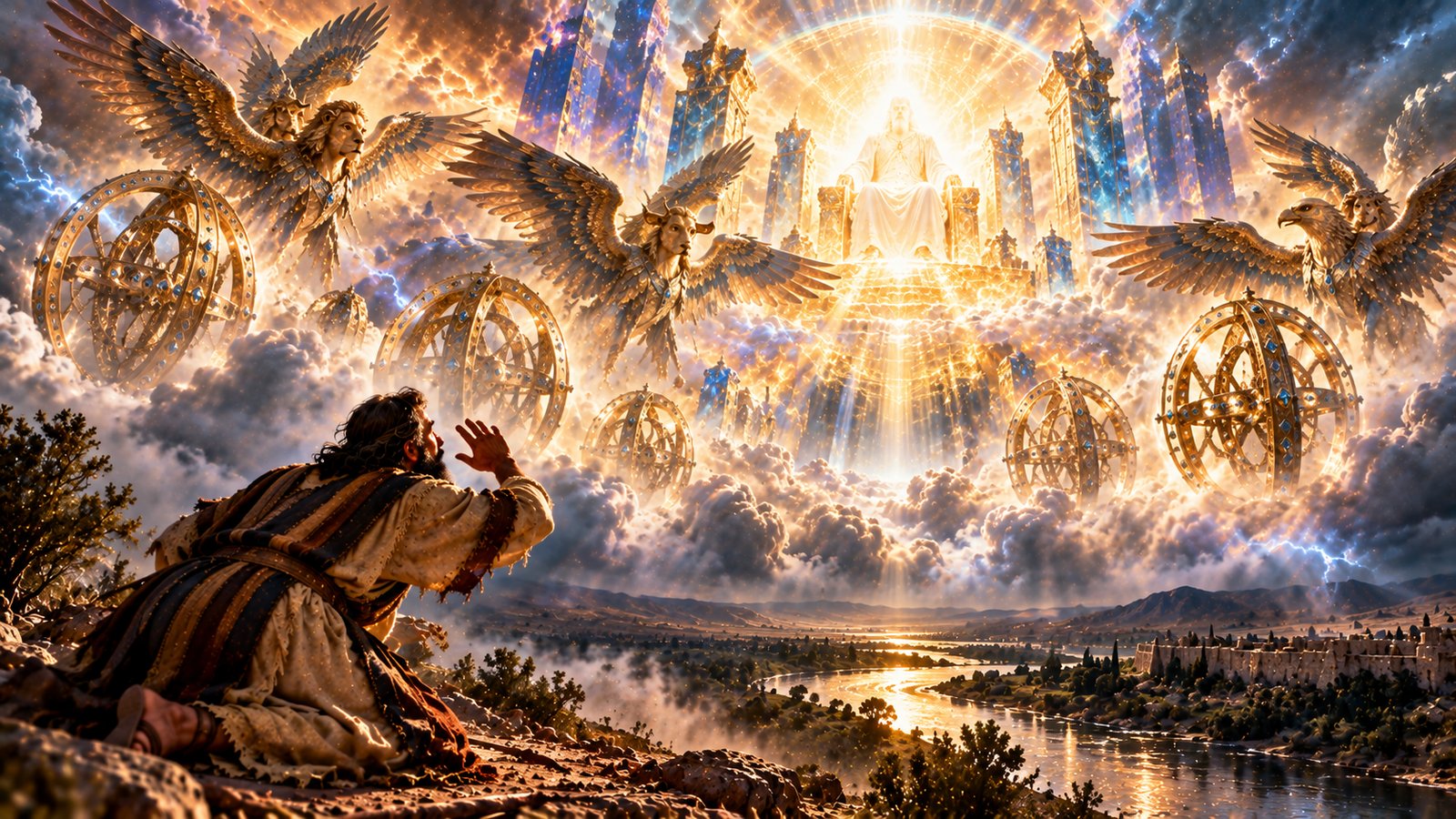
Setting: Among Judean captives by the river Chebar in Babylonia, in the fifth year of Jehoiachin's captivity, before Jerusalem's final destruction. Principal figures: Ezekiel the priest, the four living creatures, and the Lord whose glory appears. Primary passages: Ezekiel 1–2; 10:20.
Daniel's story showed faithful allegiance far from Jerusalem. Now we stand with another captive, Ezekiel, a priest living in Babylonia. The earthly Temple still stands, but he is separated from its service. There, among the deported people, the heavens open. This vision changes how we understand the place of meeting. God had appointed a sanctuary in Jerusalem, yet His throne was never confined within its walls. The Lord can reveal His glory and speak His word among the exiles. Babylon has displaced His people; it has not captured their God.
God Speaks Where His People Have Been Scattered
1Now in the thirtieth year, in the fourth month, in the fifth day of the month, as I was among the captives by the river Chebar, the heavens were opened, and I saw visions of God.
2In the fifth of the month, which was the fifth year of King Jehoiachin’s captivity,
3Yahweh’s word came to Ezekiel the priest, the son of Buzi, in the land of the Chaldeans by the river Chebar; and Yahweh’s hand was there on him.
The location matters. Ezekiel receives God's word in the land of the Chaldeans, among people whose national life has been broken by conquest. His priestly identity has not disappeared, and neither has God's ability to call him.
The text gives a date within Jehoiachin's captivity. The meaning of the opening reference to the thirtieth year is debated; it is often understood as Ezekiel's age, but the verse does not explicitly say so. We do not need to resolve it to hear the central announcement: God's word reaches a priest in exile.
For people accustomed to meeting God at the Temple, this is profound reassurance. Distance from an appointed earthly place does not make the Lord distant in power, knowledge, or care.
A Vision Larger Than Familiar Categories
4I looked, and behold, a stormy wind came out of the north: a great cloud, with flashing lightning, and a brightness around it, and out of the middle of it as it were glowing metal, out of the middle of the fire.
5Out of its center came the likeness of four living creatures. This was their appearance: They had the likeness of a man.
6Everyone had four faces, and each one of them had four wings.
Ezekiel describes what he sees through repeated comparisons: likeness, appearance, and something like glowing metal. These words invite careful reading. He is reporting an overwhelming vision, not giving an ordinary description of an earthly object.
The creatures have human, lion, ox, and eagle faces, with wings and human hands (Ezekiel 1:7–11). Later he identifies the living creatures as cherubim (Ezekiel 10:20). Their presence connects the vision with the sanctuary's cherubim imagery while exceeding anything a carved representation could convey.
We should resist reducing the vision to a mechanical diagram or identifying its wheels with modern technology. Its focus is the majesty of the God who reveals Himself. Wonder should lead us to reverence and listening.
Movement Governed by the Spirit
19When the living creatures went, the wheels went beside them. When the living creatures were lifted up from the earth, the wheels were lifted up.
20Wherever the spirit was to go, they went. The spirit was to go there. The wheels were lifted up beside them; for the spirit of the living creature was in the wheels.
21When those went, these went. When those stood, these stood. When those were lifted up from the earth, the wheels were lifted up beside them; for the spirit of the living creature was in the wheels.
The vision displays coordinated movement rather than confusion. Creatures and wheels move together, directed by the spirit described in the passage. The wheels' astonishing appearance and their rims full of eyes contribute to its sense of power and awareness (Ezekiel 1:15–18).
The throne scene is not fixed helplessly in Jerusalem. This matters to captives who may wonder whether their God can act beyond the land. The Lord governs where empires appear to govern everything.
That assurance does not cancel His judgments or promise an immediate return. Ezekiel will speak difficult words to these same people. God's nearness includes both comfort and correction.
Above the Creatures Is the Throne
26Above the expanse that was over their heads was the likeness of a throne, as the appearance of a sapphire stone. On the likeness of the throne was a likeness as the appearance of a man on it above.
27I saw as it were glowing metal, as the appearance of fire within it all around, from the appearance of his waist and upward; and from the appearance of his waist and downward I saw as it were the appearance of fire, and there was brightness around him.
28As the appearance of the rainbow that is in the cloud in the day of rain, so was the appearance of the brightness all around. This was the appearance of the likeness of Yahweh’s glory. When I saw it, I fell on my face, and I heard a voice of one that spoke.
The vision reaches its center above the creatures: the throne and the appearance of the Lord's glory. Ezekiel's response is to fall on his face and listen. The spectacle serves the encounter with the One who speaks.
The rainbow recalls imagery already associated with God's covenant faithfulness in Noah's story (Genesis 9:12–17). Ezekiel does not explicitly explain that connection here, but readers of the wider Bible can recognize the shared imagery without assigning a hidden meaning to every detail.
We began this journey with heaven's greater reality behind earthly sanctuaries. Here that reality confronts a displaced priest. The God worshiped at the Temple remains enthroned even when His people cannot approach its courts.
The Lie and the Truth: Has God Become Unreachable?
The lie is that displacement has placed the exiles beyond God's reach, as though His reign depended on their access to Jerusalem. The truth is that He reigns, sees, and speaks in the very place of their loss.
Faith is fundamentally trusting our good Father. This trust allows us to seek Him in unfamiliar circumstances without demanding familiar surroundings first. It also prepares us to receive whatever His word requires.
The Spirit Raises the Servant to Listen
1He said to me, “Son of man, stand on your feet, and I will speak with you.”
2The Spirit entered into me when he spoke to me, and set me on my feet; and I heard him who spoke to me.
Ezekiel does not rise by demonstrating that he is strong enough for the encounter. The Spirit sets him on his feet so he can hear. God's call includes His enabling.
The Lord sends him to a rebellious people, whether they listen or refuse (Ezekiel 2:3–7). Like Isaiah, Ezekiel receives a calling that cannot be measured simply by applause. He must first hear God and then speak faithfully.
An encounter with glory does not remove the need for obedience. The Spirit's work leads the servant toward God's word and the responsibility of bearing it.
Exiles Still Addressed as God's People
These captives are part of Judah, within the descendants of Jacob. Their exile belongs to the covenant judgment unfolding in Israel's history, but God continues addressing them as His people. Jerusalem's remaining inhabitants do not have exclusive possession of His attention. The same Lord will confront sin in the city and speak hope to those scattered among the nations.
Through Jesus, Nearness to the God Who Reigns
The New Testament reveals God's glory in Jesus Christ, who makes the Father known and ministers as our High Priest in the heavenly sanctuary (John 1:14–18; Hebrews 8:1–2). We need not claim that Ezekiel understood every later revelation to recognize how his vision prepares us for the Bible's fuller account of divine glory and access.
Through Christ, believing Jews and Gentiles draw near to the Father by one Spirit and become His dwelling place together (Ephesians 2:18–22). Adoption welcomes us as children before priestly service calls us to minister. God's presence reaches the places where His people actually live.
Glory beside an Exile's River
Here the meeting place is beside the river Chebar, where heaven opens and the Lord speaks to a priest in captivity. The vision does not establish a rival temple in Babylon. It reveals that the Lord of the sanctuary is free to meet and commission His servant there.
The journey leads toward the New Jerusalem, where the Lord God Almighty and the Lamb are the temple and His servants see His face (Revelation 21:22; 22:3–4). Ezekiel's vision keeps our eyes on that reigning God when earthly circumstances appear to deny His nearness.
Temple Prayer Response: Teach Me to Hear You Here
Here is a sample prayer to begin with. Make it your own, and continue in your own words.
Father, thank You that Your throne is not threatened by the circumstances that unsettle me. Forgive me for confusing unfamiliar surroundings with Your absence. Jesus, thank You for bringing me near to the Father. Holy Spirit, steady me, open my understanding of Scripture, and give me a listening heart. Teach me to worship with reverence and obey where I am today. Amen.
Be still for a moment. Name the circumstance that has made God seem distant, then read again what this passage reveals about His reign. Ask what faithful response His word calls for today.
Ezekiel 1–3; 10:15–22; Genesis 9:12–17; John 1:14–18; Ephesians 2:18–22; Hebrews 8:1–2; Revelation 21:22; 22:3–4.
Quotations are from the World English Bible (WEB), public domain (ebible.org/eng-web), and were checked against that text (Ezekiel 1 and 2). Ezekiel's repeated language of likeness and appearance is retained. The opening thirtieth year is not explicitly identified as his age. Interpretations of individual visionary details differ; the teaching emphasizes the throne, divine glory, and prophetic commission rather than speculative identifications. The illustration is artistic; its architecture, count and configuration of creatures and wheels, and humanlike portrayal of the enthroned figure should not be treated as a precise rendering of every textual detail. The lie/truth framing is editorial.