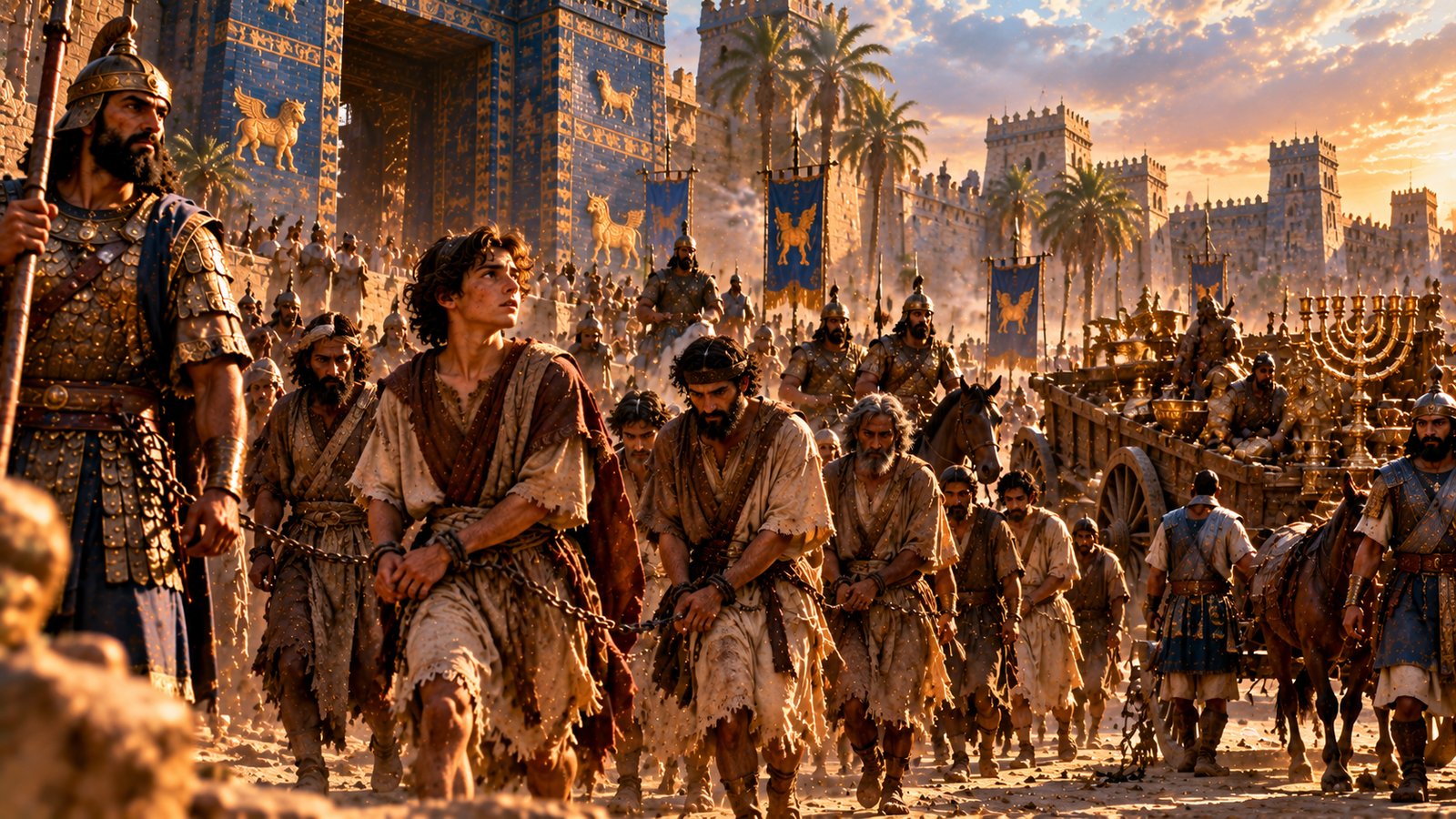
Setting: Babylonian captivity during the reign of Jehoiakim, before Jerusalem's final destruction; the chapter also briefly looks ahead to Daniel's later prayer life. Principal figures: Daniel, Hananiah, Mishael, Azariah, Nebuchadnezzar, and the officials responsible for the youths' training. Primary passage: Daniel 1. Supporting passages: 1 Kings 8:46–50; Daniel 6:10–11; 1 Peter 2:11–12.
Josiah heard God's word and called Judah back to covenant worship, but his successors did not sustain that return. Babylon now enters the story as the power carrying Judeans and sacred vessels away from Jerusalem. We are not yet at the Temple's final destruction. Daniel's story begins during an earlier stage of captivity, when the sanctuary still stands but some of its vessels have already been taken. Our journey pauses with young people removed from home and brought into a foreign court. The question reaches beyond the survival of a building: can God's people remain faithful when the familiar place of worship is far away and another kingdom is reshaping their lives?
Sacred Vessels in a Foreign Treasure House
1In the third year of the reign of Jehoiakim king of Judah, Nebuchadnezzar king of Babylon came to Jerusalem and besieged it.
2The Lord gave Jehoiakim king of Judah into his hand, with some of the vessels of the house of God; and he carried them into the land of Shinar to the house of his god. He brought the vessels into the treasure house of his god.
The opening places the Temple directly within the crisis. Vessels once used in the Lord's house are carried into the house of a Babylonian god. Their relocation makes Judah's humiliation visible.
Yet the narrator does not say Babylon's god defeated the Lord. The Lord gave Judah's king into Nebuchadnezzar's hand. The book interprets the loss within God's sovereignty and the wider covenant story of judgment.
This does not make the captivity painless. It tells the reader that the God who reigns in heaven has not lost His authority because His people have lost their freedom. Daniel must now learn faithfulness in circumstances he did not choose.
A New Education, New Names, and a Royal Table
3The king spoke to Ashpenaz, the master of his eunuchs, that he should bring in some of the children of Israel, even of the royal offspring and of the nobles:
4youths in whom was no defect, but well-favored, skillful in all wisdom, endowed with knowledge, understanding science, and who had the ability to stand in the king’s palace; and that he should teach them the learning and the language of the Chaldeans.
5The king appointed for them a daily portion of the king’s delicacies and of the wine which he drank, and that they should be nourished three years, that at its end they should stand before the king.
6Now among these of the children of Judah were Daniel, Hananiah, Mishael, and Azariah.
7The prince of the eunuchs gave names to them: to Daniel he gave the name Belteshazzar; to Hananiah, Shadrach; to Mishael, Meshach; and to Azariah, Abednego.
Babylon prepares selected Judean youths for service in its palace. Language, learning, food, and names become part of their new situation. They are being trained to function within the empire that has taken them captive.
The passage does not portray every act of cultural learning as compromise. Daniel and his companions receive the education and later serve the king. Their faithfulness requires discernment about where participation becomes defilement.
We should also distinguish the text from reconstruction. It identifies youths drawn from royal and noble families, but it does not supply Daniel's exact age, describe his parents' fate, or say he personally belonged to the royal household. We can recognize the pressures of his situation without inventing a biography.
A Decision Made in the Heart
8But Daniel purposed in his heart that he would not defile himself with the king’s delicacies, nor with the wine which he drank. Therefore he requested of the prince of the eunuchs that he might not defile himself.
9Now God made Daniel find kindness and compassion in the sight of the prince of the eunuchs.
10The prince of the eunuchs said to Daniel, “I fear my lord the king, who has appointed your food and your drink. For why should he see your faces worse looking than the youths who are of your own age? Then you would endanger my head with the king.”
Daniel determines that he will not defile himself. He then makes a request. Conviction and respectful conduct appear together: he does not need contempt for the official in order to remain loyal to God.
The precise reason the food and wine would defile him is not fully explained. Interpreters discuss food laws, possible associations with idolatry, and the significance of the king's provision. The passage's clear emphasis is Daniel's resolve to remain undefiled and God's kindness at work through an official.
The official's fear is also real. Daniel's choice affects someone living under royal authority. Faithfulness therefore calls for wisdom as well as courage.
The Lie and the Truth: Must I Compromise to Have a Future?
The lie is that survival and usefulness require surrendering our loyalty to God. The truth is that God can sustain faithful people within a setting they cannot control.
Faith is fundamentally trusting our good Father. Daniel cannot restore Judah's freedom or arrange his return home. He can entrust his future to God and act faithfully in the decision before him. A heart that belongs to the Lord need not be handed over to the surrounding culture.
Faithfulness Finds a Practical Way Forward
11Then Daniel said to the steward whom the prince of the eunuchs had appointed over Daniel, Hananiah, Mishael, and Azariah:
12“Test your servants, I beg you, ten days; and let them give us vegetables to eat and water to drink.
13Then let our faces be examined before you, and the face of the youths who eat of the king’s delicacies; and as you see, deal with your servants.”
14So he listened to them in this matter, and tested them for ten days.
15At the end of ten days, their faces appeared fairer and they were fatter in flesh than all the youths who ate of the king’s delicacies.
16So the steward took away their delicacies and the wine that they were given to drink, and gave them vegetables.
Daniel proposes a limited test that addresses the official's concern. His companions share the alternative food, and the steward sees a favorable result. Their conviction becomes an ordered, practical response.
This is not a universal formula promising that the same menu will produce the same result for everyone. The story concerns faithful allegiance and God's provision in a particular situation. Its lasting invitation is to seek a wise way to obey rather than assuming compromise is inevitable.
God Gives Wisdom in Babylon
17Now as for these four youths, God gave them knowledge and skill in all learning and wisdom; and Daniel had understanding in all visions and dreams.
18At the end of the days which the king had appointed for bringing them in, the prince of the eunuchs brought them in before Nebuchadnezzar.
19The king talked with them; and among them all was found no one like Daniel, Hananiah, Mishael, and Azariah. Therefore they stood before the king.
20In every matter of wisdom and understanding concerning which the king inquired of them, he found them ten times better than all the magicians and enchanters who were in all his realm.
21Daniel continued even to the first year of King Cyrus.
The book gives God the credit for their wisdom. Babylon supplies instruction, but the Lord remains the giver who enables His people to serve faithfully.
The closing reference to Cyrus opens a much longer horizon. Daniel's life of service extends beyond this first test and beyond Nebuchadnezzar's reign. The empire that seems to control his future will not have the final word.
The favorable outcome here does not mean faithfulness always brings promotion or safety. Later chapters bring threats, fire, and a lions' den. Daniel 1 establishes the allegiance that must continue when obedience becomes more costly.
Faithful Judeans within a People in Exile
Daniel and his companions are Judeans, part of the descendants of Jacob caught in the unfolding captivity. Judah's national failure does not make every captive personally guilty of every offense that brought judgment. God sustains faithful members of His people within the consequences of a wider history. Their story continues Israel's covenant journey in exile; it does not replace Israel with a different people or turn Babylon into a new sanctuary.
Prayer Still Reaches the God of the Temple
10When Daniel knew that the writing was signed, he went into his house (now his windows were open in his room toward Jerusalem) and he kneeled on his knees three times a day, and prayed, and gave thanks before his God, as he did before.
11Then these men assembled together, and found Daniel making petition and supplication before his God.
This later scene belongs to another stage of Daniel's life, long after the opening chapter. A decree threatens his prayer, yet he continues his established practice of petition and thanksgiving.
His orientation toward Jerusalem recalls Solomon's prayer for captives who turn toward the land, city, and house associated with God's name, asking God to hear from heaven (1 Kings 8:46–50). Distance from the Temple has not closed the possibility of prayer.
The Lord is never confined to the building. Daniel remains attached to the covenant God whose appointed sanctuary stood in Jerusalem. The next chapter's vision to Ezekiel will reveal that same Lord's glory among exiles in another foreign setting.
Through Jesus, Faithful Witness Where We Live
11Beloved, I beg you as foreigners and pilgrims to abstain from fleshly lusts which war against the soul,
12having good behavior among the nations, so in that of which they speak against you as evildoers, they may see your good works and glorify God in the day of visitation.
Peter calls believers to holy conduct among the nations. Our situation is not identical to Daniel's captivity, but the shared principle is clear: belonging to God should shape how we live within the wider world.
Through Jesus, we are brought near to the Father, and believing Jews and Gentiles are built together into His dwelling by the Spirit (Ephesians 2:11–22). Adoption gives us our identity as children; priestly worship and faithful service flow from that belonging.
We can learn, work, serve, and speak respectfully while keeping our allegiance to Christ. The Holy Spirit helps us discern where an ordinary demand would violate obedience to Him. Daniel encourages a steady faithfulness that reaches decisions often made far from a public worship gathering.
Faithfulness Far from Home
In Daniel 1, Temple vessels have been removed, but the God to whom they belong continues acting. He gives favor and wisdom within captivity. Later, a room facing Jerusalem becomes the setting for Daniel's regular prayer to the God who hears from heaven.
The sanctuary story now teaches us to distinguish the loss of access to an earthly place from the loss of God's presence and care. His purposes continue toward the New Jerusalem, where He and the Lamb are the temple and His people dwell with Him forever (Revelation 21:3, 22).
Temple Prayer Response: Keep My Heart Faithful Here
You do not need a formula to respond to what you have just read. Here is a sample prayer to begin with. Make it your own, and keep going in your own words.
Father, thank You that unfamiliar circumstances do not place me beyond Your care. Forgive me for assuming I must compromise to secure my future. Jesus, thank You for bringing me near and making me part of the Father's family. Holy Spirit, give me discernment, courage, and gracious words. Help me receive what I can faithfully learn, refuse what would turn my heart from You, and serve with integrity where You have placed me. Keep thanksgiving and prayer alive in my ordinary days. Amen.
Now consider one setting where you feel pressure to compromise. Ask what faithful obedience would look like there, test your response by Scripture, and continue in your own words.
Daniel 1; 2:17–23; 3; 6; 1 Kings 8:46–50; Ephesians 2:11–22; 1 Peter 2:4–12; Revelation 21:3, 22.
Scripture quotations are from the World English Bible (WEB), public domain (ebible.org/eng-web), and were checked against that text (Daniel 1 and 6, and 1 Peter 2). Daniel 1 is the primary narrative; Daniel 6 is an explicitly identified later illustration, not part of the youths' initial training. The relationships among Daniel's opening chronological notice and other ancient and biblical records are debated; this chapter follows the narrative without claiming to resolve them. Daniel's exact age and the specific basis of the food's defiling character are not supplied. The illustration is artistic: the gate, chains, procession, and particular vessels shown are not a documented reconstruction of Daniel's arrival. It should not be used to infer that the Ark of the Covenant was among the vessels taken. The lie/truth framing is an editorial teaching device.