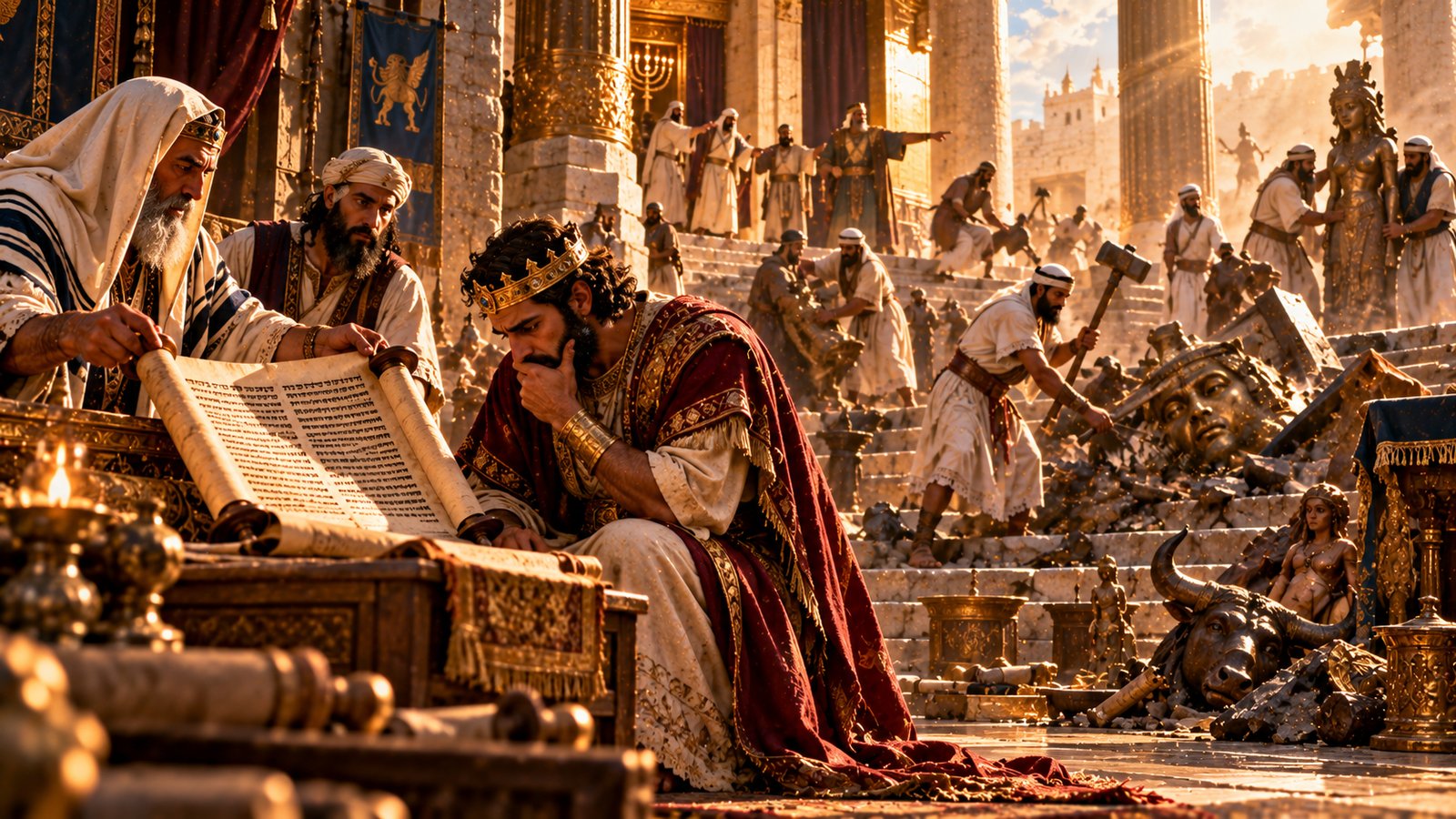
Setting: Judah and Jerusalem during Josiah's reign, especially the discovery of the Book of the Law and the Passover in his eighteenth year. Principal figures: Josiah, Hilkiah the high priest, Shaphan the scribe, Huldah the prophetess, and the people gathered at the Temple. Primary passages: 2 Kings 22–23; 2 Chronicles 34–35.
Jerusalem survived Assyria's threats, but deliverance did not make the next generations faithful. After Hezekiah, the reigns of Manasseh and Amon brought renewed idolatry. Josiah inherited a kingdom deeply marked by that departure. He became king at eight years old and later began seeking the God of David (2 Chronicles 34:1–3). The Temple again stands at the center of the story. During repairs to its fabric, a book is found that exposes the condition of the people's lives. The place where God meets His people must also be the place where His word is heard and obeyed.
A Book Found in the House of God
8Hilkiah the high priest said to Shaphan the scribe, “I have found the book of the law in Yahweh’s house.” Hilkiah delivered the book to Shaphan, and he read it.
9Shaphan the scribe came to the king, and brought the king word again, and said, “Your servants have emptied out the money that was found in the house, and have delivered it into the hands of the workmen who have the oversight of Yahweh’s house.”
10Shaphan the scribe told the king, saying, “Hilkiah the priest has delivered a book to me.” Then Shaphan read it before the king.
11When the king had heard the words of the book of the law, he tore his clothes.
The repair work matters, and the workers are commended for faithfulness (2 Kings 22:3–7). Yet repairing the building brings an encounter with a deeper authority. Hilkiah finds the Book of the Law, and Shaphan reads it to Josiah.
Chronicles identifies it as the book of the Lord's law given by Moses (2 Chronicles 34:14). The narratives do not describe the scroll's precise contents or explain exactly how long it had been missing. We should not invent those details. What matters here is the authority of the words Josiah hears.
Chronicles also places Josiah's seeking God and initial cleansing of the land before this discovery. The book does not create his first interest in the Lord; its reading deepens and directs his response. A person already pursuing reform must still let Scripture search and correct him.
The King Lets the Word Judge Him
12The king commanded Hilkiah the priest, Ahikam the son of Shaphan, Achbor the son of Micaiah, Shaphan the scribe, and Asaiah the king’s servant, saying,
13“Go inquire of Yahweh for me, and for the people, and for all Judah, concerning the words of this book that is found; for great is Yahweh’s wrath that is kindled against us, because our fathers have not listened to the words of this book, to do according to all that which is written concerning us.”
Josiah recognizes the distance between God's covenant and the nation's conduct. His torn clothes express grief, but he does more than react emotionally. He sends to inquire of the Lord about what the people have heard.
The delegation goes to Huldah the prophetess. She confirms judgment because Judah has forsaken the Lord and worshiped other gods. She also announces that God has heard Josiah's humble, tenderhearted response and that he will not see the coming national devastation (2 Kings 22:14–20).
Huldah does not soften the message to flatter the king. God's word confronts both ruler and nation, and Josiah receives it as something to obey. The sanctuary cannot be treated as proof that everything is well while the covenant is being disregarded.
The Lie and the Truth: Can Neglected Truth Stay Neglected?
The lie is that inherited religious practice can continue safely without being tested by God's word. The truth is that His word remains authoritative even when a community has forgotten, ignored, or contradicted it.
Josiah cannot undo the past, but he can respond faithfully in his own generation. Faith is fundamentally trusting our good Father, including trusting His correction more than the comfort of familiar habits. A tender heart allows the truth to change its direction.
The People Hear the Covenant Together
1The king sent, and they gathered to him all the elders of Judah and of Jerusalem.
2The king went up to Yahweh’s house, and all the men of Judah and all the inhabitants of Jerusalem with him—with the priests, the prophets, and all the people, both small and great; and he read in their hearing all the words of the book of the covenant which was found in Yahweh’s house.
3The king stood by the pillar and made a covenant before Yahweh to walk after Yahweh and to keep his commandments, his testimonies, and his statutes with all his heart and all his soul, to confirm the words of this covenant that were written in this book; and all the people agreed to the covenant.
The book is brought from the king's hearing into the hearing of the gathered people. Leaders, ministers, and ordinary households stand under the same word. The Temple becomes the setting for covenant renewal.
Josiah commits himself to wholehearted obedience. The people agree, but the chapters that follow will show how much a nation needs more than a public declaration. A faithful leader can call a community toward obedience; each generation still must respond.
For our worshiping communities, Scripture must shape what we teach, celebrate, and practice. Its reading is not an ornament added to an otherwise self-directed religious life. We gather before the God whose word governs us.
Repentance Removes Competing Worship
4The king commanded Hilkiah the high priest, and the priests of the second order, and the keepers of the threshold, to bring out of Yahweh’s temple all the vessels that were made for Baal, for the Asherah, and for all the army of the sky; and he burned them outside of Jerusalem in the fields of the Kidron, and carried their ashes to Bethel.
5He got rid of the idolatrous priests whom the kings of Judah had ordained to burn incense in the high places in the cities of Judah and in the places around Jerusalem; those also who burned incense to Baal, to the sun, to the moon, to the planets, and to all the army of the sky.
6He brought out the Asherah from Yahweh’s house, outside of Jerusalem, to the brook Kidron, and burned it at the brook Kidron, and beat it to dust, and cast its dust on the graves of the common people.
The extent of the pollution is startling: objects connected with rival worship had entered the Lord's own Temple. Josiah's response reaches the sanctuary, Jerusalem, and the wider land. He also desecrates Topheth, where children had been made to pass through fire, and dismantles the altar at Bethel associated with Jeroboam (2 Kings 23:10, 15).
The story deliberately reaches back to earlier chapters. Solomon's compromised worship and Jeroboam's rival sanctuary are named among the practices Josiah confronts (2 Kings 23:13–15). Choices made long before him had become institutions. Hearing God's word requires him to address their continuing influence.
These are acts within ancient Israel's covenant and royal order. The Christian application is wholehearted repentance, obedience, and the rejection of idols in our own lives; Josiah's royal judgments are not the Church's instructions for enforcing worship. Through Jesus, we call people to faith and serve in the power of His Spirit.
Remembering the God Who Redeemed Them
21The king commanded all the people, saying, “Keep the Passover to Yahweh your God, as it is written in this book of the covenant.”
22Surely there was not kept such a Passover from the days of the judges who judged Israel, nor in all the days of the kings of Israel, nor of the kings of Judah;
23but in the eighteenth year of King Josiah, this Passover was kept to Yahweh in Jerusalem.
Reform includes restored worship. Passover recalls the Lord's rescue from Egypt and brings the people back to their identity as those He redeemed. Chronicles describes the preparations, the ministry of priests and Levites, and generous provision for the assembled worshipers (2 Chronicles 35:1–19).
The comparison celebrates the exceptional character of this Passover. It does not require us to erase the celebration under Hezekiah that we have just studied. Both accounts testify to meaningful returns to the Lord's appointed worship.
A Faithful Response amid Unfinished Consequences
25There was no king like him before him, who turned to Yahweh with all his heart, and with all his soul, and with all his might, according to all the law of Moses; and there was none like him who arose after him.
26Notwithstanding, Yahweh didn’t turn from the fierceness of his great wrath, with which his anger burned against Judah, because of all the provocation with which Manasseh had provoked him.
27Yahweh said, “I will also remove Judah out of my sight, as I have removed Israel; and I will cast off this city which I have chosen, even Jerusalem, and the house of which I said, ‘My name shall be there.’ ”
Scripture honors Josiah's wholehearted return and still announces coming judgment. His obedience is real; it does not erase the nation's accumulated rebellion or guarantee the faithfulness of those who follow him.
Josiah later dies after confronting Egypt's king at Megiddo. Chronicles records that, in this encounter, he failed to heed words that came from God (2 Chronicles 35:20–24). The reforming king also needed continuing discernment and obedience. His earlier faithfulness did not make him incapable of a later mistake.
Huldah's promise of being gathered to his grave in peace must be read alongside that violent death. In its immediate context, it includes the assurance that he would not witness Judah's coming devastation. The tension should not be hidden or turned into a claim that he died without violence.
Josiah's Reform Reaches the Remnant of Israel
Judah remains the southern kingdom, while the northern kingdom has already fallen. Josiah's reforms reach into former northern territory, and contributions for the Temple include people from Manasseh, Ephraim, and the remnant of Israel (2 Chronicles 34:6–9). God's covenant continues to address the descendants of Jacob across political division and loss. The approaching judgment will not cancel the larger story of His promises, the coming Messiah, and His purpose to dwell with a redeemed people.
Through Jesus, the Word Takes Root in the Heart
22But be doers of the word, and not only hearers, deluding your own selves.
23For if anyone is a hearer of the word and not a doer, he is like a man looking at his natural face in a mirror;
24for he sees himself, and goes away, and immediately forgets what kind of man he was.
25But he who looks into the perfect law of freedom and continues, not being a hearer who forgets but a doer of the work, this man will be blessed in what he does.
James brings the question directly into Christian life: does hearing become doing? We can possess a Bible, quote its words, and still resist the correction it gives. Scripture invites a response that continues after the moment of conviction.
Through Jesus, the mediator of the new covenant, God provides more than a public pledge to improve. The promise announced to Israel and Judah includes His law written within and sins forgiven (Hebrews 8:6–12). Believing Jews and Gentiles are brought near through Christ and built together into God's dwelling by the Spirit (Ephesians 2:11–22).
We obey as people welcomed by grace, not as people trying to earn adoption. The Holy Spirit teaches and empowers the Father's children to live in His truth. Josiah's response helps us recognize the humility that welcomes that work.
The House and the Heard Word
Here the Temple is the place where the covenant book is found and the people gather to hear it. Its repair must be joined with their return to the God who speaks. The worship He ordains governs the life of the community.
Our journey leads toward the New Jerusalem, where God and the Lamb are the temple and His servants see His face (Revelation 21:22; 22:3–4). Until then, we learn to live before Him with listening hearts. A Bible kept nearby becomes transformative as we receive and obey its truth through the Spirit.
Temple Prayer Response: Give Me a Tender Heart
You do not need a formula to respond to what you have just read. Here is a sample prayer to begin with. Make it your own, and keep going in your own words.
Father, thank You for speaking truth that brings me back to You. Forgive me for the passages I have ignored and the habits I have protected from Your correction. Jesus, thank You for forgiving my sin and bringing me into the Father's family. Holy Spirit, give me a tender heart. Help me understand Scripture faithfully and put it into practice. Show me the next act of obedience, and let my worship become a life that agrees with Your word. Amen.
Now open a passage you have been studying and ask what response it calls for. Confess what needs to change, choose a practical act of obedience, and continue in your own words.
2 Kings 22–23; 2 Chronicles 34–35; James 1:19–27; Hebrews 8:6–12; Ephesians 2:11–22; Revelation 21:22; 22:3–4.
Scripture quotations are from the World English Bible (WEB), public domain (ebible.org/eng-web), and were checked against that text (2 Kings 22 and 23, and James 1). Kings and Chronicles arrange and emphasize the reforms differently; Chronicles records Josiah's seeking God and initial purge before the book's discovery. The scroll's exact extent and textual history are debated; the chapter follows the biblical description without claiming to identify its physical contents. Huldah's promise concerning Josiah and the later account of his violent death are presented together rather than silently harmonized. The illustration is an artistic composite, not a reconstruction of one scene, and its visible scroll lettering and arrangement of furniture are not historical evidence. The lie/truth framing is an editorial teaching device.