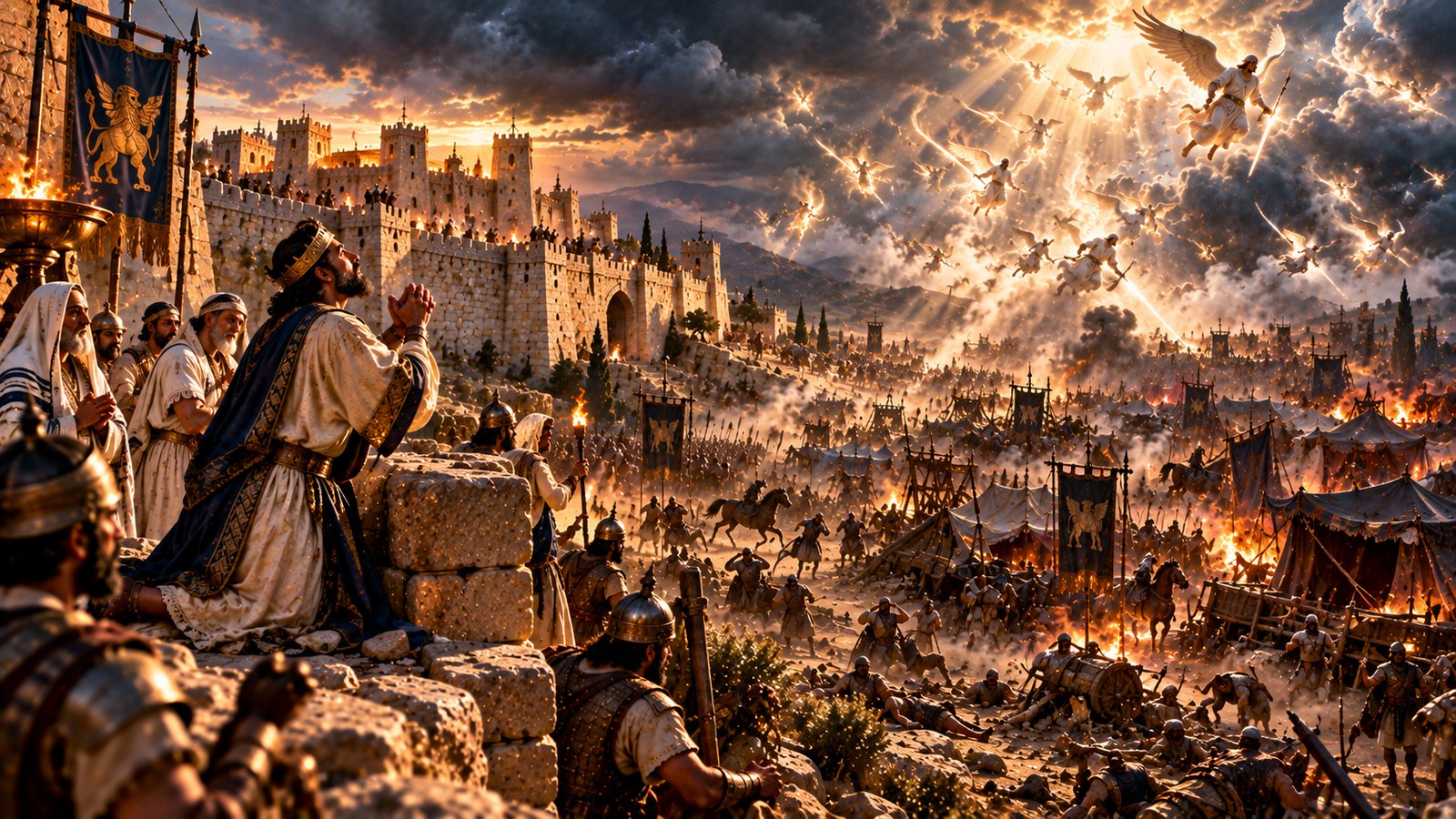
Setting: Judah and Jerusalem during Sennacherib's Assyrian campaign, commonly dated to 701 BC. Principal figures: Hezekiah, Isaiah, Sennacherib, and the people of Jerusalem. Primary passages: 2 Kings 18–19; Isaiah 36–37; 2 Chronicles 32.
Hezekiah reopened the Temple, restored its service, and called people to return to the Lord. Now the king's trust faces a terrifying test. Assyria has already conquered the northern kingdom. Sennacherib invades Judah, captures fortified cities, and sends representatives to Jerusalem. The God worshiped at the restored sanctuary is publicly mocked as powerless to save. The Temple becomes the place where Hezekiah brings the threat before the Lord. This chapter carries the story from restored worship into urgent intercession: will Judah trust the living God when a powerful enemy insists that faith is foolish?
Faithfulness Does Not Prevent Every Crisis
7“Be strong and courageous. Don’t be afraid or dismayed because of the king of Assyria, nor for all the multitude who is with him; for there is a greater one with us than with him.
8An arm of flesh is with him, but Yahweh our God is with us to help us and to fight our battles.” The people rested themselves on the words of Hezekiah king of Judah.
Chronicles introduces the invasion after Hezekiah's acts of faithfulness (2 Chronicles 32:1). Returning to God has not removed every danger. The king strengthens defenses, organizes the people, and takes measures concerning the water supply. Trusting God includes responsible action (2 Chronicles 32:2–6).
Kings also records Hezekiah's attempt to satisfy Sennacherib with tribute, including silver and gold taken from the Temple (2 Kings 18:14–16). Scripture does not flatten him into a hero who never struggles. Under pressure, this reforming king must learn again where his security rests.
The Enemy Tries to Redefine God
Assyria's spokesman addresses the people in their own language, using fear to weaken their resolve. He appeals to Assyria's victories and asks why Jerusalem's God should prove different from the gods of conquered nations (2 Kings 18:28–35).
He also misrepresents Hezekiah's reforms. Removing unauthorized high places is presented as an offense against the very God Hezekiah trusts (2 Kings 18:22). Obedience is made to sound like the reason they should expect defeat.
The accusation reaches beyond military strength. It challenges God's trustworthiness and treats the Creator as another local deity. We have heard a version of this challenge since Eden: can the One who speaks really be trusted?
A King Enters the Place of Prayer
1When King Hezekiah heard it, he tore his clothes, covered himself with sackcloth, and went into Yahweh’s house.
2He sent Eliakim, who was over the household, Shebna the scribe, and the elders of the priests, covered with sackcloth, to Isaiah the prophet the son of Amoz.
Hezekiah responds with humility. He enters the Lord's house and seeks the prophet's intercession. The king who called others to worship now comes as a man who needs help.
God answers through Isaiah, telling him not to fear the blasphemous words and announcing that the Assyrian king will return to his own land (2 Kings 19:5–7). Yet another message of intimidation follows. Receiving God's word does not immediately silence every competing voice.
The Letter Is Real; the Lord Is Greater
14Hezekiah received the letter from the hand of the messengers and read it. Then Hezekiah went up to Yahweh’s house, and spread it before Yahweh.
15Hezekiah prayed before Yahweh, and said, “Yahweh, the God of Israel, enthroned above the cherubim, you are the God, even you alone, of all the kingdoms of the earth. You have made heaven and earth.
16Incline your ear, Yahweh, and hear. Open your eyes, Yahweh, and see. Hear the words of Sennacherib, which he has sent to defy the living God.
Hezekiah reads the letter. Faith does not require him to pretend its contents are harmless. He carries the actual threat into the place of worship and spreads it before the Lord.
His prayer begins with who God is. The Lord enthroned above the cherubim is the Creator and God of every kingdom. The sanctuary's imagery recalls His covenant presence, while the prayer declares that His authority reaches far beyond Jerusalem.
The account does not say Hezekiah entered the Most Holy Place or handled the Ark. He went to the Lord's house to pray. Bringing the letter is an expression of dependence, not a ritual that forces an answer.
An Honest Prayer for Rescue and God's Honor
17Truly, Yahweh, the kings of Assyria have laid waste the nations and their lands,
18and have cast their gods into the fire; for they were no gods, but the work of men’s hands, wood and stone. Therefore they have destroyed them.
19Now therefore, Yahweh our God, save us, I beg you, out of his hand, that all the kingdoms of the earth may know that you, Yahweh, are God alone.”
Hezekiah acknowledges Assyria's destruction. He distinguishes the living God from the manufactured gods that could be burned. His request is direct: save us. Its purpose reaches outward, so that the kingdoms may know the Lord.
This is a pattern we can learn from without turning it into a formula. Name God's character, tell Him the truth about the danger, ask plainly for help, and seek His honor in the answer. Temple Prayer brings our real circumstances into relationship with the Father.
The Lie and the Truth: Does Visible Power Have the Final Word?
The lie is that an enemy's record of success determines what God can do. God's truth is that He reigns over nations, hears prayer, and remains faithful to His purposes. Assyria's power is real, but it is accountable to Him.
Faith is fundamentally trusting our good Father. Hezekiah does not have to become stronger than Assyria before he can pray. He comes to the One whose wisdom and authority exceed the crisis.
God Answers with His Own Commitment
32“Therefore Yahweh says concerning the king of Assyria, ‘He will not come to this city, nor shoot an arrow there. He will not come before it with shield, nor cast up a mound against it.
33He will return the same way that he came, and he will not come to this city,’ says Yahweh.
34‘For I will defend this city to save it, for my own sake and for my servant David’s sake.’ ”
God's message through Isaiah explicitly acknowledges Hezekiah's prayer (2 Kings 19:20). The answer exposes Assyria's arrogance and promises a future for Judah's remnant (2 Kings 19:21–31). The city's deliverance rests on the Lord's own purpose and His commitment connected with David.
The promise is specific to this event. It does not make Jerusalem permanently immune to judgment. Later generations will discover that possessing the Temple cannot protect persistent rebellion. We must receive both truths: the Lord truly saves here, and this rescue never becomes permission to disregard Him.
The Army Cannot Overrule the Lord
35That night, Yahweh’s angel went out and struck one hundred eighty-five thousand in the camp of the Assyrians. When men arose early in the morning, behold, these were all dead bodies.
36So Sennacherib king of Assyria departed, went home, and lived at Nineveh.
37As he was worshiping in the house of Nisroch his god, Adrammelech and Sharezer struck him with the sword; and they escaped into the land of Ararat. Esar Haddon his son reigned in his place.
The narrator attributes the devastating blow to Yahweh's angel. Sennacherib withdraws, and the chapter later records his death in the house of his own god. The narrative's compressed ending should not be read as saying that his assassination happened immediately after the withdrawal.
We need not invent an explanation for how the army was struck. Scripture identifies divine intervention without supplying a medical or military mechanism. Its central declaration is that the Lord's word prevailed and Jerusalem was delivered.
A Rescue That Carries the Story Toward the Messiah
The northern kingdom has fallen, but Judah and Jerusalem remain. Hezekiah prays to the God of Israel, and the promise concerning David places this rescue within God's continuing covenant purposes. Preserving Judah at this moment carries the story forward toward the Messiah from David's line. Gentile believers later share in God's promises through Jesus; they do not take this event as evidence that Israel's identity or promises have been erased.
Through Jesus, Confidence in the Father's Love
31What then shall we say about these things? If God is for us, who can be against us?
32He who didn’t spare his own Son, but delivered him up for us all, how would he not also with him freely give us all things?
Our confidence rests most deeply in the Father's gift of His Son. Through Jesus, we draw near as children, and the Holy Spirit helps us pray in our weakness (Romans 8:15–16, 26–27). The Father's love is not something we must prove afresh by demanding a particular outcome.
Romans 8 also names suffering, persecution, danger, and death while declaring that nothing can separate believers from God's love in Christ (Romans 8:35–39). Jerusalem's rescue encourages bold prayer; it does not promise that every believer will escape every earthly loss. Jesus' resurrection secures the final victory beyond death itself.
A Threat Spread Before His Throne
Here the Temple is the place where a frightened king lays the crisis before the reigning God. Prayer joins the earthly sanctuary to heaven's authority. God hears, speaks through His prophet, and acts according to His covenant purpose.
Today Christ opens our access to the Father, and the Spirit dwells in His people (Ephesians 2:18–22). We can bring the actual letter, diagnosis, conflict, or fear before Him. Our journey ends in the New Jerusalem, where God and the Lamb are the temple and death is gone (Revelation 21:4, 22). The rescue of this earthly city is one chapter in that greater story.
Temple Prayer Response: This Is What I Am Facing
You do not need a formula to respond to what you have just read. Here is a sample prayer to begin with. Make it your own, and keep going in your own words.
Father, You made heaven and earth, and this situation is not beyond Your sight. Here is what I am facing. Forgive me for treating fear as a more reliable voice than Your word. Jesus, thank You that Your death and resurrection reveal the Father's love and open the way for me to draw near. Holy Spirit, help me pray honestly, take the steps of obedience before me, and trust the Father with what I cannot control. Bring Your help, and let Your name be honored. Amen.
Now name the specific concern you want to place before Him. Ask for His help and wisdom, listen with Scripture open, and continue in your own words.
2 Kings 18–19; Isaiah 36–37; 2 Chronicles 32; Romans 8:15–17, 26–39; Ephesians 2:18–22; Hebrews 4:14–16; Revelation 21:4, 22.
Scripture quotations are from the World English Bible (WEB), public domain (ebible.org/eng-web), and were checked against that text (2 Chronicles 32, 2 Kings 19, and Romans 8). Quotations follow 2 Kings rather than silently combining its wording with Isaiah's parallel account. The campaign is commonly dated to 701 BC; the relationship among biblical regnal notices and historical chronology is discussed by scholars. Second Kings 19:35 identifies Yahweh's angel and gives the number of those struck without describing a physical mechanism. The chapter's final verses compress the withdrawal and Sennacherib's later death. The illustration is an artistic composite: its multiple visible angels, camp fires, and placement of the praying king are not details established by the account. The lie/truth framing is an editorial teaching device.