Setting: Judah and Jerusalem during Hezekiah's reign, in the late eighth century BC. These reforms belong to the years overlapping the northern kingdom's final crisis; exact regnal chronology and the dating of the Passover are debated. Principal figures: Hezekiah, the priests and Levites, and worshipers from Judah and the northern tribes. Primary passages: 2 Chronicles 29–31; 2 Kings 18:1–6.
The northern kingdom's fall showed the consequences of refusing God's warnings. Now our journey returns to the overlapping years of Hezekiah's reign in Judah. The contrast is striking: while generations of substituted worship had hardened many hearts, another king called people back to the Lord's appointed meeting place. Jerusalem's Temple still stood, but its doors had been shut and its service neglected. Reform began by reopening what unfaithfulness had closed.
The Meeting Place Must Be Cleansed
3In the first year of his reign, in the first month, he opened the doors of Yahweh’s house and repaired them.
4He brought in the priests and the Levites and gathered them together into the wide place on the east,
5and said to them, “Listen to me, you Levites! Now sanctify yourselves, and sanctify the house of Yahweh, the God of your fathers, and carry the filthiness out of the holy place.
6For our fathers were unfaithful, and have done that which was evil in Yahweh our God’s sight, and have forsaken him, and have turned away their faces from the habitation of Yahweh, and turned their backs.
Hezekiah names the problem plainly. The previous generation had turned its back on the Lord. The closed doors, extinguished lamps, and neglected offerings expressed a deeper abandonment of the God whose presence gave the sanctuary its meaning (2 Chronicles 29:7).
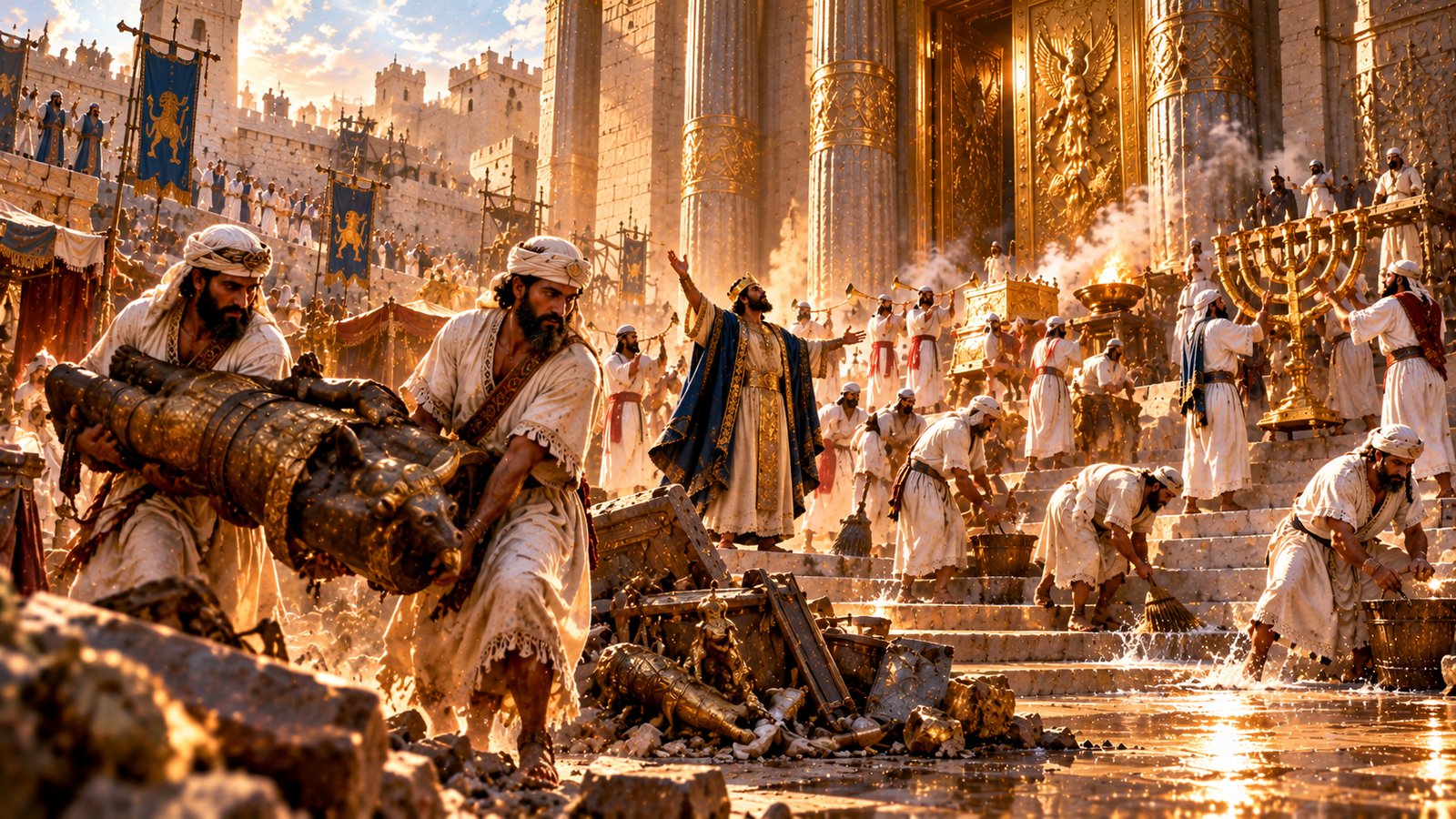
The king therefore addresses the ministers before the building. They must consecrate themselves and then cleanse the house. The priests and Levites respond, carrying uncleanness out and restoring the altar, the table of showbread, and the vessels needed for service (2 Chronicles 29:15–19).
Repentance has practical work to do. Opening a door while leaving the pollution inside would not restore faithful worship. In our lives, receiving God's correction may require confession, abandoning a habit, repairing harm, or removing something we have allowed to compete with Him.
Restoration Follows God's Word
25He set the Levites in Yahweh’s house with cymbals, with stringed instruments, and with harps, according to the commandment of David, of Gad the king’s seer, and Nathan the prophet; for the commandment was from Yahweh by his prophets.
26The Levites stood with David’s instruments, and the priests with the trumpets.
27Hezekiah commanded them to offer the burnt offering on the altar. When the burnt offering began, Yahweh’s song also began, along with the trumpets and instruments of David king of Israel.
28All the assembly worshiped, the singers sang, and the trumpeters sounded. All this continued until the burnt offering was finished.
Sacrifice, priestly ministry, music, and the worshiping assembly come together again. Earlier in the chapter, the king commands offerings for all Israel (2 Chronicles 29:20–24). Worship is being restored according to the word God had given, including the directions associated with David and the prophets.
This is the opposite of Jeroboam's approach. Jeroboam arranged worship around the security of his throne. Hezekiah restores the service of the Lord's house under God's authority. The assembly's gladness grows within that return to obedience.
The sanctuary becomes again a place where God's people acknowledge His rule through the worship He ordains. Music matters, but the story includes cleansing, atonement, willing offerings, and bowed hearts. Renewal reaches beyond a powerful song.
Even a Sacred Memory Can Become an Idol
4He removed the high places, broke the pillars, and cut down the Asherah. He also broke in pieces the bronze serpent that Moses had made, because in those days the children of Israel burned incense to it; and he called it Nehushtan.
5He trusted in Yahweh, the God of Israel, so that after him was no one like him among all the kings of Judah, nor among them that were before him.
6For he joined with Yahweh. He didn’t depart from following him, but kept his commandments, which Yahweh commanded Moses.
The bronze serpent had a genuine place in Israel's history. God had instructed Moses to make it during the wilderness crisis (Numbers 21:4–9). But people were now burning incense to it. A remembered instrument of God's provision had become an object of misplaced devotion.
Hezekiah's trust required him to remove it. An object's important history did not authorize its misuse. The same warning applies to us when we give a ministry method, treasured experience, or religious object the trust that belongs to God.
The Lie and the Truth: Is It Too Late to Return?
The lie is that inherited failure has made genuine renewal impossible, or that keeping familiar religious objects is enough. God's truth is that He calls His people to return with their hearts and their actions. A previous generation's unfaithfulness does not excuse the next generation's refusal to obey.
Faith is fundamentally trusting our good Father. Here that trust means believing His mercy is real enough to come back, and His holiness matters enough to put away what He has forbidden.
An Invitation Beyond Judah
8Now don’t be stiff-necked, as your fathers were, but yield yourselves to Yahweh, and enter into his sanctuary, which he has sanctified forever, and serve Yahweh your God, that his fierce anger may turn away from you.
9For if you turn again to Yahweh, your brothers and your children will find compassion with those who led them captive, and will come again into this land, because Yahweh your God is gracious and merciful, and will not turn away his face from you if you return to him.”
Hezekiah sends couriers through Israel and Judah, inviting the people to celebrate Passover in Jerusalem. The message names the God of Abraham, Isaac, and Israel and addresses survivors of Assyrian attacks (2 Chronicles 30:1–7). Shared covenant history remains stronger than the boundaries created by divided kingdoms.
Some ridicule the messengers. Others humble themselves and come, including men from Asher, Manasseh, and Zebulun (2 Chronicles 30:10–12). The invitation exposes a choice: mock the call or receive the mercy it announces.
The assembly celebrates in the second month because the priests and people had not been ready in the first. Numbers 9:9–12 already provided for a second-month Passover in specified circumstances; Chronicles records how Hezekiah and the assembly addressed their wider situation. Their purpose is a genuine return, not the invention of a rival feast.
Mercy for People Whose Hearts Are Turning
18For a multitude of the people, even many of Ephraim, Manasseh, Issachar, and Zebulun, had not cleansed themselves, yet they ate the Passover other than the way it is written. For Hezekiah had prayed for them, saying, “May the good Yahweh pardon everyone
19who sets his heart to seek God, Yahweh, the God of his fathers, even if they aren’t clean according to the purification of the sanctuary.”
20Yahweh listened to Hezekiah, and healed the people.
The account acknowledges the problem rather than pretending every requirement was met. Hezekiah intercedes, appealing to God's goodness for people who have set their hearts to seek Him. The Lord hears and heals.
Mercy does not make holiness irrelevant. The surrounding chapters are full of consecration and restored obedience. Here mercy meets imperfect people who are returning. God's response gives us courage to seek Him honestly instead of waiting until we imagine we can approach without needing grace.
The celebration becomes so joyful that the assembly agrees to continue another seven days. Priests bless the people, and their prayer reaches God's holy dwelling in heaven (2 Chronicles 30:23–27). Once again, the earthly meeting place directs our attention to the God who hears from heaven.
Descendants of Jacob Invited Home
Judah is the southern kingdom, but the invitation addresses the wider descendants of Jacob. Northern Israelites and foreigners join the assembly, showing that political division and Assyrian devastation have not erased every connection to covenant worship (2 Chronicles 30:25). This is a gathering within Israel's history, before the New Testament Church. It prepares us to recognize God's continuing purpose to bring His people near without treating Israel as a discarded part of the story.
Renewal Must Continue After the Gathering
20Hezekiah did so throughout all Judah; and he did that which was good, right, and faithful before Yahweh his God.
21In every work that he began in the service of God’s house, in the law, and in the commandments, to seek his God, he did it with all his heart and prospered.
The festival leads into practical reform. Participants remove idolatrous worship sites, and Hezekiah organizes priestly service, offerings, storage, and distribution (2 Chronicles 31:1–19). Worship requires faithful stewardship after the crowd goes home.
For us, a season of renewed prayer should become a life of sustained obedience: time given to Scripture, habits brought under correction, generosity, and faithful service. An emotional beginning needs a continuing response.
Hezekiah's prosperity is not a promise that obedience eliminates every crisis. Assyria will soon threaten Judah. The next chapter will test the same trust that has reopened the Temple doors.
Through Jesus, a People Restored for Worship
9But you are a chosen race, a royal priesthood, a holy nation, a people for God’s own possession, that you may proclaim the excellence of him who called you out of darkness into his marvelous light.
10In the past, you were not a people, but now are God’s people, who had not obtained mercy, but now have obtained mercy.
Through Jesus' sacrifice and priestly ministry, believers draw near to the Father (Hebrews 10:19–22). We do not repeat the animal offerings Hezekiah restored. Christ has provided the decisive sacrifice, and His people offer spiritual sacrifices acceptable through Him (1 Peter 2:4–5).
God welcomes us as His children before calling us into priestly service. His Spirit dwells in believers, forming a living temple of believing Jews and Gentiles together (Romans 8:15–16; Ephesians 2:11–22). Hezekiah's reform gives us an earlier picture of returning to God's appointed worship; it does not establish a mandatory ceremony for Christian renewal.
Reopened Doors and Listening Hearts
Here God's people return to His house in Jerusalem, where consecration, sacrifice, praise, and intercession restore the life of worship. The building's service matters because it belongs to the Lord, and the worshipers' hearts matter because they belong to Him too.
The journey continues toward the New Jerusalem, where God's servants worship Him and see His face (Revelation 22:3–4). Hezekiah's reopened doors anticipate the joy of restored fellowship, while Jesus supplies the lasting access no earthly reform could accomplish.
Temple Prayer Response: Return with My Whole Heart
You do not need a formula to respond to what you have just read. Here is a sample prayer to begin with. Make it your own, and keep going in your own words.
Father, thank You that You are gracious and merciful toward those who return to You. Forgive me for neglected worship and divided loyalties. Jesus, thank You for cleansing me and opening the way to the Father. Holy Spirit, show me what I need to put away and what faithful habit I need to restore. Teach me to minister to You with thanksgiving, repentance, and an obedient heart. Let this return become a continuing walk with You. Amen.
Now be still for a moment. Ask Him what has crowded out your attention to Him and what practical step will express your return today. Test what comes to mind by Scripture, and continue in your own words.
2 Chronicles 29–31; 2 Kings 18:1–12; Numbers 9:9–14; 21:4–9; Romans 8:15–16; Ephesians 2:11–22; Hebrews 10:19–22; 1 Peter 2:4–10; Revelation 22:3–4.
Scripture quotations are from the World English Bible (WEB), public domain (ebible.org/eng-web), and were checked against that text (2 Chronicles 29, 30, and 31, 2 Kings 18, and 1 Peter 2). The sequence of our chapters is thematic as well as historical; Hezekiah's reign overlaps the northern kingdom's final years, and chronological reconstructions differ. The second-month celebration is discussed alongside Numbers 9 without claiming that the situations are identical. The illustration is an artistic composite, not a reconstruction of one documented moment. The Ark belonged in the Most Holy Place, so no placement of sacred furniture outside in the artwork should be understood as a detail of Hezekiah's reform. The lie/truth framing is an editorial teaching device.