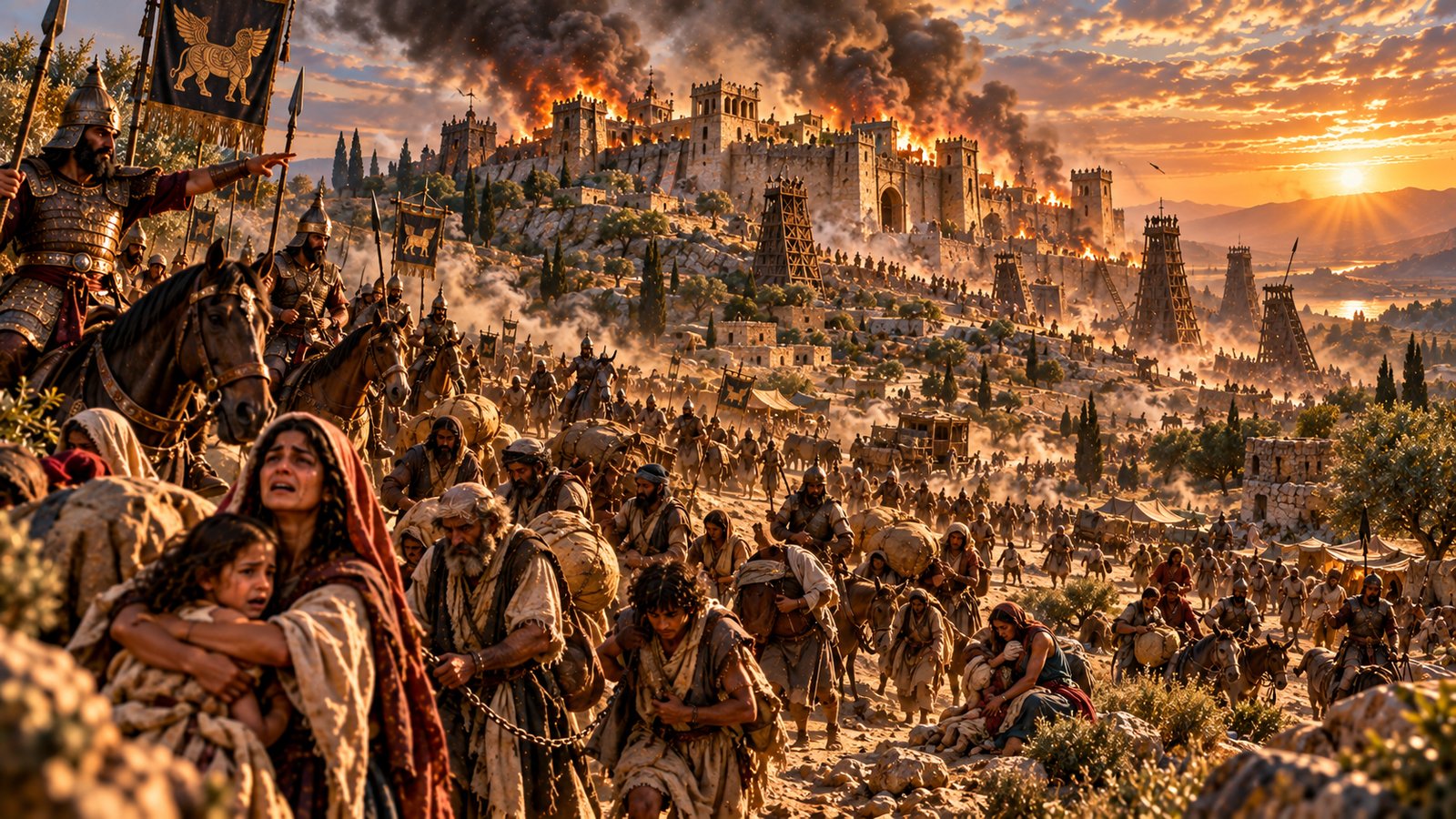
Setting: Samaria and the northern kingdom of Israel in the late eighth century BC, with Samaria's fall commonly dated to 722–721 BC. Principal figures: Hoshea, the Assyrian rulers, the people of Israel, and the prophets whose warnings they rejected. Primary passages: 2 Kings 17; John 4:19–26; Romans 11.
At our last stop, Isaiah saw the holy King, received cleansing, and answered His call. His commission included a warning about people who would hear without understanding and a land facing devastation. Now we turn from Judah to the northern kingdom of Israel, where generations of rejected warnings reach a terrible outcome. Samaria falls to Assyria. Jerusalem and its Temple are still standing in Judah; this is the fall of the northern kingdom, not the later destruction of Solomon's Temple. The sanctuary thread runs directly through this tragedy. Jeroboam established rival places of worship so his people would not return to Jerusalem. Those places remained part of a national life increasingly shaped by idols. The question is now unavoidable: what happens when God's people keep their religious activity but refuse the God who governs their worship?
A Capital Besieged, a People Carried Away
5Then the king of Assyria came up throughout all the land, went up to Samaria, and besieged it three years.
6In the ninth year of Hoshea the king of Assyria took Samaria and carried Israel away to Assyria, and placed them in Halah, and on the Habor, the river of Gozan, and in the cities of the Medes.
7It was so because the children of Israel had sinned against Yahweh their God, who brought them up out of the land of Egypt from under the hand of Pharaoh king of Egypt, and had feared other gods,
8and walked in the statutes of the nations whom Yahweh cast out from before the children of Israel, and of the kings of Israel, which they made.
Hoshea had become subject to Assyria and paid tribute. He then sought support from Egypt and stopped making the payments, and the Assyrian king imprisoned him (2 Kings 17:1–4). The siege and deportations belong to that struggle between kingdoms and empires.
Yet Kings also gives the covenant explanation. The people had sinned against the very God who delivered them from Egypt. They had received freedom to belong to Him, but learned to fear other gods and follow other authorities.
The reversal is painful: a people brought out from bondage are now carried away from their land. Behind the national account stand households losing their homes and the familiar places of their lives. We should read the judgment with grief, remembering that Scripture names real human suffering.
The Warnings Were Invitations to Return
13Yet Yahweh testified to Israel and to Judah, by every prophet and every seer, saying, “Turn from your evil ways, and keep my commandments and my statutes, according to all the law which I commanded your fathers, and which I sent to you by my servants the prophets.”
14Notwithstanding, they would not listen, but hardened their neck like the neck of their fathers who didn’t believe in Yahweh their God.
God had spoken before the siege began. His prophets called both Israel and Judah to turn from evil and keep His word. The warning itself was an expression of His faithfulness: He confronted the people's direction and called them back.
Kings identifies unbelief beneath their stubbornness. They would not trust the Lord enough to receive His correction. The question that began in Eden remains before us: will God's people believe His word or follow another voice?
Faith is fundamentally trusting our good Father. That trust includes receiving correction when His commands challenge what we prefer. Religious familiarity can make us skilled at hearing the words without surrendering the choices those words address.
What They Worshiped Reshaped How They Lived
15They rejected his statutes and his covenant that he made with their fathers, and his testimonies which he testified to them; and they followed vanity, and became vain, and followed the nations that were around them, concerning whom Yahweh had commanded them that they should not do like them.
16They abandoned all the commandments of Yahweh their God, and made molten images for themselves, even two calves, and made an Asherah, and worshiped all the army of the sky, and served Baal.
17They caused their sons and their daughters to pass through the fire, used divination and enchantments, and sold themselves to do that which was evil in Yahweh’s sight, to provoke him to anger.
The two calves take us back to Jeroboam. His political solution became part of an enduring pattern of unfaithfulness. The account also names Asherah, heavenly bodies, Baal, divination, and the horror of children passing through fire.
Worship was shaping the community's life. Turning from God's covenant did not produce freedom from spiritual authority; it left people following destructive substitutes. Even their children suffered within the religious world adults embraced.
This is why the place of meeting matters throughout our journey. God's appointed worship taught a redeemed people to live under His word. Rival sanctuaries trained them to accept worship shaped by other loyalties. A shrine could look religious while leading people away from the Lord.
The Lie and the Truth: Can Substitutes Keep Us Safe?
The lie was that idols, inherited religious habits, and political power could secure a future while God's commands were ignored. The truth was that the Lord's warnings mattered, and no substitute could cancel the consequences of persistent covenant rebellion.
For us, the application begins with honest examination. What do we trust enough to obey? What do we protect from God's correction? Money, influence, and familiar routines can become places where we seek security without surrender. The answer is repentance and renewed trust in the Father.
The Long Reach of Jeroboam's Choice
22The children of Israel walked in all the sins of Jeroboam which he did; they didn’t depart from them
23until Yahweh removed Israel out of his sight, as he said by all his servants the prophets. So Israel was carried away out of their own land to Assyria to this day.
Kings deliberately connects the catastrophe with an earlier decision about worship. Jeroboam's fear produced institutions that outlived him. Later generations continued walking a path he helped establish.
Leaders' choices can shape a community long after the original crisis passes. Parents, teachers, pastors, and public leaders therefore need more than immediate results; we need faithfulness to the word of God. Convenience today can become a destructive inheritance tomorrow.
Judah is given no permission to feel superior. Second Kings 17:19 explicitly says that Judah also failed to keep God's commandments. Jerusalem's appointed Temple would not protect a people determined to resist its Lord.
Religion Returns, but the Divided Heart Remains
32So they feared Yahweh, and also made from among themselves priests of the high places for themselves, who sacrificed for them in the houses of the high places.
33They feared Yahweh, and also served their own gods, after the ways of the nations from among whom they had been carried away.
The chapter continues beyond the conquest. Assyria resettles people from other regions in Samaria's cities. After attacks by lions, a deported priest is sent back to teach them about the worship of the God of the land (2 Kings 17:24–28). Yet they retain their own gods.
The account describes religious acknowledgment alongside divided service. Verse 34 then denies that they truly fear Yahweh in the covenant sense. Recognition of His power has not become exclusive allegiance and obedience.
This episode contributes to the later history of Samaria, but it is not a complete account of Samaritan identity centuries afterward. We should not turn it into a simplistic judgment about every Samaritan. Jesus will meet people there with truth and mercy.
The Northern Kingdom and the Promises of God
Here Israel means the northern kingdom and its people, descended from Jacob; Judah remains as a separate southern kingdom. The conquest ends the northern kingdom's independent rule and brings deportation and resettlement. This national judgment does not mean God has erased Israel or transferred all His promises to a replacement people. Romans 11 will teach Gentile believers to receive mercy humbly, remembering that God can graft natural branches in again and that His gifts and calling are irrevocable (Romans 11:23–29).
Jesus Meets a Worshiper in Samaria
21Jesus said to her, “Woman, believe me, the hour is coming when neither in this mountain nor in Jerusalem will you worship the Father.
22You worship that which you don’t know. We worship that which we know; for salvation is from the Jews.
23But the hour comes, and now is, when the true worshipers will worship the Father in spirit and truth, for the Father seeks such to be his worshipers.
24God is spirit, and those who worship him must worship in spirit and truth.”
Centuries later, a Samaritan woman asks Jesus about the proper place of worship. He does not teach that all worship is equally true. He identifies salvation's Jewish setting and announces the worship the Father seeks.
Through Israel's Messiah, access to the Father opens beyond the dispute between mountains. John 4 moves from that conversation to Samaritans believing in Jesus as the Savior of the world (John 4:39–42). The land marked by a painful history becomes a place where people receive His word.
For the Church, believing Jews and Gentiles are built together into God's dwelling in the Spirit through Christ (Ephesians 2:11–22). We are welcomed as children and called to worship with undivided hearts. The lesson from Samaria remains urgent: acknowledging God while serving competing masters is not the worship He seeks.
A Warning That Calls for Humility
17But if some of the branches were broken off, and you, being a wild olive, were grafted in among them and became partaker with them of the root and of the richness of the olive tree,
18don’t boast over the branches. But if you boast, remember that it is not you who support the root, but the root supports you.
Paul's olive-tree picture rules out Gentile boasting. Sharing in God's promises is a gift of grace, and the warning about unbelief calls us to reverence and continuing faith (Romans 11:19–22).
We should therefore resist treating another person's suffering as proof that we know God's particular judgment on them. Second Kings supplies a revealed explanation for this covenant event. It does not authorize us to assign the same explanation to every modern disaster or defeat.
Returning to the One Who Speaks
In this chapter, the northern kingdom's high places stand as evidence of departure from God's appointed worship. The Lord still addresses His people through His prophets, calling them back to His covenant. The tragedy is that they refuse that word.
Our journey will eventually reach the New Jerusalem, where the Lord God Almighty and the Lamb are the temple and nothing unclean enters (Revelation 21:22–27). God's purpose remains fellowship with a holy, redeemed people. The proper response to Samaria's fall is to hear Him today and return wholeheartedly.
Temple Prayer Response: An Undivided Heart
You do not need a formula to respond to what you have just read. Here is a sample prayer to begin with. Make it your own, and keep going in your own words.
Father, thank You for speaking before I see where my choices are leading. Forgive me for ignoring Your correction or honoring You with words while serving another master. Jesus, thank You for bringing me to the Father in truth and mercy. Holy Spirit, expose the loyalties I have protected from You. Give me an undivided heart, and help me leave a faithful example for the people who follow me. Keep me humble toward Israel and grateful for Your grace. Amen.
Now be still for a moment. Ask Him what warning you have been postponing and what practical obedience would look like today. Test what comes to mind by Scripture, and continue in your own words.
1 Kings 12:25–33; 2 Kings 17; Isaiah 6:9–13; John 4:19–26, 39–42; Romans 11:1–5, 17–32; Ephesians 2:11–22; Revelation 21:22–27.
Scripture quotations are from the World English Bible (WEB), public domain (ebible.org/eng-web), and were checked against that text (2 Kings 17, John 4, and Romans 11). Second Kings 17 supplies the covenant explanation of the conquest. Samaria's fall is commonly dated to 722–721 BC; details of the transition between Shalmaneser V and Sargon II and the stages of conquest are discussed by historians. This chapter refers to the Assyrian conquest without assigning every stage to one ruler. The illustration is an artistic reconstruction, not an archaeological record of Samaria's appearance or the precise course of the siege. The account of resettlement is not a complete genealogy of later Samaritans. The lie/truth framing is an editorial teaching device.