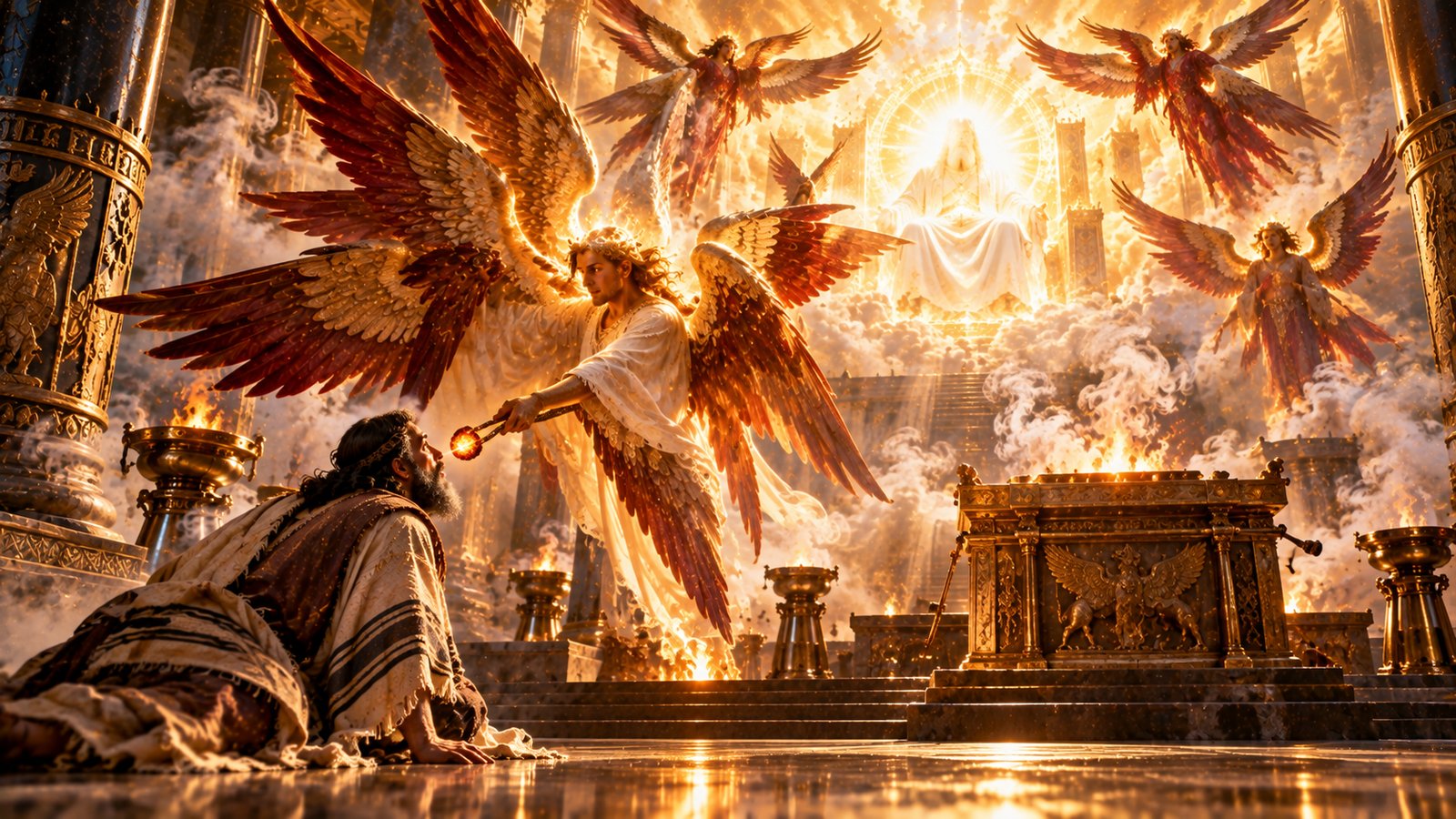
Setting: Jerusalem and Judah in the year King Uzziah died, commonly dated around 740 BC; exact chronology is debated. Principal figures: Isaiah, the Lord enthroned, and the seraphim. Primary passages: Isaiah 6; 2 Chronicles 26; John 12:37–43; Hebrews 10:19–23.
Our last chapter followed Jeroboam's fear into a system of rival worship. Now we move forward several generations, from the northern kingdom's substitute sanctuaries to a vision centered on the Lord's own throne and Temple. Israel and Judah remain divided. Isaiah ministers in Judah, where Jerusalem's Temple still stands. Yet possessing the appointed sanctuary does not mean the people are listening to the God who meets them there. This chapter opens a new part of our journey: the prophets will expose sin, announce judgment, and reveal hope that survives the coming devastation.
An Earthly King Dies; the True King Reigns
1In the year that King Uzziah died, I saw the Lord sitting on a throne, high and lifted up; and his train filled the temple.
2Above him stood the seraphim. Each one had six wings. With two he covered his face. With two he covered his feet. With two he flew.
3One called to another, and said, “Holy, holy, holy, is Yahweh of Armies! The whole earth is full of his glory!”
The meeting place is a Temple filled with the majesty of the King. Isaiah sees the Lord enthroned, His robe filling the sanctuary, and heavenly attendants declaring His holiness. The vision brings the Temple and the heavenly throne together; Isaiah does not give us a floor plan or explain precisely where he was standing when he saw it.
Uzziah's death marks a change in Judah's earthly leadership. The throne Isaiah sees remains occupied. The future of God's people rests ultimately with the Lord who reigns over them.
Uzziah's own history sharpens the contrast. After becoming strong, he proudly entered the Temple to burn incense, a responsibility assigned to Aaron's consecrated descendants. When priests confronted him, he became angry and was struck with leprosy (2 Chronicles 26:16–21). Isaiah's vision does not explicitly explain Uzziah's death through that incident, but the accounts together remind us that royal power never gives someone authority to redesign worship.
Even the seraphim cover themselves before the Lord. Their repeated declaration of holiness directs our attention to His incomparable majesty and purity. The whole earth belongs beneath that glory. The Temple reveals the King's presence without containing His reign.
The Presence That Exposes Our Need
4The foundations of the thresholds shook at the voice of him who called, and the house was filled with smoke.
5Then I said, “Woe is me! For I am undone, because I am a man of unclean lips and I live among a people of unclean lips, for my eyes have seen the King, Yahweh of Armies!”
The place shakes, and Isaiah's confidence in himself collapses. He recognizes the uncleanness of his own lips and the condition of the people among whom he lives. He cannot treat national sin as something entirely outside himself.
The contrast with Uzziah is searching. One man resisted correction in the sanctuary; the other acknowledges his need before the King. Isaiah does not bargain, offer excuses, or claim that being called as a prophet makes him exempt.
This is one reason worship must include repentance. God's presence brings us into truth about Him and ourselves. As the Holy Spirit exposes sinful speech, pride, or divided loyalty through Scripture, we can confess honestly. The good Father's holiness is not opposed to His goodness. His goodness will not leave us comfortable with what destroys fellowship.
Cleansing Comes from God's Provision
6Then one of the seraphim flew to me, having a live coal in his hand, which he had taken with the tongs from off the altar.
7He touched my mouth with it, and said, “Behold, this has touched your lips; and your iniquity is taken away, and your sin forgiven.”
Isaiah names his uncleanness; God provides cleansing. The coal comes from the altar, and the accompanying word announces that his guilt is removed and his sin forgiven. The initiative belongs to God.
Isaiah does not cleanse his own lips or earn forgiveness by volunteering for a difficult assignment. He receives mercy before he answers the call to serve. The order matters: the holy King makes provision for the person who cannot make himself clean.
The passage does not identify which altar Isaiah sees, and we should not turn the coal into an independent source of spiritual power. This is God's appointed action within the vision. It reveals His authority to forgive and prepare His servant.
The Lie and the Truth: Does My Guilt Have the Final Word?
The lie is that acknowledged guilt must end our usefulness forever, or that we must hide it to remain useful. God's truth is that He can cleanse and commission those who receive His mercy. Isaiah's confession leads to forgiveness and service.
This does not make sin trivial or promise that every consequence disappears. It gives us a reason to come into the light. Faith is fundamentally trusting our good Father: trusting His judgment about our sin and His provision for our cleansing.
A Cleansed Mouth Becomes a Willing Voice
8I heard the Lord’s voice, saying, “Whom shall I send, and who will go for us?” Then I said, “Here I am. Send me!”
The mouth Isaiah confessed as unclean now answers God's invitation. Worship becomes willingness. The encounter at the place of God's presence prepares him to carry God's message beyond it.
There is an echo of Moses at the burning bush: God makes Himself known, the person becomes conscious of His holiness, and an encounter becomes a calling. Each account has its own details, but both establish that God's presence directs His servants' lives.
For believers today, priestly worship also reaches into ordinary obedience. We draw near through Jesus, receive the Father's correction, and surrender our words and actions to Him. Ministering to God prepares us to serve the people He loves.
Sent to People Who Will Resist
9He said, “Go, and tell this people, ‘You hear indeed, but don’t understand. You see indeed, but don’t perceive.’
10Make the heart of this people fat. Make their ears heavy, and shut their eyes; lest they see with their eyes, hear with their ears, understand with their heart, and turn again, and be healed.”
The commission is sobering. Isaiah is not promised an eager audience. These words announce judicial hardening: his ministry will confront people whose resistance to God is already evident in the book's opening chapters (Isaiah 1–5). God's word exposes that resistance and becomes an instrument of judgment.
The relationship between human responsibility and divine hardening requires care. We should neither soften the warning into a mere misunderstanding nor suggest that God delights in sincere repentance being refused. Isaiah elsewhere urgently calls the wicked to return to the Lord for mercy (Isaiah 55:6–7). Here the warning is that persistent refusal to listen has devastating consequences.
Faithful service cannot be measured only by immediate popularity. Isaiah must speak what God gives him. We too must let Scripture correct us rather than selecting only the words we already find comfortable.
Judgment Will Come, but the Story Will Continue
11Then I said, “Lord, how long?” He answered, “Until cities are waste without inhabitant, houses without man, the land becomes utterly waste,
12and Yahweh has removed men far away, and the forsaken places are many within the land.
13If there is a tenth left in it, that also will in turn be consumed, as a terebinth, and as an oak whose stump remains when they are cut down, so the holy seed is its stump.”
Isaiah asks how long this condition will last. The answer reaches into devastation, depopulation, and removal from the land. Having the Temple will not make Judah immune to covenant judgment.
Yet the final image leaves a stump and a holy seed. Judgment is severe, even reaching what remains, but the imagery preserves a future beyond the cutting down. Later Isaiah will speak of a shoot coming from Jesse's stump (Isaiah 11:1). We should distinguish those passages while recognizing the wider book's movement toward hope through the promised King.
Judgment and a Remnant
At this point, Israel refers to the descendants of Jacob living in two divided kingdoms; Isaiah's immediate setting is Judah and Jerusalem. God confronts His covenant people through a prophet, exposing the failure that outward worship cannot conceal. Judgment and remnant hope both belong to their history; the passage does not announce that another people has replaced them. Later, believing Gentiles will share in God's promises through Israel's Messiah, and Paul will warn them against boasting over Israel (Romans 11:17–29).
The Glory of Jesus and Our Access to the Father
19Having therefore, brothers, boldness to enter into the holy place by the blood of Jesus,
20by the way which he dedicated for us, a new and living way, through the veil, that is to say, his flesh,
21and having a great priest over God’s house,
22let’s draw near with a true heart in fullness of faith, having our hearts sprinkled from an evil conscience and having our body washed with pure water,
23let’s hold fast the confession of our hope without wavering; for he who promised is faithful.
John 12:37–41 connects Isaiah's words about unbelief with Jesus and identifies the glory Isaiah saw with His glory. The holy King of Isaiah's vision belongs to the revelation that comes into fuller view in the Messiah.
Hebrews tells believers how we draw near: through Jesus' blood and priestly ministry. Our cleansing rests on His sacrifice. The coal is not a prayer technique to reproduce, and we do not need a new vision to obtain forgiveness. We trust the Savior God has provided.
Through Christ, believing Jews and Gentiles are built together into a dwelling place for God in the Spirit (Ephesians 2:11–22). Adoption welcomes us as the Father's children; His Spirit forms our lives for worship and service. Isaiah's encounter helps us recognize the holiness and mercy of the God who now dwells in His people.
From the Throne to the New Jerusalem
Here the meeting place is the Temple in a vision of the enthroned Lord. Worship declares His holiness, His provision cleanses the worshiper, and His word governs the mission. The sanctuary is a place of surrender to the King who rules beyond its walls.
Revelation again records heavenly worship declaring God holy (Revelation 4:8). At the journey's end, the New Jerusalem needs no temple building because the Lord God Almighty and the Lamb are its temple, and God's servants see His face (Revelation 21:22; 22:3–4). The holy presence before which Isaiah trembled becomes the everlasting home of a redeemed people.
Temple Prayer Response: Cleanse My Lips and Send Me
You do not need a formula to respond to what you have just read. Here is a sample prayer to begin with. Make it your own, and keep going in your own words.
Father, You are holy, and Your mercy invites me to come honestly. Forgive my pride, careless words, and resistance to Your correction. Jesus, thank You that Your blood cleanses my conscience and opens the way to the Father. Holy Spirit, renew my speech and give me a willing heart. Teach me to worship with reverence, receive Your forgiveness with faith, and obey even when the response is difficult. Here I am. Send me into this day as Your child and servant. Amen.
Now be still for a moment. Ask Him what needs to change in your speech, and where He is asking for your willing obedience. Test what comes to mind by Scripture, and continue in your own words.
Isaiah 1–6; 11:1–10; 55:6–7; 2 Chronicles 26:16–23; Exodus 3:1–12; John 12:37–43; Romans 11:17–29; Ephesians 2:11–22; Hebrews 10:19–23; Revelation 4:8; 21:22; 22:3–4.
Scripture quotations are from the World English Bible (WEB), public domain (ebible.org/eng-web), and were checked against that text (Isaiah 6 and Hebrews 10). Historical context: 2 Chronicles 26. The connection with Jesus is explicit in John 12:37–41. The approximate date of Uzziah's death varies with chronological reconstruction. Isaiah 6 does not specify the prophet's physical location during the vision or identify the altar. The illustration is artistic, not a measured reconstruction; its furniture arrangement and the depicted appearance and posture of heavenly beings should not be treated as details established by the passage. The lie/truth framing is an editorial teaching device.