Setting: after Solomon's death, traditionally around 930 BC; exact regnal dates are debated. Principal figures: Jeroboam, Rehoboam, and a man of God from Judah. Primary passages: 1 Kings 11:26–40; 12–13; 2 Chronicles 11:13–17; John 4:19–24.
At our previous stop we stood beside the king who built Yahweh's Temple but turned his heart toward other gods. The consequence now becomes visible in Israel's political and worship life. Solomon dies. Rehoboam refuses the people's request to lighten their burdens. Ten tribes reject his rule and follow Jeroboam, whom the prophet Ahijah had already identified as the future ruler over much of Israel. The northern kingdom and Judah become distinct kingdoms. But this is more than a story of competing kings. It is a story of competing invitations: will the people trust the God who made covenant promises, or a religious system designed to secure a ruler's power?
The Father's Invitation: Trust Me
37I will take you, and you shall reign according to all that your soul desires, and shall be king over Israel.
38It shall be, if you will listen to all that I command you, and will walk in my ways, and do that which is right in my eyes, to keep my statutes and my commandments, as David my servant did, that I will be with you, and will build you a sure house, as I built for David, and will give Israel to you.
Jeroboam's rise did not begin as a rebellion against God's foreknowledge. God promised him a kingdom and invited him to obey. The conditional promise of a lasting house was not a guarantee independent of faithfulness. The heart of the test was simple: could Jeroboam trust the God who had given him his throne? Faith is fundamentally trust in the good Father. Fear would soon answer for him.
The King's Fear Becomes a Religious Program
Jerusalem, with the Temple Solomon had built, remained in Judah. Jeroboam worried that if northern Israelites continued to go there to offer sacrifices, their loyalties would return to the Davidic king. Instead of seeking God's direction, he devised a political solution with spiritual consequences.
26Jeroboam said in his heart, “Now the kingdom will return to David’s house.
27If this people goes up to offer sacrifices in Yahweh’s house at Jerusalem, then the heart of this people will turn again to their lord, even to Rehoboam king of Judah; and they will kill me, and return to Rehoboam king of Judah.”
28So the king took counsel, and made two calves of gold; and he said to them, “It is too much for you to go up to Jerusalem. Look and behold your gods, Israel, which brought you up out of the land of Egypt!”
Notice the progression: fear, calculation, counsel, manufacture, announcement. Jeroboam did not merely establish convenient meeting places. He commissioned two golden calves and attached to them Israel's foundational deliverance story. His words deliberately recall the golden calf episode at Sinai (Exodus 32:4). The Lord who had redeemed His people was being misrepresented by an image made with human hands.
Bethel and Dan: Two Locations, One False Claim
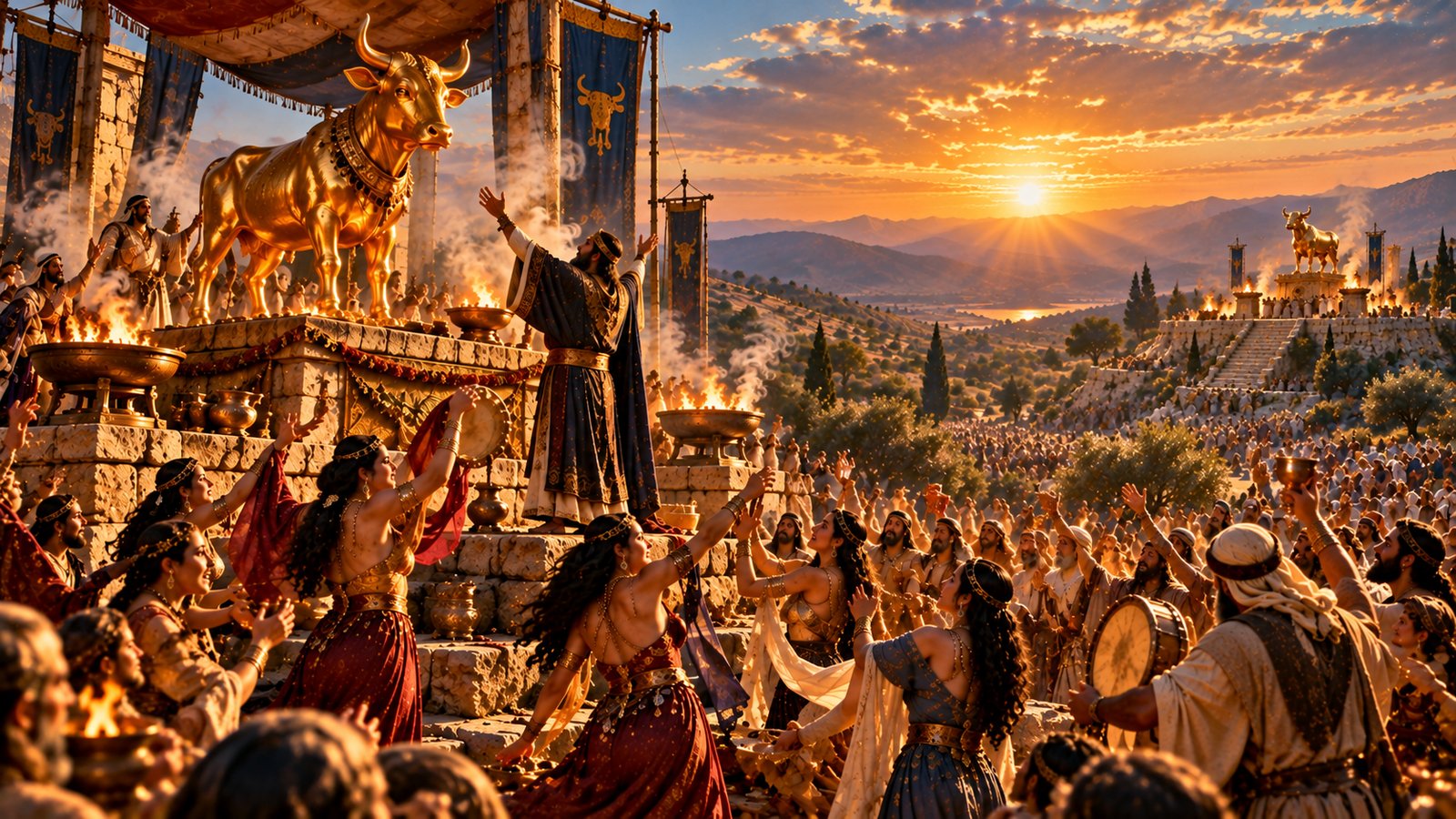
Bethel lay toward the southern end of the northern kingdom, near the border with Judah; Dan lay far to the north. By positioning a calf at each site, Jeroboam offered geographically convenient alternatives to Jerusalem. Scripture says the people went to worship before the one at Dan. It does not give a detailed floor plan of either sanctuary or prove that their structures were identical.
29He set the one in Bethel, and the other he put in Dan.
30This thing became a sin, for the people went even as far as Dan to worship before the one there.
The illustration depicts rival worship, not a photograph of archaeologically certain buildings. Its two-sanctuary composition is symbolic of two places separated by a great distance, not evidence that Bethel and Dan stood side by side. The golden calves belong to Jeroboam's account. Do not confuse them with the bronze oxen supporting the great Sea in Solomon's Temple: those oxen were furnishings, not objects of worship (1 Kings 7:25).
A Priesthood and Festival of His Own Design
Jeroboam's alterations reached beyond the images. He made shrines at high places, appointed priests who were not from the sons of Levi, and established a festival in the eighth month that imitated Judah's worship calendar. The Bible stresses that he devised the date in his own heart. Religious enthusiasm cannot make a human invention into God's command.
31He made houses of high places, and made priests from among all the people, who were not of the sons of Levi.
32Jeroboam ordained a feast in the eighth month, on the fifteenth day of the month, like the feast that is in Judah, and he went up to the altar. He did so in Bethel, sacrificing to the calves that he had made, and he placed in Bethel the priests of the high places that he had made.
33He went up to the altar which he had made in Bethel on the fifteenth day in the eighth month, even in the month which he had devised of his own heart; and he ordained a feast for the children of Israel, and went up to the altar to burn incense.
This is a sobering distortion of priesthood. God had called Israel to be His treasured people and a kingdom of priests (Exodus 19:5–6), and had given particular priestly responsibilities under the old covenant. Jeroboam appointed religious officers to support his own system. The problem was not that the people were too far from Jerusalem to pray; God is never confined to one building. The problem was replacing covenant worship with a system that denied God's revealed commands.
A Place of His Own Making
Jeroboam gave the people places, images, priests, and a festival, all arranged to secure his throne. Everything looked like worship, but none of it was the place God had ordained or the worship He had commanded. Fear was governing Israel's worship instead of the Lord.
God meets His people where He has chosen to meet them, and He governs their worship by His word. A convenient place, a popular symbol, or a sincere crowd cannot turn a human invention into His appointment.
The Warning at the Altar
In 1 Kings 13, a man of God from Judah confronts Jeroboam at the altar in Bethel and announces judgment. When Jeroboam stretches out his hand to seize him, his hand withers. The altar splits. At the prophet's intercession, the king's hand is restored. Mercy reaches him even at the site of his rebellion, yet the king does not turn away from his false worship.
33After this thing, Jeroboam didn’t turn from his evil way, but again made priests of the high places from among all the people. Whoever wanted to, he consecrated him, that there might be priests of the high places.
34This thing became sin to the house of Jeroboam, even to cut it off and to destroy it from off the surface of the earth.
An extraordinary sign does not automatically produce a surrendered heart. The chapter asks us to examine our response when the Spirit corrects us. Are we merely relieved when trouble passes, or do we repent and return?
From Rival Shrines to Worship in Spirit and Truth
Centuries later, a Samaritan woman asked Jesus a question about rival places of worship: her ancestors' mountain or Jerusalem? Jesus did not tell her that every form of worship was equally true. He spoke of the Father's coming purpose: worship that is rooted in truth and animated by the Spirit.
23But the hour comes, and now is, when the true worshipers will worship the Father in spirit and truth, for the Father seeks such to be his worshipers.
24God is spirit, and those who worship him must worship in spirit and truth.”
Jesus fulfills what the old covenant sanctuaries anticipated. Through His sacrifice and priestly ministry we draw near to the Father; through the Holy Spirit, God's people become His dwelling. This does not excuse Jeroboam's idolatry. It shows why the answer to false worship is not another political shrine but a restored relationship with the Father through the true King.
The Lie and the Truth
The lie: “If I control the worship system, I can protect my future. Convenience, popularity, and visible symbols will keep the people secure.”
The truth: the Lord who calls us is trustworthy. He does not need us to replace His word with our own designs. Jesus leads us to the Father, and the Holy Spirit teaches us to worship in truth.
Our Temple Prayer Today
At the Gate, thank the Father for His goodness and faithfulness. At the Altar, remember Jesus' sacrifice, not an image or achievement of our own making. At the Laver, ask the Holy Spirit to uncover fears that make you manipulate people or compromise obedience. In the Holy Place, welcome the Spirit's light, receive the Father's provision, and offer intercession for leaders who are tempted to use religion to secure influence. Draw near with confidence through Jesus our High Priest. Rest in the Father's presence and listen.
Temple Prayer Response: Bringing the Heart Back to God
You do not need a formula to respond to what you have just read. Here is a sample prayer to begin with. Make it your own, and keep going in your own words.
Father, You are good, and I choose to trust You. Forgive me for the times I have made decisions from fear and then tried to make them look spiritual. Jesus, thank You for opening the way into the Father's presence. Holy Spirit, show me where convenience or control has replaced obedience. Give me a pure heart, and teach me to worship in spirit and truth. I want Your presence more than the appearance of success. Amen.
Now be still for a moment. Ask Him where fear has been shaping your decisions, and listen for His answer.
The northern kingdom's false worship will echo through generations. Jeroboam's sin becomes a recurring measure by which later kings are judged. Yet God's redemptive purpose keeps moving toward the faithful Son of David, Jesus Christ, whose kingdom will never be divided.
1 Kings 11:26–40; 12:1–33; 13; 2 Chronicles 11:13–17; Exodus 19:5–6; 32; John 4:19–24.
Scripture quotations are from the World English Bible (WEB), public domain (ebible.org/eng-web), and were checked against that text (1 Kings 11, 12, and 13, and John 4). Commentary is the author's own. Bethel and Dan's precise cultic arrangements, architecture, and chronology require cautious historical treatment. The illustration is a dramatic visualization, not archaeological documentation.