Setting: Solomon's later reign, approximately the mid-tenth century BC. Principal figures: Solomon and the Lord, who appeared to him twice. Primary passages: 1 Kings 9:1–9; 11:1–13; James 4:7–10.
At our previous stop, Solomon dedicated the Temple and the glory of Yahweh filled the house (1 Kings 8). Now we follow the same king further into his reign. The Temple still stands, but Solomon's heart is no longer fully with the Lord. Our next chapter shows how the kingdom divides and rival sanctuaries appear at Bethel and Dan.
A Temple of Gold, a Divided Heart
Solomon's Temple still stood in Jerusalem. Its beauty testified to the dedication of a king who had asked God for wisdom. Yet 1 Kings 11 tells us that Solomon's later life took a tragic direction. He gave his loyalty to other gods. The chapter does not claim that the Temple ceased functioning, nor does it describe the exact appearance of Solomon's foreign shrines. The contrast is nevertheless unmistakable: a king can build a magnificent sanctuary and still turn his heart away from the Lord.
4As for you, if you will walk before me as David your father walked, in integrity of heart and in uprightness, to do according to all that I have commanded you, and will keep my statutes and my ordinances,
5then I will establish the throne of your kingdom over Israel forever, as I promised to David your father, saying, ‘There shall not fail from you a man on the throne of Israel.’
God's warning came after the Temple dedication. He asked for integrity of heart, not architectural achievement alone. His call to obedience was an invitation to covenant faithfulness.
Relationships and Rival Loyalties
Solomon's foreign marriages belonged to the royal world of diplomacy and power, although Scripture does not assign one motive to every relationship. What it does tell us is the spiritual result: he clung to women whose worship drew him away from Yahweh. The issue is not foreign ancestry itself (Ruth the Moabite worshiped Yahweh) but allegiance to other gods.
1Now King Solomon loved many foreign women, together with the daughter of Pharaoh: women of the Moabites, Ammonites, Edomites, Sidonians, and Hittites,
2of the nations concerning which Yahweh said to the children of Israel, “You shall not go among them, neither shall they come among you, for surely they will turn away your heart after their gods.” Solomon joined to these in love.
3He had seven hundred wives, princesses, and three hundred concubines. His wives turned his heart away.
4When Solomon was old, his wives turned away his heart after other gods; and his heart was not perfect with Yahweh his God, as the heart of David his father was.
5For Solomon went after Ashtoreth the goddess of the Sidonians, and after Milcom the abomination of the Ammonites.
6Solomon did that which was evil in Yahweh’s sight, and didn’t go fully after Yahweh, as David his father did.
The recurring word is heart. Solomon did not simply tolerate differences in custom; he went after other gods. The lie is that we can give God a religious place in our lives while reserving our deepest trust for competing masters.
High Places Outside Jerusalem
Solomon's compromise eventually became visible. The king who had built Yahweh's Temple also built high places associated with Chemosh and Molech. Worshipers burned incense and offered sacrifices. These were not additional rooms in the Temple; they were rival places of worship. Their precise architecture is not described in the passage.
7Then Solomon built a high place for Chemosh the abomination of Moab, on the mountain that is before Jerusalem, and for Molech the abomination of the children of Ammon.
8So he did for all his foreign wives, who burned incense and sacrificed to their gods.
Notice the location: the high place was on the mountain before Jerusalem. The rival shrines did not stand far away. They rose within sight of the house the Lord had chosen for His name.
Two Places, Two Loyalties
The Temple was the place God had chosen, and it stood in Jerusalem with its altar, its priests, and its ordained worship. Solomon's high places stood on the mountain before the city, offering a different worship to different gods. The same king served at both.
God does not share His place. He meets His people where He has ordained, and He governs their worship by His word. A heart divided between Him and rival loyalties has already left the place, even while standing beside it.
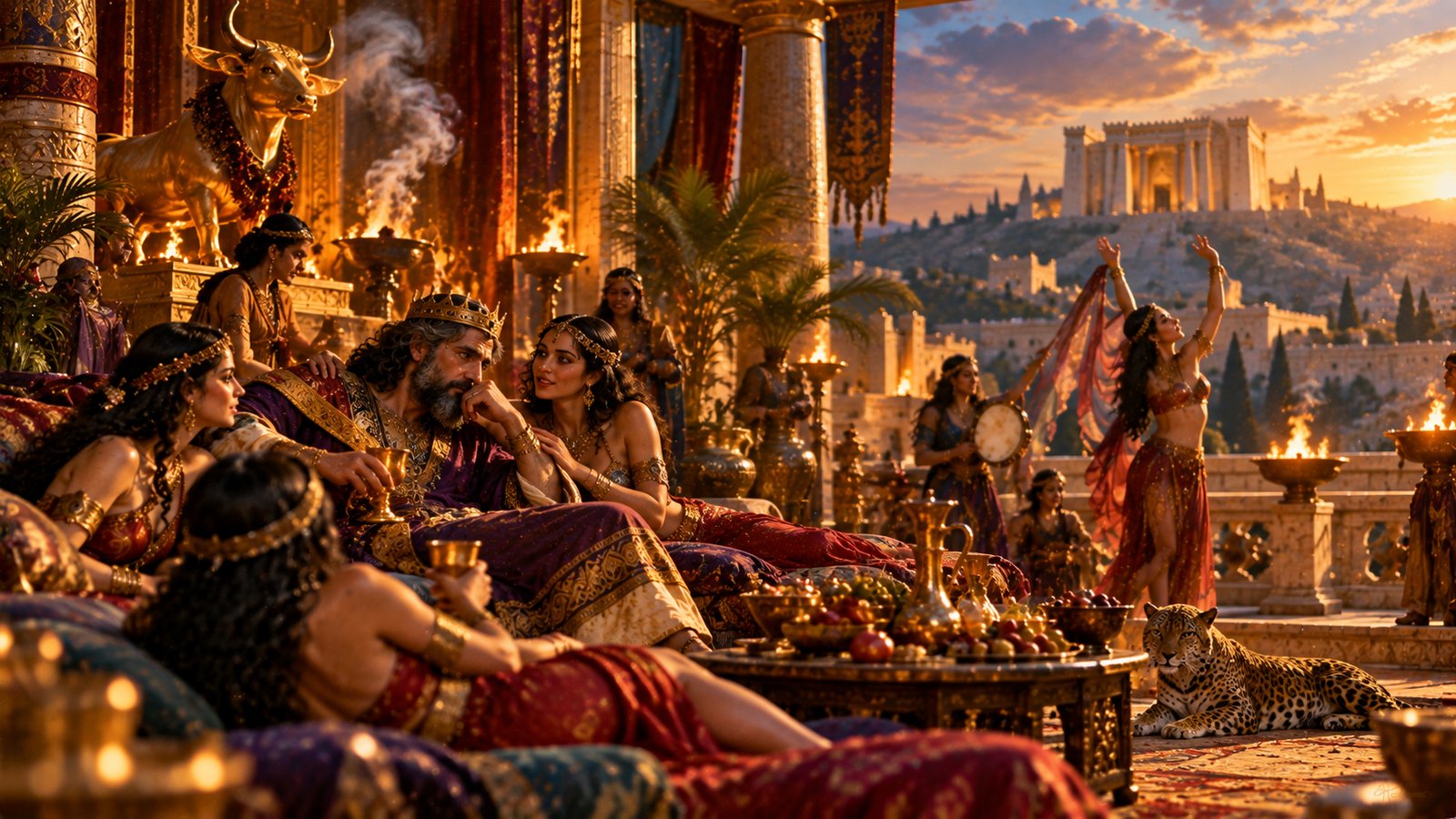
The chapter illustration is a dramatic reconstruction of Solomon's compromised royal world, not documentary evidence of a golden bull idol in his palace. The bronze oxen beneath the Temple's great Sea (1 Kings 7:25) were not objects of worship. Golden calves become an explicit part of our story in the next chapter, when Jeroboam establishes sanctuaries at Bethel and Dan.
God's Response
Solomon had received God's revelation and warnings. The consequences of his unfaithfulness reached the kingdom itself.
9Yahweh was angry with Solomon, because his heart was turned away from Yahweh, the God of Israel, who had appeared to him twice,
10and had commanded him concerning this thing, that he should not go after other gods; but he didn’t keep that which Yahweh commanded.
11Therefore Yahweh said to Solomon, “Because this is done by you, and you have not kept my covenant and my statutes, which I have commanded you, I will surely tear the kingdom from you, and will give it to your servant.
God also said that the full rupture would come after Solomon's lifetime, for David's sake (1 Kings 11:12–13). His judgment was real, yet His covenant purpose did not vanish.
The Greater Son of David
Solomon's story makes us long for a king whose heart will never turn away. Jesus is the greater Son of David who remained faithful to His Father. Through Him we receive forgiveness and access to God's presence. As believers, we are adopted into the Father's family and called to serve as a holy priesthood. The Spirit dwells in us, but grace does not make cherished idolatry harmless.
7Be subject therefore to God. Resist the devil, and he will flee from you.
8Draw near to God, and he will draw near to you. Cleanse your hands, you sinners. Purify your hearts, you double-minded.
9Lament, mourn, and weep. Let your laughter be turned to mourning and your joy to gloom.
10Humble yourselves in the sight of the Lord, and he will exalt you.
Our Temple Prayer Today
Begin with thanksgiving. The Father is good, and faith is fundamentally trusting Him. Ask the Holy Spirit to expose rival loyalties: approval, wealth, power, comfort, control, or relationships that have displaced obedience to Jesus. Confess what He shows you. Thank Jesus for His mercy and ask for one practical act of renewed faithfulness. Pray for leaders and families to walk in integrity. Then listen to the Spirit.
The truth Solomon forgot is the truth we must remember: God's presence is not a trophy of our achievements. The Father wants our trust, love, and faithful response.
Temple Prayer Response: A Whole Heart for the Lord
You do not need a formula to respond to what you have just read. Here is a sample prayer to begin with. Make it your own, and keep going in your own words.
Father, thank You that You are good and that I can trust You. Forgive me for the places where my heart has divided its loyalty. Jesus, thank You that You are the faithful Son of David and that You forgive and restore. Holy Spirit, show me any rival loyalty I have been protecting, and give me one practical act of faithfulness today. Draw near to me as I draw near to You. Amen.
Now be still for a moment. Ask Him what has been competing for your heart, and listen for His answer.
1 Kings 9:1–9; 11:1–43; 7:25; Ruth 1–4; James 4:7–10.
Scripture quotations are from the World English Bible (WEB), public domain (ebible.org/eng-web), and were checked against that text (1 Kings 9 and 11, and James 4). Commentary is the author's own. The illustration is a dramatic reconstruction, not documentary evidence; Scripture does not describe Solomon's foreign shrines in detail.