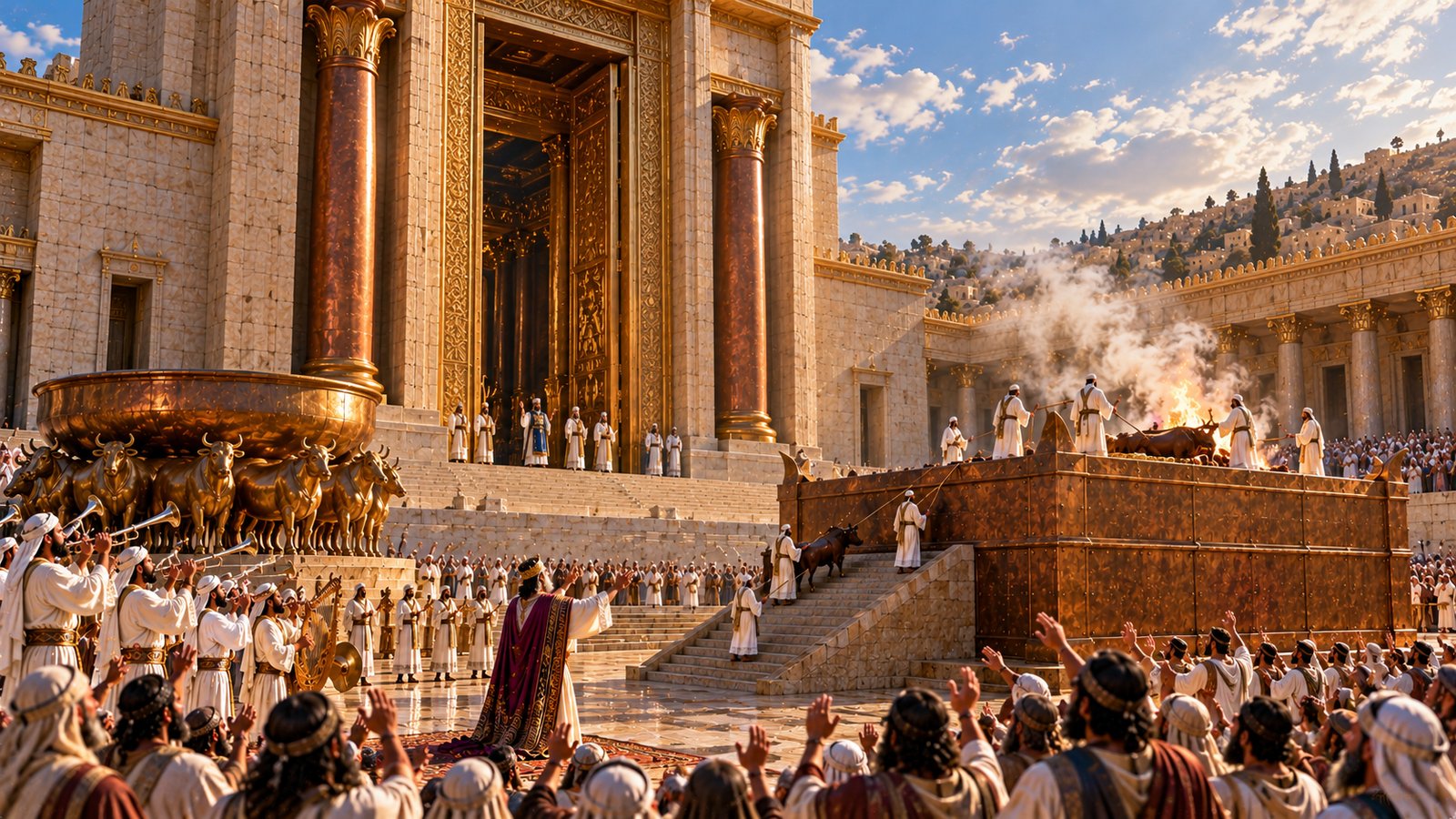
Setting: Solomon's reign, approximately the mid-tenth century BC. Principal figures: Solomon, the priests and Levites, and the assembled people of Israel. Primary passages: 1 Kings 5–8; 2 Chronicles 2–7.
At our previous stop, David brought the Ark into Jerusalem and set it inside a tent he prepared. He appointed Levites to minister with thanksgiving, praise, and remembrance, and he prepared for a Temple he would not be the one to build (1 Chronicles 16; 22; 28–29). Now Solomon builds that house and dedicates it before Yahweh (1 Kings 5–8; 2 Chronicles 2–7). Our next chapter will show that a glorious Temple does not guarantee a faithful heart (1 Kings 11).
A Father's Preparation, a Son's Assignment
David longed to build a house for Yahweh, but God appointed his son Solomon to carry out the work (1 Chronicles 22:7–10). David gathered materials, prepared plans, and commissioned leaders. Solomon inherited not only a throne but a sacred responsibility. The Temple would become the central sanctuary for Israel's worship, replacing the portable Tabernacle as the nation's principal place of sacrifice and prayer.
The biblical narrative places the Temple on Mount Moriah, at the site associated with Ornan's threshing floor (2 Chronicles 3:1). The construction took seven years (1 Kings 6:37–38). Its stonework, cedar, gold, carved cherubim, and carefully ordered spaces expressed holiness and beauty. Yet its purpose was not architectural spectacle. It was to honor the name of the living God and serve the worship of His people.
11Yahweh’s word came to Solomon, saying,
12“Concerning this house which you are building, if you will walk in my statutes, and execute my ordinances, and keep all my commandments to walk in them, then I will establish my word with you, which I spoke to David your father.
13I will dwell among the children of Israel, and will not forsake my people Israel.”
Before the dedication, God spoke about obedience. He did not say that the expense of the building would replace covenant faithfulness. The promise of His dwelling among Israel was joined to the call to walk in His ways. This is the tension that will shape Solomon's entire story.
The Ark Comes Home
The Temple's dedication brought together the storylines we have followed through the last two chapters. The Ark, which David had placed in a tent in Jerusalem, was carried into the new sanctuary. The Tabernacle and its holy vessels were also brought up. Priests and Levites took their appointed places. The nation gathered to witness a decisive transition in Israel's worship.
6The priests brought in the ark of Yahweh’s covenant to its place, into the inner sanctuary of the house, to the most holy place, even under the cherubim’s wings.
7For the cherubim spread their wings out over the place of the ark, and the cherubim covered the ark and its poles above.
8The poles were so long that the ends of the poles were seen from the holy place before the inner sanctuary, but they were not seen outside. They are there to this day.
The Ark did not become a magical source of power. It was the covenant chest, placed where the Lord had directed. The priests' work showed reverence for the holiness of the sanctuary. The Most Holy Place, once associated with the portable tent, now stood within the permanent Temple.
The Glory Fills the House
The dedication was not only a royal ceremony. Singers and instrumentalists gave thanks and praise. The account in 2 Chronicles emphasizes the united sound of trumpets, cymbals, and voices as the people celebrated Yahweh's goodness and enduring loving kindness (2 Chronicles 5:11–13). Then something happened no craftsman could build and no king could command.
10It came to pass, when the priests had come out of the holy place, that the cloud filled Yahweh’s house,
11so that the priests could not stand to minister by reason of the cloud; for Yahweh’s glory filled Yahweh’s house.
12Then Solomon said, “Yahweh has said that he would dwell in the thick darkness.
13I have surely built you a house of habitation, a place for you to dwell in forever.”
The priests could not continue their ministry because of the cloud. God was not a decoration added to Solomon's achievement. His glory overwhelmed the human activity of the moment. The Temple was dedicated to Him; His presence was His gift, not the result of human engineering.
The Lie and the Truth: Can We Contain God?
The central lie is that a sacred building can contain God, control His favor, or guarantee His approval. Solomon himself rejected the notion that his magnificent Temple could hold the Creator. The Lord was willing to place His name there and hear His people's prayers, but He was never confined to its walls.
27But will God in very deed dwell on the earth? Behold, heaven and the heaven of heavens can’t contain you; how much less this house that I have built!
28Yet have respect for the prayer of your servant and for his supplication, Yahweh my God, to listen to the cry and to the prayer which your servant prays before you today;
29that your eyes may be open toward this house night and day, even toward the place of which you have said, ‘My name shall be there;’ to listen to the prayer which your servant prays toward this place.
30Listen to the supplication of your servant, and of your people Israel, when they pray toward this place. Yes, hear in heaven, your dwelling place; and when you hear, forgive.
Notice the direction of Solomon's prayer. He asks the Lord to hear in heaven. He asks Him to forgive. The building is the appointed focus of covenant worship, but the One addressed in prayer reigns over heaven and earth. The Temple is not a cage for divine presence; it is a gift that points worshipers to the God who hears.
A House for His Name
The Temple was the place God chose for His name, where His people brought their sacrifices and directed their prayers (1 Kings 8:29). It was not a place people selected for themselves. God had appointed the site, shaped the pattern through David, and spoken about obedience before a single offering was made there.
Here the pattern of the whole series comes into focus. God meets His people at the place He ordains, and He governs their life through the worship He has commanded. Solomon's prayer shows that the place never limited God; it directed His people to Him.
A House of Prayer for the Nations
Solomon's dedication also looked beyond Israel. He prayed that a foreigner who came because of Yahweh's great name would be heard, so that all the peoples of the earth might know and fear the Lord (1 Kings 8:41–43). God's purpose for Israel was never merely to display a beautiful national monument. His name and His goodness were to be known among the nations.
41“Moreover, concerning the foreigner, who is not of your people Israel, when he comes out of a far country for your name’s sake
42(for they shall hear of your great name and of your mighty hand and of your outstretched arm), when he comes and prays toward this house,
43hear in heaven, your dwelling place, and do according to all that the foreigner calls to you for; that all the peoples of the earth may know your name, to fear you, as do your people Israel, and that they may know that this house which I have built is called by your name.
This passage should shape how we read the Temple story. The Lord's holiness does not mean indifference toward people outside Israel. His covenant with Israel was part of a larger purpose to make His name known. In Jesus, people from every nation are invited to come to the Father through Him (Ephesians 2:11–22).
Solomon Knew the People Would Need Mercy
The dedication prayer was not naive about human failure. Solomon anticipated sin, judgment, displacement, repentance, and the need for forgiveness. He asked God to hear those who turned back with their whole heart (1 Kings 8:46–53). The glory of the building could not preserve Israel if its people turned from the Lord.
46If they sin against you (for there is no man who doesn’t sin), and you are angry with them and deliver them to the enemy, so that they carry them away captive to the land of the enemy, far off or near;
47yet if they repent in the land where they are carried captive, and turn again, and make supplication to you in the land of those who carried them captive, saying, ‘We have sinned and have done perversely; we have dealt wickedly,’
48if they return to you with all their heart and with all their soul in the land of their enemies who carried them captive, and pray to you toward their land which you gave to their fathers, the city which you have chosen and the house which I have built for your name,
49then hear their prayer and their supplication in heaven, your dwelling place, and maintain their cause;
The later exile would show the painful relevance of Solomon's words. Babylon destroyed the First Temple in 586 BC (2 Kings 25), but that event belongs to a later chapter in our journey. For now, Solomon's own dedication tells us that no building, ritual, or national privilege can replace a heart that turns to God.
Jesus and the Greater Temple
Solomon's Temple mattered profoundly in Israel's covenant history. Yet Jesus spoke of His own body as the Temple (John 2:19–22), and the New Testament presents Him as our heavenly High Priest (Hebrews 8:1–2). His sacrifice provides the access to the Father that the earlier offerings anticipated. Believers are joined to Christ and built together into a dwelling place for God in the Spirit (Ephesians 2:19–22).
We must distinguish these truths carefully. The Church is not a replica of Solomon's building. Nor does calling believers God's temple mean that holiness no longer matters. Through Christ, we are adopted into the Father's family and called to live as a holy priesthood. We approach Him by grace, not by purchasing His presence with a beautiful structure or impressive ceremony.
Our Temple Prayer Today
Imagine standing with the people as the priests carry the Ark into the sanctuary. Hear the instruments and the thanksgiving. Then see the cloud fill the house until the priests cannot continue. Let that scene remind you that God is more glorious than anything we can build for Him.
Thank the Father for His goodness. Come to Him through Jesus, our High Priest. Confess any way you have treated worship as a routine that guarantees His approval. Ask the Holy Spirit to search your heart and teach you obedience. Pray for those far from God, remembering Solomon's prayer for the foreigner. Bring your family, your community, and the nations before Him. Then listen for His direction.
The Temple's greatness was never the gold on its walls. Its glory was the Lord to whom it belonged. The Father invites us to trust Him, and He hears humble prayer.
Temple Prayer Response: Humble Prayer Before a Glorious God
You do not need a formula to respond to what you have just read. Here is a sample prayer to begin with. Make it your own, and keep going in your own words.
Father, thank You that You are far greater than anything we could build, and that You still hear the prayers of Your people. Forgive me for treating worship as a routine that secures Your approval. Jesus, thank You that You are my High Priest and the true Temple, and that through You I may come to the Father. Holy Spirit, search my heart and teach me to obey. I pray for people far from You, for my family, and for the nations. Hear in heaven, Your dwelling place, and forgive. Amen.
Now be still for a moment. Ask Him where you have trusted a place or a routine more than Him, and listen for His answer.
1 Kings 5–8; 2 Chronicles 2–7; 1 Chronicles 22; 28–29; John 2:19–22; Hebrews 8:1–2; Ephesians 2:11–22.
Scripture quotations are from the World English Bible (WEB), public domain (ebible.org/eng-web), and were checked against that text (1 Kings 6 and 8). Commentary is the author's own. The illustration is an artistic depiction of the dedication scene, with the bronze altar, the bronze Sea on twelve oxen, and the Temple's pillars and doors; it does not show the cloud, and Scripture does not describe the crowd's arrangement in detail.