Setting: David's reign, approximately the tenth century BC. Principal figures: David, Uzzah, Obed-Edom, the Levites, and Michal. Primary passages: 2 Samuel 6; 1 Chronicles 13; 15–16.
At our previous stop, the Tabernacle and bronze altar were at Gibeon, while the Ark was in a separate tent in Jerusalem (1 Chronicles 16:39–40; 2 Chronicles 1:3–5). Now we return to the events that brought the Ark into David's city. These chapters overlap in time; we are following two parts of the same story, not advancing through a new generation. In this chapter David brings the Ark from its long stay in Kiriath-jearim, through a difficult interruption, to the tent he prepared in Jerusalem (2 Samuel 6; 1 Chronicles 13; 15–16). Our next chapter follows Solomon, who builds the Temple and brings the Ark into a permanent sanctuary (1 Kings 5–8).
A King Who Wanted God Near
Imagine the road leading toward Jerusalem alive with singing, trumpets, cymbals, and people walking beside the Ark of the Covenant. David is not watching from a palace balcony. He is among the worshipers, celebrating with all his might. Yet the joy of this day was preceded by fear and grief. To understand the dancing, we must first understand the lesson that stopped the first procession.
For many years the Ark had remained in Kiriath-jearim after its return from Philistine territory (1 Samuel 7:1–2). David, now king, wanted to bring it to his capital. His longing was significant: he wanted the worship of Yahweh to stand at the heart of Israel's life. But a good desire does not cancel the holiness of the One we worship.
The First Attempt: Enthusiasm Without the Appointed Order
3They set God’s ark on a new cart, and brought it out of Abinadab’s house that was on the hill; and Uzzah and Ahio, the sons of Abinadab, drove the new cart.
4They brought it out of Abinadab’s house which was in the hill, with God’s ark; and Ahio went before the ark.
5David and all the house of Israel played before Yahweh with all kinds of instruments made of cypress wood, with harps, with stringed instruments, with tambourines, with castanets, and with cymbals.
The procession was sincere and joyful, but the Ark was placed on a cart. The law had provided for its transport by designated Levites using carrying poles (Numbers 4:15; 7:9; Exodus 25:14–15). The Ark was not an ordinary royal possession to move by whatever method seemed convenient.
6When they came to the threshing floor of Nacon, Uzzah reached for God’s ark and took hold of it, for the cattle stumbled.
7Yahweh’s anger burned against Uzzah, and God struck him there for his error; and he died there by God’s ark.
8David was displeased because Yahweh had broken out against Uzzah; and he called that place Perez Uzzah to this day.
This is a difficult passage. Scripture reports the judgment; it does not invite us to pretend we know everything about Uzzah's inner intentions. The tragedy confronts David and us with the reality that God's holiness cannot be managed by human instinct. David became afraid, and the procession stopped. The Ark remained for three months in the household of Obed-Edom, which the Lord blessed (2 Samuel 6:9–12).
The Lie and the Truth
The dominant lie was that enthusiasm for worship could replace obedience to God's revealed instructions. The truth was not that music, celebration, and joy were wrong. The truth was that love for God must be joined to reverence for Him. David's later correction shows that he learned from the first attempt rather than abandoning the desire to honor the Lord.
12and said to them, “You are the heads of the fathers’ households of the Levites. Sanctify yourselves, both you and your brothers, that you may bring the ark of Yahweh, the God of Israel, up to the place that I have prepared for it.
13For because you didn’t carry it at first, Yahweh our God broke out in anger against us, because we didn’t seek him according to the ordinance.”
14So the priests and the Levites sanctified themselves to bring up the ark of Yahweh, the God of Israel.
15The children of the Levites bore God’s ark on their shoulders with its poles, as Moses commanded according to Yahweh’s word.
Now the Levites carry the Ark on their shoulders, as commanded. David's correction was practical and spiritual. He did not merely say that his heart was in the right place; he changed what he did. Repentance includes a willingness to obey the truth God has made known.
The Second Procession: Holiness and Joy Together
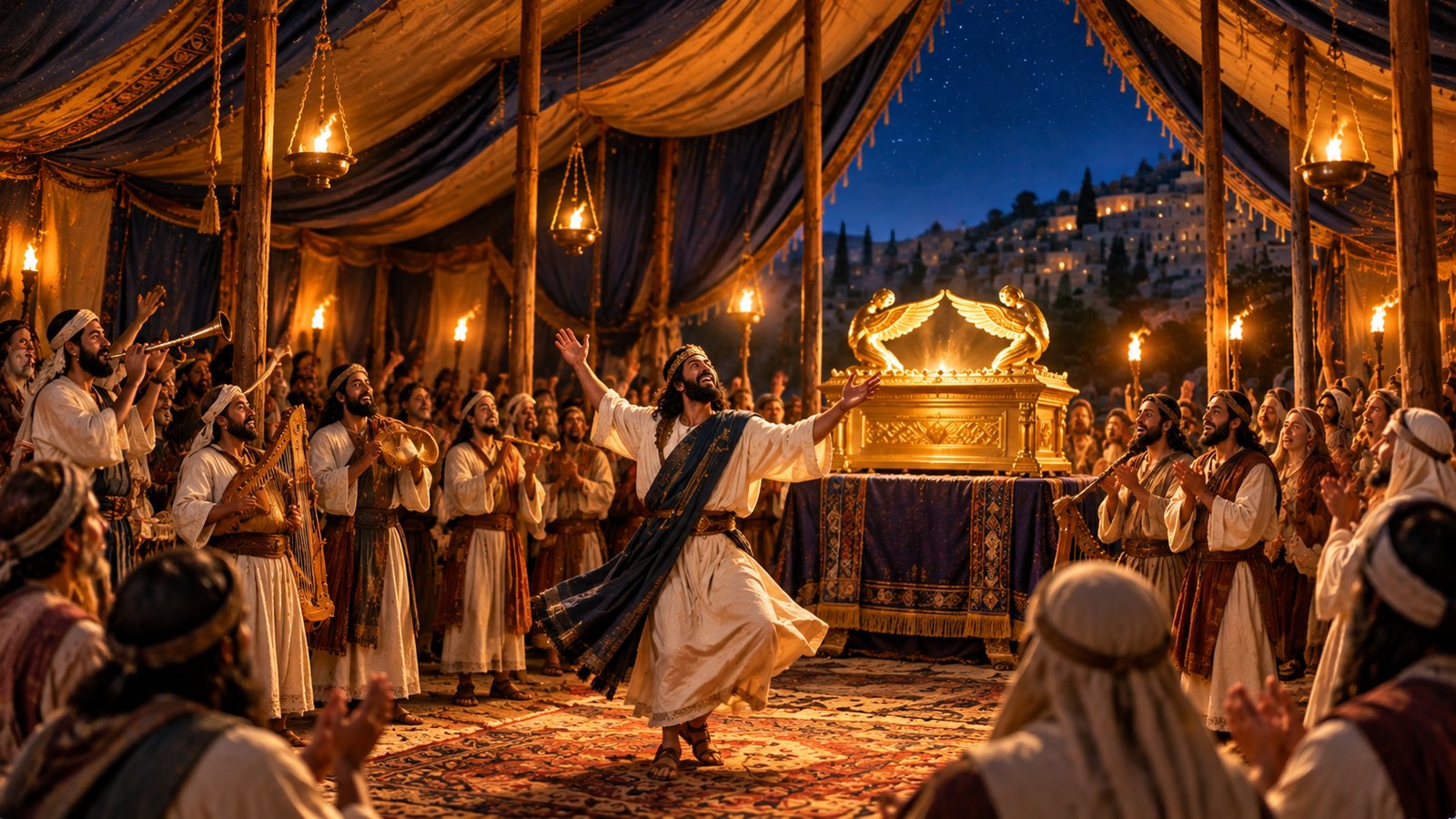
The second procession was not subdued by reverence. It overflowed with joy. The Levites carried the Ark; sacrifices marked the journey; singers and musicians sounded their instruments; David danced before Yahweh. His royal status did not make him too important to worship openly.
12King David was told, “Yahweh has blessed the house of Obed-Edom, and all that belongs to him, because of God’s ark.” So David went and brought up God’s ark from the house of Obed-Edom into David’s city with joy.
13When those who bore Yahweh’s ark had gone six paces, he sacrificed an ox and a fattened calf.
14David danced before Yahweh with all his might; and David was clothed in a linen ephod.
15So David and all the house of Israel brought up Yahweh’s ark with shouting and with the sound of the trumpet.
Michal, Saul's daughter and David's wife, saw him dancing and despised him in her heart (2 Samuel 6:16, 20–23). David answered that his celebration was before Yahweh. The passage contrasts David's willingness to humble himself in worship with contempt for his public expression. It does not mean that every outward display is automatically genuine worship. What matters is the Lord before whom the heart bows.
The Tent David Prepared
The Ark finally reached Jerusalem and was placed inside a tent David had prepared. This was not the same as Solomon's later stone Temple. Nor was it simply the Mosaic Tabernacle transported intact from Gibeon: Chronicles explicitly distinguishes the Ark's tent in Jerusalem from the Tabernacle and bronze altar at Gibeon.
1They brought in God’s ark, and set it in the middle of the tent that David had pitched for it; and they offered burnt offerings and peace offerings before God.
2When David had finished offering the burnt offering and the peace offerings, he blessed the people in Yahweh’s name.
3He gave to everyone of Israel, both man and woman, to everyone a loaf of bread, a portion of meat, and a cake of raisins.
4He appointed some of the Levites to minister before Yahweh’s ark, and to commemorate, to thank, and to praise Yahweh, the God of Israel:
Notice the people in this scene: priests offering sacrifices, Levites appointed to minister, and men and women receiving food as the celebration spreads through the community. David's tent was not merely an empty landmark. It was a place associated with active thanksgiving, remembrance, praise, and ongoing service.
Worship That Remembers Who God Is
David's appointed worshipers were called to remember God's marvelous works, tell His deeds, seek His face, and proclaim His glory. Worship in the biblical sense reaches beyond a song into the whole life of trust and obedience.
8Oh give thanks to Yahweh. Call on his name. Make what he has done known among the peoples.
9Sing to him. Sing praises to him. Tell of all his marvelous works.
10Glory in his holy name. Let the heart of those who seek Yahweh rejoice.
11Seek Yahweh and his strength. Seek his face forever more.
The language is active: give thanks, call, make known, sing, tell, glory, seek. These are movements of a heart turning toward God. Worship is not an attempt to flatter God into doing our will. It is a response to His goodness and a way of placing our attention again upon His truth.
A Tent in the City of David
David brought the Ark into the center of Israel's national life, and Jerusalem became the city where God's presence was honored. But the place did not govern how God was approached. The first attempt shows that His people could not invent the method; the second shows them returning to what He had said, with the Levites carrying the Ark on poles (1 Chronicles 15:13–15).
Where God meets His people, and how they come, is set by His word. At David's tent, reverence for His instructions and joy in His presence stood side by side.
David's Failure and the Mercy He Needed
We must not turn David into a flawless worship hero. His later adultery with Bathsheba and arranged killing of Uriah were grievous sins (2 Samuel 11). Nathan confronted him, and David confessed (2 Samuel 12). Psalm 51 gives voice to the need for cleansing and renewal. This failure was not an event at David's tent, and we should not depict it as one. It does, however, remind us that visible worship and public spiritual leadership do not exempt anyone from repentance.
David also longed to build a permanent house for God, but the Lord appointed his son Solomon to build it (1 Chronicles 22:7–10). David prepared materials and handed on plans and responsibilities (1 Chronicles 22; 28–29). A faithful calling sometimes includes preparing the next generation to complete what we cannot finish ourselves.
Jesus, Our High Priest; We, His Children
David's tent should not be confused with a direct description of the New Testament church. Yet its themes of worship, priestly service, thanksgiving, holiness, and access find their fulfillment in Jesus Christ. He is the greater High Priest who opens the way to the Father through His own sacrifice (Hebrews 9–10). Believers receive the Spirit and are called God's children and a royal priesthood (Romans 8:15–17; 1 Peter 2:9).
We do not earn adoption through the quality of our worship. We worship because, through Christ, the Father has welcomed us. The Holy Spirit teaches us to trust Him, turn from sin, and minister in spirit and truth. Reverence need not silence joy; joy need not discard obedience.
Our Temple Prayer Today
Begin by thanking the Father for His goodness. Remember what He has done, not only what you still need. Come through Jesus, our true High Priest, and confess any area where sincerity has become an excuse for ignoring His Word. Ask the Holy Spirit to teach you what obedience looks like today. Worship freely, whether with singing, silence, prayer, service, or an act of reconciliation. Intercede for those entrusted to you. Then listen and respond.
The great lesson of David's tent is not that we must reproduce an ancient ceremony. It is that the God who invites us near is both holy and good. Faith is trusting our Father enough to rejoice in His presence and obey His voice.
Temple Prayer Response: Rejoicing and Obeying
You do not need a formula to respond to what you have just read. Here is a sample prayer to begin with. Make it your own, and keep going in your own words.
Father, thank You that You are holy and that You are good, and that You invite me near. Forgive me for the times my zeal ran ahead of Your word, and for the times I have held back my joy. Jesus, thank You that You are my High Priest and that I may come to the Father through You. Holy Spirit, teach me to hold reverence and joy together, and to obey what You have shown me. I want to rejoice in Your presence and listen to Your voice. Amen.
Now be still for a moment. Ask Him where reverence or joy has been missing in your worship, and listen for His answer.
2 Samuel 5–6; 11–12; 1 Chronicles 13; 15–16; 22; 28–29; Exodus 25:14–15; Numbers 4:15; 7:9; Psalm 51; Hebrews 9–10; Romans 8:15–17; 1 Peter 2:9.
Scripture quotations are from the World English Bible Classic (WEB), public domain (ebible.org/eng-web), and were checked against that text (2 Samuel 6 and 1 Chronicles 15 and 16). Commentary is the author's own. The account of Uzzah is a difficult passage, and the text does not describe his inner intentions. David's tent in Jerusalem is distinct from the Mosaic Tabernacle at Gibeon. The illustration is an artistic depiction of the second procession and the tent; Scripture does not describe the tent's furnishings in detail.