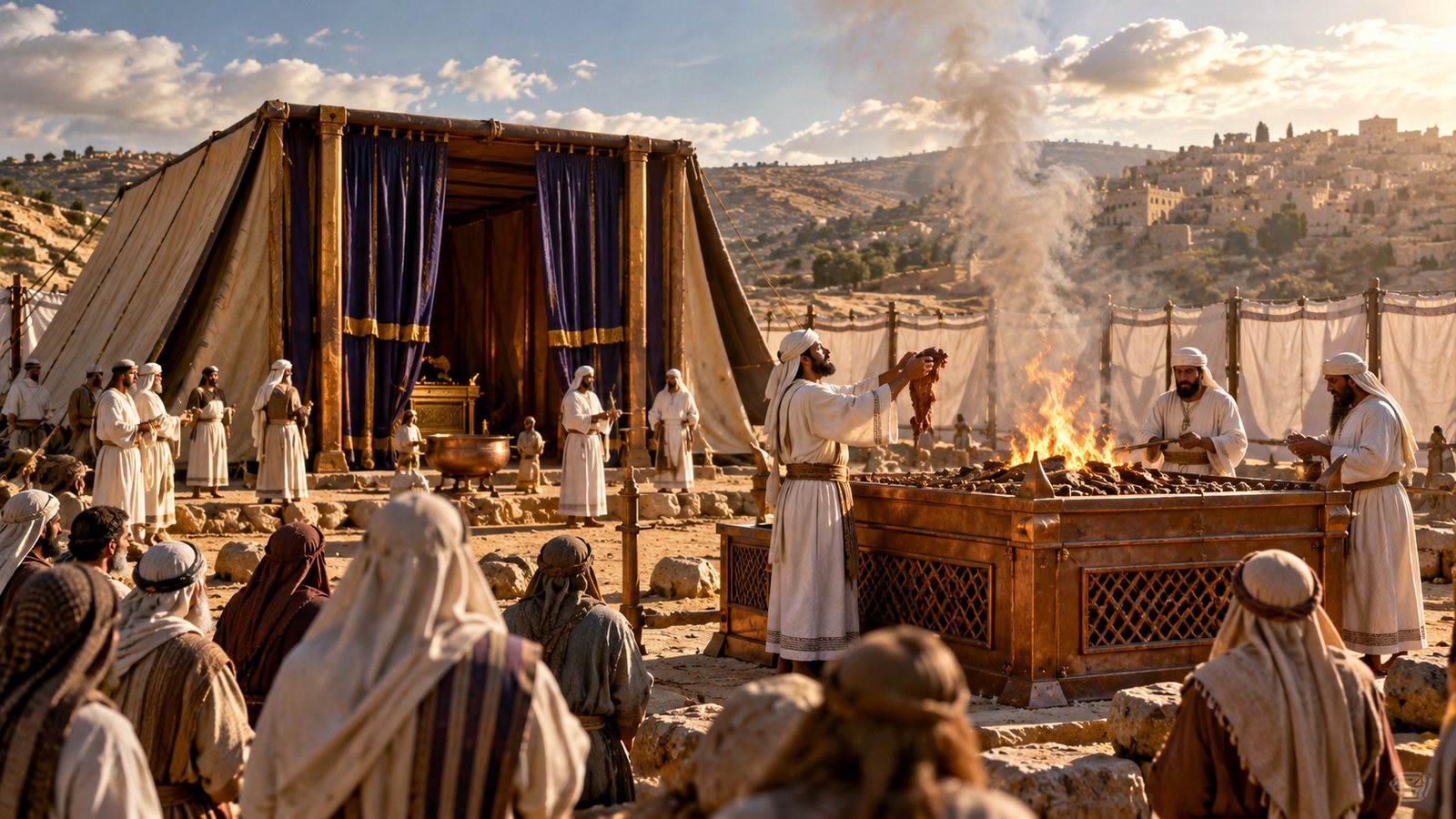
Setting: The united monarchy, in the reigns of David and Solomon (approximately the tenth century BC). Principal figures: David, Zadok and the priests, Heman and Jeduthun, and Solomon. Primary passages: 1 Chronicles 16:37–42; 21:28–30; 2 Chronicles 1:3–12.
At our previous stop, the Philistines returned the Ark, and Israel was called to turn wholeheartedly to Yahweh (1 Samuel 6–7). Between that story and the arrangement we are about to see, Samuel continued as judge, Israel demanded a king, Saul's reign ended, and David became king (1 Samuel 8–31; 2 Samuel 1–5). David eventually brought the Ark to Jerusalem after a sobering lesson about approaching the holy God (2 Samuel 6; 1 Chronicles 13–15). We will return to that procession more fully in the next chapter. The biblical accounts overlap here: this chapter follows the Tabernacle and altar at Gibeon, while the next follows the Ark in David's Jerusalem tent.
The Tent Remained, but the Ark Was Elsewhere
Imagine approaching the worship center at Gibeon at the beginning or end of the day. Priests attend the bronze altar; smoke rises from the sacrifices; instruments and thanksgiving accompany the service. The pattern entrusted to Moses has not been forgotten. Yet the Ark, once kept in the Most Holy Place, is not here. David has prepared another tent for it in Jerusalem. The story of God's dwelling has reached an unusual turning point.
39and Zadok the priest and his brothers the priests, before Yahweh’s tabernacle in the high place that was at Gibeon,
40to offer burnt offerings to Yahweh on the altar of burnt offering continually morning and evening, even according to all that is written in Yahweh’s law, which he commanded to Israel;
41and with them Heman and Jeduthun and the rest who were chosen, who were mentioned by name, to give thanks to Yahweh, because his loving kindness endures forever;
42and with them Heman and Jeduthun with trumpets and cymbals for those that should sound aloud, and with instruments for the songs of God, and the sons of Jeduthun to be at the gate.
These verses describe an organized, continuing priestly ministry. Zadok and the priests are assigned to the Tabernacle at Gibeon. Morning and evening offerings continue according to the law; musicians give thanks because God's loving kindness endures forever. The separation of Ark and altar did not mean that God's commands had ceased to matter. The priests were still responsible for their calling.
Notice what the passage does not say. It does not tell us that God's presence was trapped inside either location, or that Israel could secure His favor simply by maintaining a schedule. Sacred places and faithful practices were gifts, but they were never substitutes for trusting and obeying the Lord.
Two Locations in One Story
The Ark represented God's covenant kingship and His holy presence among His people. The bronze altar was associated with sacrifice, atonement, and the priestly service established in the wilderness. Under David, the Ark was in Jerusalem while the Mosaic Tabernacle and altar remained at Gibeon. This was a real arrangement in the biblical account, not a claim that Israel had two competing gods or two equally independent covenant systems.
3Then Solomon, and all the assembly with him, went to the high place that was at Gibeon; for God’s Tent of Meeting was there, which Yahweh’s servant Moses had made in the wilderness.
4But David had brought God’s ark up from Kiriath Jearim to the place that David had prepared for it; for he had pitched a tent for it at Jerusalem.
5Moreover the bronze altar that Bezalel the son of Uri, the son of Hur, had made was there before Yahweh’s tabernacle; and Solomon and the assembly were seeking counsel there.
The Chronicler carefully names both sites. The Tent of Meeting and Bezalel's bronze altar are at Gibeon; the Ark has been brought to David's tent in Jerusalem. We should not silently merge these locations into one scene. Nor should we pretend that the biblical record tells us every detail of how the Tabernacle arrived at Gibeon after the upheavals associated with Shiloh and Nob. Its location at Gibeon in this period is clear; every stage of the journey is not.
Gibeon is usually identified with the archaeological site of el-Jib, northwest of Jerusalem. The exact position of the biblical Tabernacle within the settlement has not been established by archaeology. We can trust the biblical description without inventing a discoverable footprint for the tent.
The Lie and the Truth: Can a Place Replace a Heart?
Here is the dominant temptation in this chapter: to believe that because worship is happening at an authorized place, the worshiper must therefore be right with God. Religious familiarity can quietly become spiritual presumption. Israel's earlier experience with the Ark at Shiloh had already exposed that error.
The truth is deeper. God gave Israel places, sacrifices, priests, and appointed times so that His people would approach Him as He commanded. But He desired hearts that feared Him, loved Him, trusted Him, and walked in His ways. The sacred place served the covenant relationship; it did not replace it.
David's own experience underscores this. When judgment followed his census, he confessed his sin. God answered him at the threshing floor of Ornan, and that place became important in the story of the future Temple. David did not manufacture an encounter with God by selecting a convenient religious location. He responded to God's direction in repentance and costly worship.
28At that time, when David saw that Yahweh had answered him in the threshing floor of Ornan the Jebusite, then he sacrificed there.
29For Yahweh’s tabernacle, which Moses made in the wilderness, and the altar of burnt offering, were at that time in the high place at Gibeon.
30But David couldn’t go before it to inquire of God, for he was afraid because of the sword of Yahweh’s angel.
This is not a general permission to disregard God's appointed worship. It is a particular moment of divine judgment and mercy, connected to the place God would later identify for Solomon's Temple (1 Chronicles 22:1; 2 Chronicles 3:1). The story is moving toward Jerusalem, but its center is still God's initiative, not human control.
Solomon Comes to Gibeon
After David's death, Solomon became king. He came with Israel's leaders to Gibeon, where the bronze altar stood. The record tells us that he offered sacrifices there, and that God appeared to him during the night. At this critical moment, Solomon did not first ask for a stronger army, a larger palace, or longer life. He asked for wisdom to govern the people entrusted to him.
7That night, God appeared to Solomon and said to him, “Ask for what you want me to give you.”
8Solomon said to God, “You have shown great loving kindness to David my father, and have made me king in his place.
9Now, Yahweh God, let your promise to David my father be established; for you have made me king over a people like the dust of the earth in multitude.
10Now give me wisdom and knowledge, that I may go out and come in before this people; for who can judge this great people of yours?”
The Lord's response in verses 11–12 emphasizes what was in Solomon's heart. The king's request concerned the responsibility of serving God's people. That is a picture of dependence: not the claim that a holy site forces God to answer, but the humble recognition that the calling is too great without His help.
Solomon's later failures will remind us that a promising beginning is not a guarantee of lifelong obedience. We will follow that sobering turn in Chapter 14. For now, the moment at Gibeon invites us to ask whether we seek God's wisdom to serve others, or merely His power to secure ourselves.
One God, Two Places, One Way of Approach
For a time the Ark and the altar stood in two places, and God's people had to hold two things together: His presence was real, and His instructions for approaching Him still governed their worship. The Lord did not leave them to guess where to bring their offerings. He had told them, and the priests at Gibeon kept doing what He had commanded (1 Chronicles 16:40).
The place where God meets His people is never settled by what is convenient. It is settled by His word, and He governs His people through the worship He ordains.
The Priesthood and the Greater High Priest
The ministry at Gibeon kept the Mosaic sacrificial system in view. Priests served; offerings were made; thanksgiving rose. Yet these services anticipated a greater and lasting access to God. Jesus is not merely another priest working in another earthly sanctuary. Hebrews presents Him as our heavenly High Priest and the fulfillment of what the earlier sanctuary foreshadowed.
1Now in the things which we are saying, the main point is this: we have such a high priest, who sat down on the right hand of the throne of the Majesty in the heavens,
2a servant of the sanctuary and of the true tabernacle which the Lord pitched, not man.
The old Tabernacle taught Israel to take holiness, sacrifice, and priestly mediation seriously. Jesus does not make those truths irrelevant. He brings their deepest purpose into focus. Through His sacrifice and priesthood, believers may approach the Father with confidence (Hebrews 10:19–22). We are adopted children in Christ and called to be a royal priesthood, not to earn our place in the family but to minister to God from within it (Romans 8:15–17; 1 Peter 2:9).
Our First Ministry: Worship in Spirit and Truth
At Gibeon, worship was neither merely musical nor merely ceremonial. Offerings, thanksgiving, and ordered priestly service belonged together. In Christ, our worship includes thanksgiving, confession, repentance, obedience, surrender, intercession, and love. We minister to God because He is worthy. He, in turn, teaches, corrects, strengthens, and comforts us by His Spirit, not as payment for a religious performance, but in the grace of relationship.
23But the hour comes, and now is, when the true worshipers will worship the Father in spirit and truth, for the Father seeks such to be his worshipers.
24God is spirit, and those who worship him must worship in spirit and truth.”
We do not need to travel to Gibeon or Jerusalem to gain an audience with our Father. The Holy Spirit dwells in God's people. The pattern of the Tabernacle can still guide our attention through thanksgiving, faith in Christ's sacrifice, cleansing through repentance, fellowship, and prayer, but it is a teaching pattern, not a mechanical formula.
Our Temple Prayer Today
Begin with this question: Am I trusting a routine to make me acceptable, or am I trusting the Father who welcomes me through Jesus?
Give thanks for God's enduring loving kindness. Remember the blood of Christ, our true access to the Father. Confess what the Spirit brings to light. Ask for wisdom as Solomon did, not simply for personal advantage, but to serve those God has placed in your care. Pray for your family, church, and community. Then be quiet enough to listen and obey.
The Tabernacle at Gibeon teaches a beautiful balance: honor what God has established, yet never mistake the outward form for the living relationship. The Lord is holy. The Lord is good. He invites His children to trust Him.
Temple Prayer Response: Seeking Wisdom From the Father
You do not need a formula to respond to what you have just read. Here is a sample prayer to begin with. Make it your own, and keep going in your own words.
Father, thank You that Your loving kindness endures forever. Forgive me for the times I have trusted a routine, a place, or a good habit to make me acceptable instead of trusting You. Jesus, thank You that You are my High Priest and that through You I may come to the Father with confidence. Holy Spirit, give me the humble heart Solomon showed at Gibeon. Give me wisdom to love and serve the people You have placed in my care, and help me honor what You have established without mistaking the outward form for You. Amen.
Now be still for a moment. Ask Him for the wisdom you need most today, and listen for His answer.
1 Chronicles 16:37–42; 21:28–30; 22:1; 2 Chronicles 1:3–12; 3:1; Hebrews 8:1–2; 10:19–22; John 4:23–24; Romans 8:15–17; 1 Peter 2:9.
Scripture quotations are from the World English Bible Classic (WEB), public domain (ebible.org/eng-web), and were checked against that text (1 Chronicles 16 and 21, 2 Chronicles 1, Hebrews 8, and John 4). Commentary is the author's own. The biblical accounts of the Ark in Jerusalem and the Tabernacle at Gibeon overlap in time. How the Tabernacle came to Gibeon is not fully described. The illustration is an artistic depiction; the placement of the Tabernacle at Gibeon is stated in Scripture, but its exact appearance and surroundings are not described in detail.