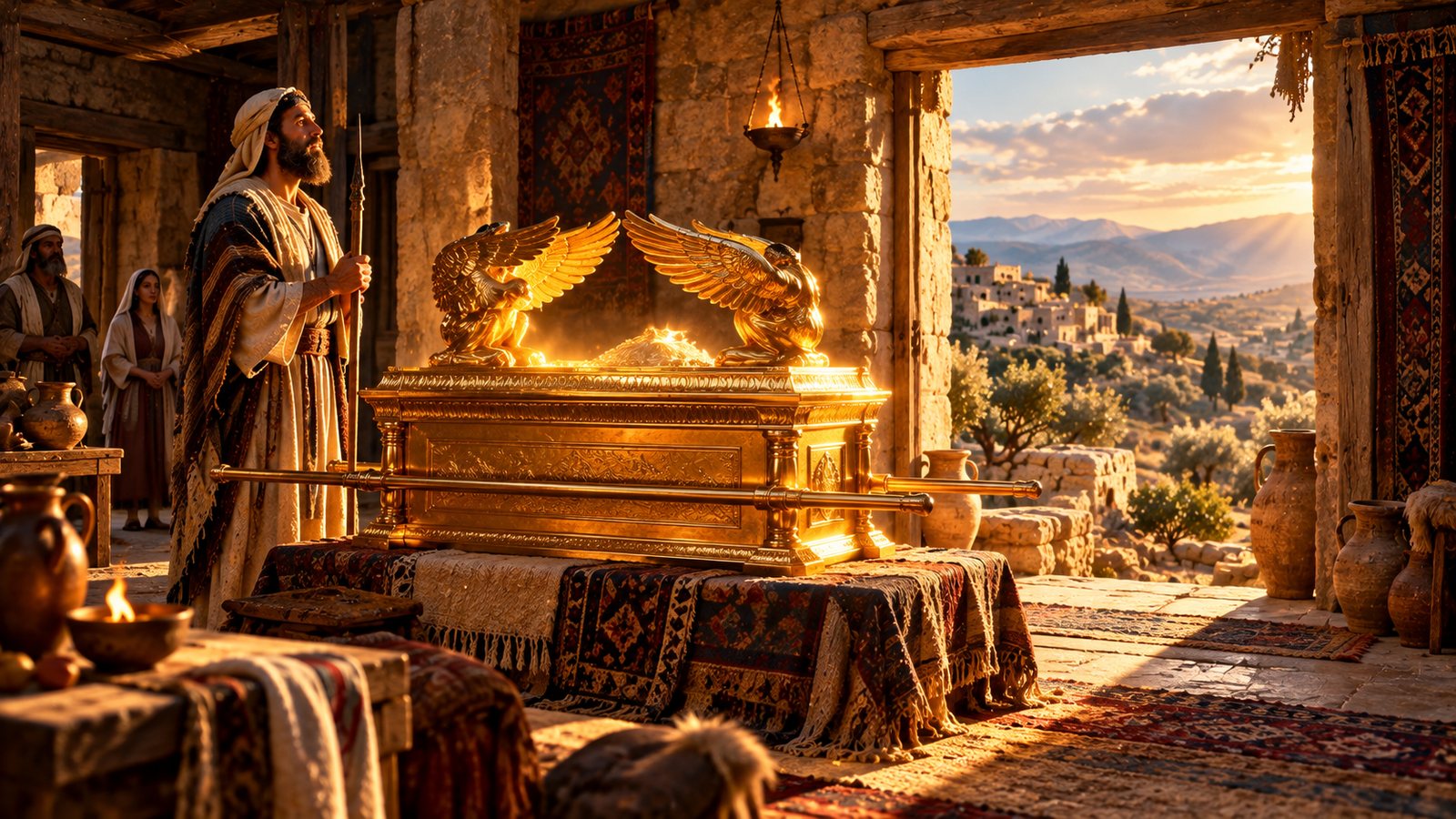
Setting: From the judges toward Israel's monarchy; exact dates are debated. Principal figures: the Philistines, the people of Beth-shemesh and Kiriath-jearim, Eleazar, and Samuel. Primary passages: 1 Samuel 5–7; 2 Samuel 6.
Our previous two stops explored the spiritual confusion of the judges. At Shiloh, Hannah prayed, Samuel learned to listen, and Eli's sons corrupted their priestly calling. In battle, Israel brought the Ark of the Covenant from Shiloh as though it guaranteed victory. Instead, the Philistines defeated Israel and captured the Ark (1 Samuel 4). We then paused at Micah's shrine and Danite idolatry in Judges 17–18, another episode from this broad era, not necessarily later in time. Now we resume the Ark's story immediately after its capture. We will travel with the narrative from Philistine cities back into Israel and finally to Kiriath-jearim, where the Ark remains for many years. Later David will seek to bring it to Jerusalem (2 Samuel 6). Our next chapter will visit the Tabernacle at Gibeon, a reminder that the Ark and the sanctuary furnishings were not always in the same place.
The God Who Needs No Rescue
Imagine the Philistines celebrating their victory. They had defeated Israel's army and carried off the Ark associated with Israel's God. They brought it to Ashdod and placed it in the temple of Dagon, beside the image of their god (1 Samuel 5:1–2).
But the next morning Dagon lay fallen face down before the Ark. The Philistines set the image upright; the following morning it had fallen again, this time with its head and hands broken off (1 Samuel 5:3–5).
The message is striking. Israel could not manipulate God into granting victory by carrying the Ark into battle. Yet the Philistines could not turn their capture of the Ark into proof that Dagon was stronger than the Lord. God did not need an Israelite army to defend His honor in Dagon's temple.
The Lord's hand weighed heavily on the people of Ashdod and the surrounding area. The Philistines moved the Ark to Gath and then Ekron, but suffering and alarm followed (1 Samuel 5:6–12). The narrative describes a devastating affliction, though the exact medical nature of the disease is uncertain. The Philistine rulers eventually decided the Ark must be returned.
The Ark was holy because of the Lord whose covenant presence it represented. It was not a magical object with power independent of Him. The God of Israel remained sovereign even when His people had been defeated.
A Cart on the Road Home
After seven months in Philistine territory, the rulers consulted priests and diviners about returning the Ark. They prepared a new cart, placed the Ark upon it with a guilt offering, and harnessed two milk cows that had not previously pulled a yoke. Their calves were kept behind (1 Samuel 6:1–10).
The Philistines devised a test: if the cows went toward Israel rather than turning back toward their calves, they would understand that the Lord had brought their calamity upon them. The cows went straight toward Beth-shemesh, without turning aside (1 Samuel 6:11–12).
The people of Beth-shemesh rejoiced to see the Ark. They offered sacrifices in response (1 Samuel 6:13–18). But the joy was followed by judgment associated with irreverent treatment of the Ark. The Hebrew text and ancient translations differ on the number of people struck down, so we should not make a disputed casualty figure the centerpiece of the lesson (1 Samuel 6:19–20).
The people asked who could stand before the Lord, this holy God. Their question echoes a truth the Tabernacle had taught from the beginning: God graciously comes near, but His holiness is not something we may treat casually.
20The men of Beth Shemesh said, “Who is able to stand before Yahweh, this holy God? To whom shall he go up from us?”
21They sent messengers to the inhabitants of Kiriath Jearim, saying, “The Philistines have brought back Yahweh’s ark. Come down and bring it up to yourselves.”
Resting at Kiriath-jearim
The people of Beth-shemesh sent word to Kiriath-jearim asking its inhabitants to come and take the Ark. They brought it to the house of Abinadab on the hill and consecrated his son Eleazar to have charge of it (1 Samuel 6:21–7:1).
This is where our journey pauses. The Ark that had traveled with Israel through the wilderness and stood in the Tabernacle at Shiloh now rested in a household at Kiriath-jearim.
Scripture does not tell us that Abinadab's house became a replacement Tabernacle or that Eleazar assumed the full duties of Israel's high priest. The text says he was consecrated to care for the Ark. We should not invent a detailed worship program at the house.
The Ark remained there for a long period. First Samuel 7:2 mentions twenty years before describing Israel's lamenting after the Lord; other passages show that the Ark was still there when David later moved it, so the total stay was longer than that initial twenty-year reference (1 Chronicles 13:5–7). Exact calculations depend on debated chronology.
1The men of Kiriath Jearim came and took Yahweh’s ark, and brought it into Abinadab’s house on the hill, and consecrated Eleazar his son to keep Yahweh’s ark.
2From the day that the ark stayed in Kiriath Jearim, the time was long—for it was twenty years; and all the house of Israel lamented after Yahweh.
3Samuel spoke to all the house of Israel, saying, “If you are returning to Yahweh with all your heart, then put away the foreign gods and the Ashtaroth from among you, and direct your hearts to Yahweh, and serve him only; and he will deliver you out of the hand of the Philistines.”
4Then the children of Israel removed the Baals and the Ashtaroth, and served Yahweh only.
The Ark Was Near; Hearts Were Far
What is most surprising about this chapter is that the Ark's return did not automatically bring national renewal. The people could point to the Ark's location in Israel, yet Samuel still had to call them to turn to the Lord.
Samuel told the house of Israel to return with all their hearts, put away foreign gods and the Ashtaroth, direct their hearts to the Lord, and serve Him alone (1 Samuel 7:3). The people responded by removing their Baals and Ashtaroth and serving the Lord (1 Samuel 7:4).
Notice the difference between possessing a sacred object and belonging wholeheartedly to God. Israel did not need a better strategy for moving the Ark. It needed repentance.
The same danger appears throughout our journey. In Eden, humanity questioned God's goodness. At Sinai, Israel made a golden calf while Moses received God's word. At Shiloh, leaders treated ministry as a privilege to exploit, and an army treated the Ark as a guarantee. Micah built his own shrine and expected prosperity because he had a Levite. Again and again, people sought security in something they could see, possess, or control.
God's invitation remained the same: trust Me, listen to My word, and return to Me.
Samuel Calls the People to Mizpah
5Samuel said, “Gather all Israel to Mizpah, and I will pray to Yahweh for you.”
6They gathered together to Mizpah, and drew water, and poured it out before Yahweh, and fasted on that day, and said there, “We have sinned against Yahweh.” Samuel judged the children of Israel in Mizpah.
7When the Philistines heard that the children of Israel were gathered together at Mizpah, the lords of the Philistines went up against Israel. When the children of Israel heard it, they were afraid of the Philistines.
Samuel gathered Israel at Mizpah, where the people fasted and confessed their sin before the Lord (1 Samuel 7:5–6). Their worship was not a display of national strength. It was an admission of need.
When the Philistines heard about the gathering, they advanced against Israel. The people became afraid and asked Samuel to continue crying out to the Lord for them (1 Samuel 7:7–8).
8The children of Israel said to Samuel, “Don’t stop crying to Yahweh our God for us, that he will save us out of the hand of the Philistines.”
9Samuel took a suckling lamb, and offered it for a whole burnt offering to Yahweh. Samuel cried to Yahweh for Israel, and Yahweh answered him.
10As Samuel was offering up the burnt offering, the Philistines came near to battle against Israel; but Yahweh thundered with a great thunder on that day on the Philistines and confused them; and they were struck down before Israel.
Samuel offered a lamb as a whole burnt offering and cried to the Lord on Israel's behalf. The Lord answered. As the Philistines approached, the Lord thundered against them, throwing them into confusion, and Israel prevailed (1 Samuel 7:9–11).
The contrast with 1 Samuel 4 could hardly be clearer. Earlier, Israel brought the Ark into battle as though its presence could force God's help. Here the people confessed their sin and depended on the Lord's mercy. The text does not suggest that repentance is a mechanical technique for guaranteeing victory. It shows a people returning to the God they had neglected.
Samuel set up a stone between Mizpah and Shen and named it Ebenezer, acknowledging that the Lord had helped them to that point (1 Samuel 7:12). Unlike Micah's image, this memorial was not a manufactured god. It testified to the help of the living God.
The Lie and the Truth: Can We Control His Presence?
The dominant lie in this chapter is that having the right sacred object nearby makes us spiritually secure, regardless of the condition of our hearts.
The truth is that God's presence is His gift, not our possession. The Ark could be carried into battle, captured, returned, and guarded. But the Lord could neither be defeated by the Philistines nor manipulated by Israel.
Scripture does not say Satan whispered this particular lie to Israel. It shows the pattern in their actions. The temptation to replace trust with a visible guarantee belongs to fallen humanity. We prefer something we can manage over a Father whose wisdom asks us to trust Him.
The God who met Abraham at Moriah and provided the ram was still the God who called Israel to return. His character had not changed. The question was whether His people would believe Him.
From Kiriath-jearim Toward David
The Ark remained at Kiriath-jearim as Israel moved toward monarchy. Samuel grew old; the people demanded a king; Saul was chosen; and eventually David rose to lead Israel (1 Samuel 8–16; 2 Samuel 5).
David would later attempt to bring the Ark from the house of Abinadab toward Jerusalem (2 Samuel 6:1–5; 1 Chronicles 13). That journey would itself reveal the seriousness of honoring God's instructions. We will return to it when we reach David's Tent.
Meanwhile, the Tabernacle's worship arrangements developed separately from the Ark's resting place. The later biblical record places the Tabernacle and bronze altar at Gibeon in the time of David and Solomon (1 Chronicles 16:39–40; 21:29; 2 Chronicles 1:3–6). Our next stop explores that unusual separation.
The Ark Is Not the Place Itself
The Ark stood for God's covenant presence, yet the Lord was never confined to it. He could be present with His people, humble a rival god in Dagon's temple, and call His people back to Himself without Israel's army or the Ark's location to defend Him. The place where God meets His people is wherever He chooses to dwell and on the terms He sets.
What He asked at Kiriath-jearim was not a better way to guard the Ark. It was a return of the heart, with foreign gods put away and worship given to Him alone.
Our Temple Prayer Today
19Having therefore, brothers, boldness to enter into the holy place by the blood of Jesus,
20by the way which he dedicated for us, a new and living way, through the veil, that is to say, his flesh,
21and having a great priest over God’s house,
22let’s draw near with a true heart in fullness of faith, having our hearts sprinkled from an evil conscience and having our body washed with pure water,
Through Jesus Christ, God's children enjoy something greater than the custody of the Ark. Jesus is our High Priest, and through His sacrifice we are invited to draw near to the Father with confidence (Hebrews 4:14–16; 10:19–22). The Holy Spirit dwells within and among believers (1 Corinthians 3:16; 6:19). Our identity is not grounded in an object we possess but in belonging to God through His Son (Romans 8:15–17).
We are called a royal priesthood, and our first ministry is worship in spirit and truth (1 Peter 2:9; John 4:23–24). That means thanksgiving, faith, confession, repentance, surrender, obedience, and intercession. Temple Prayer can help us remember those biblical movements, but it is not a spiritual machine for producing blessings.
Samuel's invitation still challenges us: turn to the Lord with all your heart. As we minister to Him, He ministers to us through His word and Spirit, exposing false securities and teaching us to trust His goodness. Sometimes that means receiving comfort. Sometimes it means laying aside an idol we have kept too long.
The Question We Carry Forward
At Kiriath-jearim, the Ark was safe in a household. Yet the real renewal began when the people returned to the Lord Himself.
What do we rely on for spiritual security: a treasured symbol, a familiar practice, a respected leader, or the living Father who calls us to trust Him?
Our journey continues to Gibeon, where the Tabernacle and altar remain important even while the Ark is elsewhere. The story will prepare us to understand David's longing for God's presence and Solomon's later construction of the Temple.
Temple Prayer Response: Returning to the Lord With All My Heart
You do not need a formula to respond to what you have just read. Here is a sample prayer to begin with. Make it your own, and keep going in your own words.
Father, thank You that You are holy and that You are faithful, even when Your people have misunderstood You. Forgive me for the times I have trusted a symbol, a habit, or a person more than You. Jesus, thank You that You are my High Priest and that I may draw near with a true heart. Holy Spirit, show me any idol I have kept too long, and give me the courage to lay it down. I return to You with all my heart. Amen.
Now be still for a moment. Ask Him what false security He is inviting you to put away, and listen for His answer.
1 Samuel 4–7; 8–16; 2 Samuel 5–6; 1 Chronicles 13; 16:39–40; 21:29; 2 Chronicles 1:3–6; Hebrews 4:14–16; 10:19–22; John 4:23–24; Romans 8:15–17; 1 Corinthians 3:16; 6:19; 1 Peter 2:9.
Scripture quotations are from the World English Bible Classic (WEB), public domain (ebible.org/eng-web), and were checked against that text. Commentary is the author's own. The exact length of the Ark's stay at Kiriath-jearim is uncertain; the twenty years in 1 Samuel 7:2 should not be treated as the full duration. Ancient textual witnesses differ over the casualty number in 1 Samuel 6:19. The precise identification of ancient Kiriath-jearim and the sequence of sanctuary relocations remain subjects of study. The illustration is an artistic depiction; Scripture does not describe the interior of Abinadab's house.