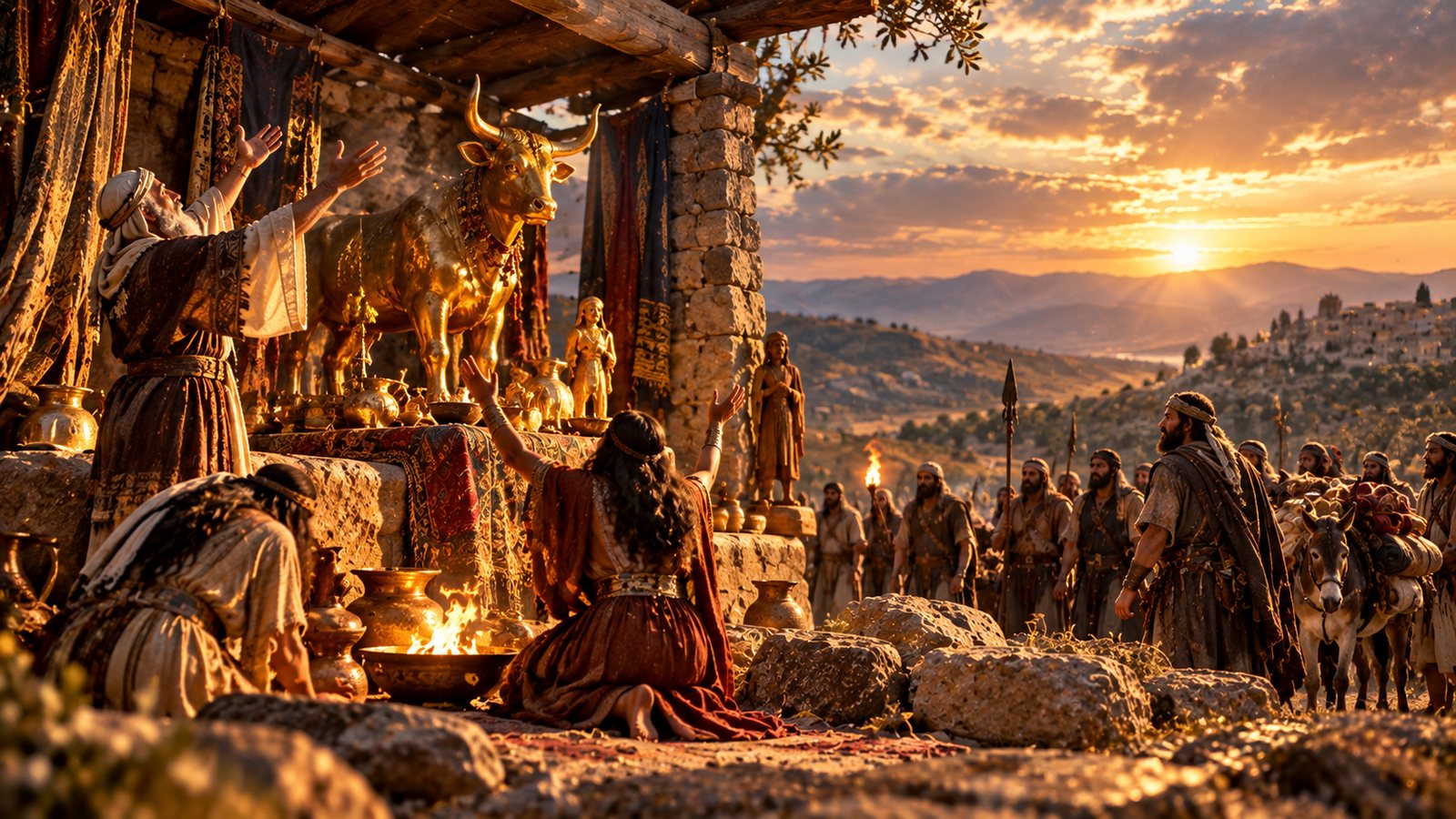
Setting: The era of the judges; the episode's precise date within that era is uncertain. Principal figures: Micah of Ephraim, his mother, a young Levite, and the tribe of Dan. Primary passages: Judges 17–18.
At our previous stop, the Tabernacle stood at Shiloh. Hannah poured out her heart to God, Samuel learned to listen, Eli's sons dishonored their ministry, and Israel treated the Ark as though it could guarantee victory (Joshua 18; 1 Samuel 1–4). Now we turn backward within the broad era of the judges to Judges 17–18. These chapters appear near the end of the book but are not necessarily later in time than all its preceding events. In fact, the reference to Jonathan, a descendant of Moses, may suggest an early setting, though the chronology is debated. Our journey is therefore thematic within this period rather than a claim that Micah's events occurred after Samuel's childhood. We have seen a sanctuary established according to God's command. Now we will enter a private home where people build something that looks religious but departs from what God said. The contrast is the point.
A House Full of Religion
The story begins with a man named Micah in the hill country of Ephraim. He admits taking eleven hundred pieces of silver from his mother. After hearing her pronounce a curse over the thief, he returns the money. His mother blesses him in the Lord's name and declares that she is dedicating the silver to the Lord so an image can be made (Judges 17:1–3).
Already the contradictions are startling. Theft and fear of a curse are followed by a blessing and a declaration of devotion. Then a portion of the silver is given to a silversmith to make an image, which is placed in Micah's house (Judges 17:4).
Micah has a shrine, an ephod, and household gods. He appoints one of his sons as priest (Judges 17:5). The household is full of religious language and objects. Yet Israel's covenant had forbidden carved images for worship and had given specific instructions for priestly service (Exodus 20:4–6; Numbers 3:5–10).
This is one of the most dangerous kinds of spiritual confusion: people can sincerely believe they are honoring God while setting aside the very word by which He revealed how He is to be worshiped.
The Verse That Explains the Age
4When he restored the money to his mother, his mother took two hundred pieces of silver, and gave them to a silversmith, who made a carved image and a molten image out of it. It was in the house of Micah.
5The man Micah had a house of gods, and he made an ephod, and teraphim, and consecrated one of his sons, who became his priest.
6In those days there was no king in Israel. Everyone did that which was right in his own eyes.
The narrator interrupts with a diagnosis: Israel had no king, and everyone did what was right in his own eyes (Judges 17:6).
The problem is larger than a missing human ruler. The story exposes what happens when personal preference replaces submission to the Lord. Micah has not openly announced that he hates God. Instead, he has assembled a worship system that combines the Lord's name with practices the Lord did not authorize.
This is the dominant lie of the chapter: "If I mean well, and my religious practices make me feel secure, I can decide for myself what obedience looks like."
But God's truth does not change to accommodate our preferences. The One who redeemed Israel from Egypt had spoken His covenant commands. He invited them to be His people, not to remake Him in a form they could own.
A Priest for Hire
10Micah said to him, “Dwell with me, and be to me a father and a priest, and I will give you ten pieces of silver per year, a suit of clothing, and your food.” So the Levite went in.
11The Levite was content to dwell with the man; and the young man was to him as one of his sons.
12Micah consecrated the Levite, and the young man became his priest, and was in the house of Micah.
A young Levite from Bethlehem in Judah travels through the hill country looking for a place to stay. Micah offers him lodging, clothing, food, and an annual payment if he will serve as his priest (Judges 17:7–10).
The Levite accepts. Micah then declares his confidence that the Lord will prosper him because he now has a Levite as priest (Judges 17:11–13).
Notice the progression. First Micah creates his own shrine. Then he appoints a priest from his household. Finally, when a Levite appears, he treats the man's lineage as a guarantee of divine favor. Rather than asking whether the whole arrangement obeys God's word, he assumes the addition of an apparently qualified religious figure will secure God's blessing.
This is the same error we encountered at Shiloh when Israel carried the Ark into battle. The outward symbol becomes a substitute for trust. Micah has confused possession of a priest with fellowship with God.
Five Men Look for Land
Meanwhile, the tribe of Dan struggles to establish its allotted territory (Judges 18:1; compare Joshua 19:40–48 and Judges 1:34). Five men are sent to explore the land. On their journey they lodge near Micah's house and recognize the voice of the young Levite (Judges 18:2–3).
They ask him to inquire of God whether their mission will succeed. He gives them a favorable answer (Judges 18:5–6). But the narrative does not tell us that this private consultation was authorized by the Lord. We should not treat the priest's reassuring words as proof that God endorsed the shrine or the Danites' later actions.
The scouts travel north and find Laish, a city they regard as prosperous and vulnerable. They return to their tribe with an encouraging report (Judges 18:7–10). Soon six hundred armed Danites set out.
Theft in the Name of Worship
18When these went into Micah’s house, and took the engraved image, the ephod, the teraphim, and the molten image, the priest said to them, “What are you doing?”
19They said to him, “Hold your peace, put your hand on your mouth, and go with us. Be a father and a priest to us. Is it better for you to be priest to the house of one man, or to be priest to a tribe and a family in Israel?”
20The priest’s heart was glad, and he took the ephod, the teraphim, and the engraved image, and went with the people.
As the Danite force passes Micah's house, the five scouts tell their companions about the shrine, ephod, household gods, and carved image. They enter and take the religious objects while the priest stands nearby (Judges 18:14–17).
The priest protests at first, but the Danites offer him a larger position: why serve one household when he could become priest to an entire tribe? He is pleased by the opportunity and goes with them, carrying the sacred objects (Judges 18:18–20).
This scene reveals the hollowness of the entire arrangement. The image can be stolen. The priest can be recruited away by a better offer. The supposed source of security is portable not because God is faithfully guiding His people, as He did in the wilderness, but because human beings are treating worship as property and influence.
Micah pursues the Danites and asks why they have taken the gods he made and the priest he hired (Judges 18:22–24). His question is tragically revealing: what kind of god can be taken away by thieves? The Danites threaten him, and he turns back because their force is stronger (Judges 18:25–26).
A City Falls; a Shrine Rises
30The children of Dan set up for themselves the engraved image; and Jonathan, the son of Gershom, the son of Moses, and his sons were priests to the tribe of the Danites until the day of the captivity of the land.
31So they set up for themselves Micah’s engraved image which he made, and it remained all the time that God’s house was in Shiloh.
The Danites attack Laish, kill its inhabitants, burn the city, rebuild it, and name it Dan after their ancestor (Judges 18:27–29). The text describes the violence without presenting it as a model for Christian conduct.
They set up the carved image, and Jonathan, identified as a descendant of Moses in the text's genealogical tradition, and his descendants serve as priests for the tribe (Judges 18:30). The chapter says the image remained in use during the period described and notes that the house of God was at Shiloh (Judges 18:30–31). The precise endpoint of this shrine's history is debated because the passage contains textual and chronological difficulties.
That final comparison is devastating. While the Lord's sanctuary was at Shiloh, the Danites maintained their own image-based worship at Dan.
Centuries later, Jeroboam would establish one of his golden-calf sanctuaries at Dan after the division of the kingdom (1 Kings 12:26–30). The later event should not be confused with Micah's shrine, but the geographical echo is striking: Dan becomes associated again with rival worship.
The Lie and the Truth: Who Defines Worship?
The dominant lie is that religious success proves divine approval. Micah expected prosperity because he had a Levite. The Danites expected security from a shrine they had stolen. The priest preferred a larger audience to faithfulness. Each person sought something religion could provide: protection, status, prosperity, or power.
Yet none of these things can replace the Lord Himself. God had not invited Israel to manufacture an image of His presence or buy His favor. He had revealed His character, redeemed them, and given them His word.
Scripture does not record Satan personally speaking to Micah or the Danites. But the deception is clear in their actions: they exchanged God's instructions for arrangements that suited their own interests. The danger is not confined to ancient idols. We can repeat the pattern whenever we value a religious experience, leader, building, ministry, or technique more than the truth God has spoken.
The God Who Cannot Be Owned
23But the hour comes, and now is, when the true worshipers will worship the Father in spirit and truth, for the Father seeks such to be his worshipers.
24God is spirit, and those who worship him must worship in spirit and truth.”
Think back to our journey. In Eden, the serpent invited humanity to distrust the Father's goodness. At Noah's ark, God designed the refuge and Noah trusted His design. At Abraham's altars, the Lord taught His people to respond when He spoke. At Moriah, God provided the ram and taught Abraham to trust His character. At the burning bush, God declared His name and sent Moses. At Sinai, the Lord gave a heavenly pattern for His dwelling, yet Israel quickly turned to a golden calf. At Shiloh, some treated the Ark as a guarantee of victory.
Now at Micah's house and in Dan, the pattern repeats: people seek the benefits of divine presence while refusing the authority of the God who gives it.
The contrast with the Tabernacle is instructive. Moses was told to build according to the pattern God showed him (Exodus 25:9, 40). Micah built according to what seemed good to him. The difference was not craftsmanship. It was whose word governed the worship.
A Shrine Without the Word
God had already told Israel where and how He would meet His people. He gave the pattern for the Tabernacle (Exodus 25:8–9) and said He would choose the place for His name (Deuteronomy 12:5–14). Micah's house shows what happens when people keep the language of worship but write their own rules for where God is found and who may serve Him.
The place where God meets His people is not decided by preference or convenience. He governs it through the worship He ordains.
Our Identity, Our Priesthood, Our Response
9But you are a chosen race, a royal priesthood, a holy nation, a people for God’s own possession, that you may proclaim the excellence of him who called you out of darkness into his marvelous light.
10In the past, you were not a people, but now are God’s people, who had not obtained mercy, but now have obtained mercy.
Under the new covenant, Jesus has opened the way to the Father. Believers are welcomed as God's children and called a royal priesthood (Romans 8:15–17; 1 Peter 2:9). The Holy Spirit dwells in God's people (1 Corinthians 3:16). We no longer need an earthly image, a hired intermediary, or a special building to make God available to us.
But access through Christ is not permission to invent a God who agrees with every preference we have. Jesus calls us to worship the Father in spirit and truth (John 4:23–24). His word renews our minds, and His Spirit helps us discern and obey what is true (John 14:26; Romans 12:2).
That is why Temple Prayer must never become another self-made shrine. The biblical pattern can guide us through thanksgiving, faith in Jesus' sacrifice, repentance, fellowship, and intercession. But the pattern is a servant, not our master. We do not perform steps to control God or secure an outcome. We come to the Father through His Son, and as we minister to Him, He ministers to us through His grace, truth, and Spirit.
The Question We Carry Forward
Micah had religious objects. The Danites had a priest and a shrine. Yet their story warns that a worship system can become elaborate while trust in God becomes shallow.
What are we really seeking when we worship: the living Father, or something we hope to gain from Him?
Our next stop follows the Ark after its capture by the Philistines. At Kiriath-jearim we will discover that the Lord's holiness and faithfulness remain unchanged, even when His people have badly misunderstood His presence.
Temple Prayer Response: Worshiping the Father as He Has Revealed Himself
You do not need a formula to respond to what you have just read. Here is a sample prayer to begin with. Make it your own, and keep going in your own words.
Father, thank You that You have told us who You are and how to come to You. Forgive me for the times I have shaped my worship around my own preferences, or trusted a leader, a routine, or an experience more than You. Jesus, thank You for opening the way to the Father. Holy Spirit, show me anywhere I have built a small shrine of my own, and teach me to worship in spirit and truth. I come to You because You are good, not because I want to use You. Amen.
Now be still for a moment. Ask Him whether anything has taken the place of His word in how you worship, and listen for His answer.
Judges 17–18; Joshua 19:40–48; Judges 1:34; Exodus 20:4–6; 25:8–9, 40; Numbers 3:5–10; Deuteronomy 12:5–14; 1 Samuel 4–7; 1 Kings 12:26–30; John 4:23–24; 14:26; Romans 8:15–17; 12:2; 1 Corinthians 3:16; 1 Peter 2:9.
Scripture quotations are from the World English Bible Classic (WEB), public domain (ebible.org/eng-web), and were checked against that text. Commentary is the author's own. The order of events in Judges 17–18 relative to Samuel's life is uncertain. The Danite shrine should not be identified as identical to Jeroboam's later sanctuary. Interpretive descriptions of the characters' motives are distinguished from the explicit narrative. Judges 17 mentions a carved image and a molten image but does not describe their shape; the golden bull in the illustration is an artistic choice. In Judges 18:30 the WEB reads "Moses," while some Hebrew manuscripts carry a variant spelling of the name that other translations read as "Manasseh."