Setting: The period from Joshua through the judges, ending with Eli and Samuel. The chronology of the judges is debated. Principal figures: Joshua, Hannah, Eli, Hophni and Phinehas, and Samuel. Primary passages: Joshua 18; Judges; 1 Samuel 1–4.
At our previous stop, God's glory filled the newly completed Tabernacle, and His cloud led Israel through the wilderness (Exodus 40). But Israel's journey toward the promised land was marked by fear and rebellion. When the spies returned from Canaan, the people believed the danger was greater than God's promise (Numbers 13–14). After the wilderness years, Moses renewed the covenant before his death. Joshua then led Israel across the Jordan (Joshua 3–4). Jericho fell, the tribes began receiving their inheritances, and Joshua built an altar on Mount Ebal and read the covenant words (Joshua 8:30–35).
Shiloh: A Home for the Tabernacle
1The whole congregation of the children of Israel assembled themselves together at Shiloh, and set up the Tent of Meeting there. The land was subdued before them.
2Seven tribes remained among the children of Israel, which had not yet divided their inheritance.
3Joshua said to the children of Israel, “How long will you neglect to go in to possess the land, which Yahweh, the God of your fathers, has given you?
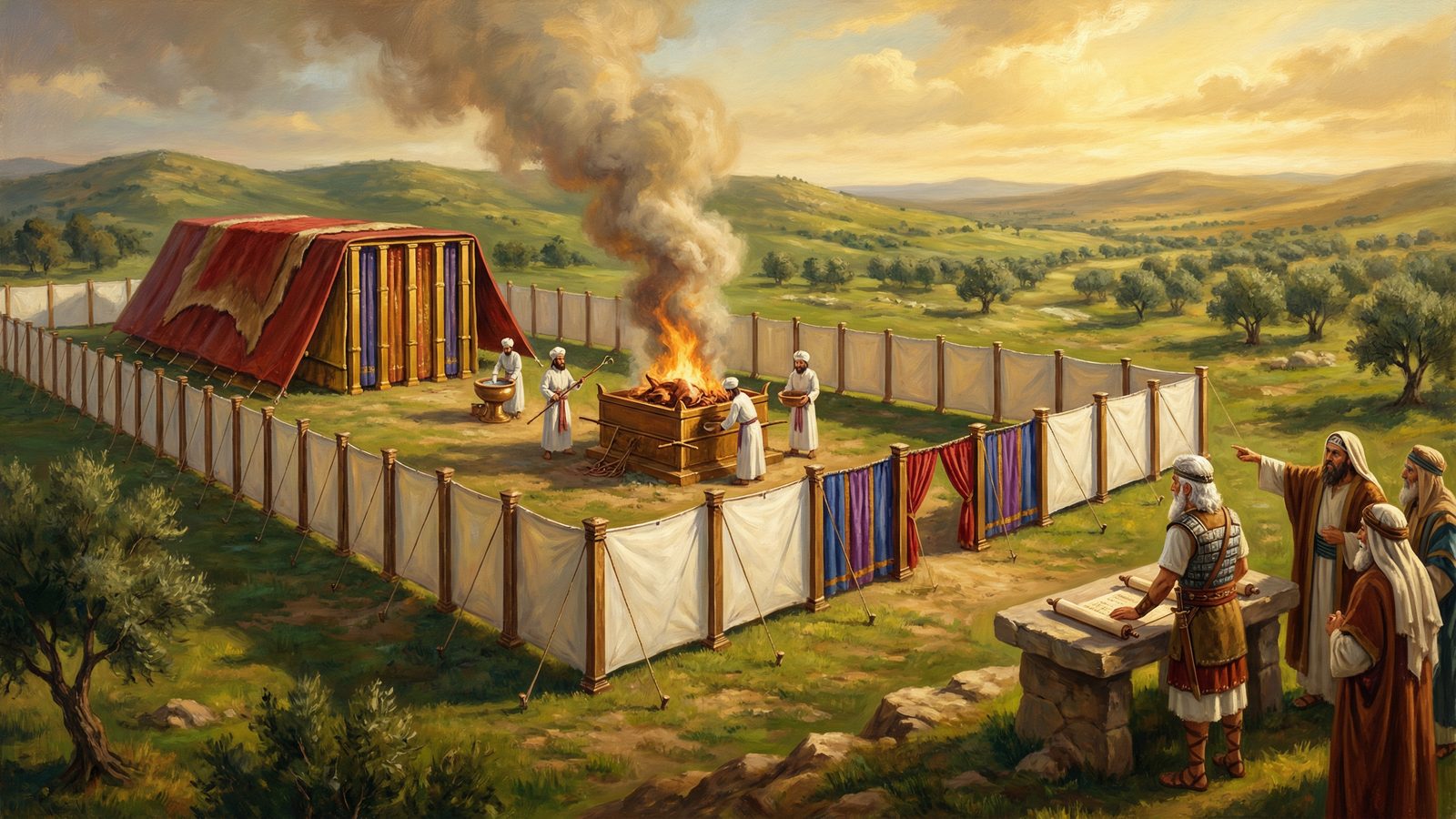
Then came a quiet but momentous event: the whole congregation assembled at Shiloh and set up the Tent of Meeting (Joshua 18:1). The portable sanctuary that had traveled with Israel now stood in the land God had promised. The Lord had not merely brought His people out of slavery; He had brought them into a life ordered around His presence.
Shiloh lay in the hill country of Ephraim, north of Jerusalem. At this sanctuary, Israel assembled before the Lord, and Joshua oversaw the allotment of remaining tribal territories (Joshua 18:1–10). Worship and ordinary communal responsibilities belonged together. The presence of the Tabernacle should have reminded every tribe that its land, future, and identity were gifts from God.
The archaeological site commonly identified with ancient Shiloh is Tel Shiloh, also called Khirbet Seilun. Excavations have revealed significant remains from ancient settlement and materials that researchers study in relation to the site's worship history. But the exact footprint of the biblical Tabernacle has not been established. The landscape helps us picture the setting; the biblical text tells us what happened there.
The People Who Did What Was Right in Their Own Eyes
The book of Judges describes repeated cycles of compromise, oppression, cries for help, and deliverance. The generation after Joshua did not consistently remain faithful to the Lord (Judges 2:10–19). Twice the book summarizes the disorder by saying that people did what was right in their own eyes (Judges 17:6; 21:25).
That is a revealing contrast. The Tabernacle remained among the people, but its presence did not guarantee that every household would listen to God's word. Their dominant temptation was to believe they could keep the signs of belonging to God while making their own desires the final authority.
This does not mean every Israelite was faithless. Scripture will introduce us to people whose humble trust shines against the darkness of the period.
Hannah: Worship Through Tears
12As she continued praying before Yahweh, Eli saw her mouth.
13Now Hannah spoke in her heart. Only her lips moved, but her voice was not heard. Therefore Eli thought she was drunk.
14Eli said to her, “How long will you be drunk? Get rid of your wine!”
15Hannah answered, “No, my lord, I am a woman of a sorrowful spirit. I have not been drinking wine or strong drink, but I poured out my soul before Yahweh.
16Don’t consider your servant a wicked woman; for I have been speaking out of the abundance of my complaint and my provocation.”
In 1 Samuel 1, Hannah comes to Shiloh carrying profound grief. She has no child and suffers repeated provocation within her household. During a visit to worship and sacrifice, she prays earnestly before the Lord, weeping and making a vow (1 Samuel 1:9–11).
Eli the priest sees her lips moving and mistakenly assumes she is drunk. Hannah explains that she has been pouring out her soul before the Lord (1 Samuel 1:12–16). She does not hide her sorrow or pretend to have an answer. She brings her need to the God she trusts.
Eli blesses her, and Hannah leaves with a changed countenance. In time, she bears Samuel and dedicates him to the Lord's service (1 Samuel 1:17–28). Her song in the following chapter praises God's holiness and His care for the humble (1 Samuel 2:1–10).
Hannah reminds us that our first ministry of worship is not confined to joyful songs. We can minister to the Lord through honest prayer, surrender, gratitude, and trust even when our hearts are aching. Her story does not promise that every prayer will receive the same earthly answer. It reveals a Father to whom we may bring our whole selves.
Eli's Sons: Ministry Without Reverence
The contrast becomes painful when Scripture turns to Hophni and Phinehas, Eli's sons. Though serving in priestly roles, they treated the Lord's offerings with contempt and exploited worshipers (1 Samuel 2:12–17). The text also records sexual misconduct with women serving at the entrance to the Tent of Meeting (1 Samuel 2:22). It does not say they traded sexual favors for sacrifices; we should not add that detail.
Eli challenged his sons, but the Lord condemned his failure to restrain them adequately (1 Samuel 2:23–25; 3:13). A prophetic message warned that judgment would fall upon his household.
Here the Temple story becomes a barometer of spiritual health. Sacred clothing, ministry titles, and familiarity with worship did not make these men faithful. The God who welcomed Hannah's humble prayer also saw the corruption of those who were supposed to serve His people.
Samuel Learns to Listen
8Yahweh called Samuel again the third time. He arose and went to Eli and said, “Here I am; for you called me.” Eli perceived that Yahweh had called the child.
9Therefore Eli said to Samuel, “Go, lie down. It shall be, if he calls you, that you shall say, ‘Speak, Yahweh; for your servant hears.’” So Samuel went and lay down in his place.
10Yahweh came, and stood, and called as at other times, “Samuel! Samuel!” Then Samuel said, “Speak; for your servant hears.”
While Eli's household deteriorated, young Samuel ministered before the Lord. One night he heard his name called and assumed Eli had spoken. After repeated calls, Eli recognized that the Lord was calling the boy and instructed him to listen (1 Samuel 3:1–10).
Samuel received a difficult word about judgment on Eli's house. As he grew, the Lord was with him, and Israel recognized him as a prophet (1 Samuel 3:11–21). Shiloh's greatest treasure was not its architecture. It was the living God who still spoke.
Notice the contrast: priests who refused correction, and a child learning to listen. God seeks hearts that respond to His voice, not people who merely stand near holy objects.
The Ark Is Not a Charm
3When the people had come into the camp, the elders of Israel said, “Why has Yahweh defeated us today before the Philistines? Let’s get the ark of Yahweh’s covenant out of Shiloh and bring it to us, that it may come among us and save us out of the hand of our enemies.”
4So the people sent to Shiloh, and they brought from there the ark of the covenant of Yahweh of Armies, who sits above the cherubim; and the two sons of Eli, Hophni and Phinehas, were there with the ark of the covenant of God.
5When the ark of Yahweh’s covenant came into the camp, all Israel shouted with a great shout, so that the earth resounded.
When Israel fought the Philistines, its army suffered defeat. The elders proposed bringing the Ark of the Covenant from Shiloh into the camp, believing its presence would save them (1 Samuel 4:1–4). The camp shouted with excitement when it arrived.
But the Ark was not a weapon Israel could control. The people had confused the symbol of God's covenant presence with a guarantee that God would endorse their actions. Israel suffered a devastating defeat. Hophni and Phinehas died, and the Ark was captured (1 Samuel 4:5–11).
Eli died upon hearing the news. Phinehas's wife, dying after childbirth, named her son Ichabod and lamented the departure of glory from Israel (1 Samuel 4:12–22).
Yet God had not lost His power. The following chapter shows the Lord humbling the Philistine god Dagon without Israel's assistance (1 Samuel 5). He is never dependent on our ability to defend Him.
The Lie and the Truth
Shiloh's dominant lie was this: “If I possess the right religious object, position, or practice, I can be secure without truly trusting and obeying God.”
Hannah's example teaches the opposite. She came without leverage, carrying her need before the Lord. Samuel listened when God spoke. Eli's sons and the army treated holy things as though they could replace holiness of heart.
Scripture does not directly attribute these specific choices to a spoken temptation from Satan. But they expose the familiar fallen tendency to trust what we can manage instead of the Father who calls us to trust Him.
The Warning of Shiloh
12“But go now to my place which was in Shiloh, where I caused my name to dwell at the first, and see what I did to it for the wickedness of my people Israel.
13Now, because you have done all these works,” says Yahweh, “and I spoke to you, rising up early and speaking, but you didn’t hear; and I called you, but you didn’t answer;
14therefore I will do to the house which is called by my name, in which you trust, and to the place which I gave to you and to your fathers, as I did to Shiloh.
After the Ark's capture, Shiloh ceased to be Israel's enduring central sanctuary. The Bible does not explain the exact fate of the Tabernacle structure there. Centuries later, Jeremiah pointed to Shiloh as a warning to Jerusalem: the presence of a sacred building did not shield a disobedient people from judgment (Jeremiah 7:12–14). Psalm 78:56–69 also remembers Shiloh in recounting Israel's unfaithfulness and the Lord's later choice of Zion.
The lesson is not that God was unfaithful to His people. It is that they could not use His gifts to excuse rejection of His word.
Our Temple Prayer Today
14Having then a great high priest who has passed through the heavens, Jesus, the Son of God, let’s hold tightly to our confession.
15For we don’t have a high priest who can’t be touched with the feeling of our infirmities, but one who has been in all points tempted like we are, yet without sin.
16Let’s therefore draw near with boldness to the throne of grace, that we may receive mercy and may find grace for help in time of need.
Through Jesus, believers have access to the Father that the worshipers at Shiloh did not yet possess in its new-covenant fullness (Hebrews 10:19–22). We are welcomed as children and called to serve as a royal priesthood (Romans 8:15–17; 1 Peter 2:9). The Holy Spirit dwells in and among God's people (1 Corinthians 3:16).
But our privilege must never become presumption. Temple Prayer is a guide to thanksgiving, repentance, faith, worship, and intercession, not a formula that forces God's blessing. As we minister to the Lord in spirit and truth, His Spirit teaches, corrects, and strengthens us (John 4:23–24).
Hannah teaches us to pour out our hearts. Samuel teaches us to listen. Eli's sons warn us that ministry without integrity dishonors God. The Ark's capture warns us not to substitute religious confidence for living trust.
Our next stop stays in the period of the judges. Micah's shrine and the tribe of Dan will reveal what happens when people design their own worship while continuing to invoke the Lord's name.
A Place Is a Gift, Not a Guarantee
Shiloh is the Tabernacle settled in the promised land (Joshua 18:1), the place where Israel was to come before the Lord. Hannah shows how to meet Him there: honestly and humbly. Eli's sons and the army show what happens when the place and its objects are used without obedience, and Jeremiah later points Jerusalem to Shiloh as a warning (Jeremiah 7:12–14). The place is a gift, but only because of the God who meets His people there.
Temple Prayer Response: Pouring Out My Heart and Listening
You do not need a formula to respond to what you have just read. Here is a sample prayer to begin with. Make it your own, and keep going in your own words.
Father, thank You that I can pour out my whole heart to You, as Hannah did, without pretending. Forgive me for the times I trusted a religious habit, a position, or my own plan instead of You. Jesus, thank You that You are my great High Priest, who understands my weakness and welcomes me to the throne of grace. Holy Spirit, quiet my heart so I can say, as Samuel did, “Speak, for Your servant hears.” Keep me from presumption, and keep me close to You. Amen.
Now be still for a moment. Bring Him the one thing you have been carrying alone, and then listen.
Numbers 13–14; Joshua 3–4; 8:30–35; 18:1–10; Judges 2:10–19; 17:6; 21:25; 1 Samuel 1–5; Psalm 78:56–69; Jeremiah 7:12–14; John 4:23–24; Romans 8:15–17; 1 Corinthians 3:16; Hebrews 4:14–16; 10:19–22; 1 Peter 2:9.
Scripture quotations are from the World English Bible Classic (WEB), public domain (ebible.org/eng-web), and were checked against that text. Where a passage begins or ends in the middle of a speech, the WEB punctuation is kept. Commentary is the author's own. The chronology of the judges is debated; the precise Tabernacle footprint and the structure's eventual fate at Shiloh remain uncertain. The account of Eli's sons should not be embellished with unrecorded transactions. The “lie and truth” framing is an editorial teaching device, not a quotation from Scripture.