Setting: The Exodus and the wilderness generation. The date of the Exodus is debated. Principal figures: Moses, Aaron, and Israel. Primary passages: Exodus 1–40.
At our last stop, Moses met the Lord in the burning bush at Horeb and was sent back to Egypt to bring God's people out (Exodus 3–4). Behind that call lay a long story. Abraham had climbed Moriah and discovered that the Lord would provide, and the promise continued through Isaac, Jacob, and Jacob's twelve sons. Joseph was sold into Egypt by his brothers, yet God used his suffering to preserve his family during famine (Genesis 37–50). Generations passed, a new Pharaoh arose who did not know Joseph, and the descendants of Israel were enslaved and oppressed (Exodus 1). The Bible does not give us a simple uninterrupted chronology that resolves every historical question about the Exodus. Its central claim, however, is unmistakable: God remembered His covenant, heard His people's cries, and acted to redeem them (Exodus 2:23–25). Our next major stop after this chapter will be Shiloh, where the Tabernacle stands in the land of Canaan (Joshua 18:1).
A Father Who Hears His Children
Moses grew up in Pharaoh's household, fled Egypt, and later encountered the Lord at the burning bush (Exodus 2–3). God revealed His covenant name and sent Moses back to confront Pharaoh. His message was not simply “let these people escape.” The Lord intended to bring them out so they could serve and worship Him (Exodus 3:12; 7:16).
Through the plagues, Egypt's supposed security and Pharaoh's claim to ultimate authority were exposed. At Passover, Israel marked its doorposts with the blood of the appointed lamb, and the Lord brought His people out (Exodus 12). The Red Sea then became another place where rescue seemed impossible until God made a way (Exodus 14).
The order matters. Israel was not rescued because it had already mastered holiness, priestly service, or sanctuary worship. God redeemed a people and then began teaching them how to live with Him. Grace came before the instructions for the Tabernacle.
From the beginning, the Lord's desire was relational. He was forming a people who would know Him, trust His word, and belong to Him. The wilderness was not merely a difficult stretch of geography. It was a place where people shaped by generations in Egypt had to learn a new identity under the care of the living God.
At Sinai: A Nation Called to Be Priests
4‘You have seen what I did to the Egyptians, and how I bore you on eagles’ wings, and brought you to myself.
5Now therefore, if you will indeed obey my voice and keep my covenant, then you shall be my own possession from among all peoples; for all the earth is mine;
6and you shall be to me a kingdom of priests and a holy nation.’ These are the words which you shall speak to the children of Israel.”
Three months after leaving Egypt, Israel reached Sinai (Exodus 19:1). God reminded them that He had carried them out of Egypt and brought them to Himself. He called them to be His treasured possession, a kingdom of priests, and a holy nation (Exodus 19:4–6). Their calling was never simply to own sacred furniture. They were to belong to God and represent His character before the nations.
The mountain trembled with thunder, fire, cloud, and trumpet sound. God spoke His covenant commandments (Exodus 19–20). Those commands taught a redeemed people how to honor Him and how to live with one another. Worship and ethics could not be separated: a nation that bowed before God but oppressed its neighbors would contradict the very testimony it had received.
Here is an early foundation of the calling that the New Testament will later describe for believers in Christ: a royal priesthood, offering spiritual sacrifices and declaring God's excellencies (1 Peter 2:5, 9). The covenants are not identical, but the continuity is meaningful. God wants a people who minister to Him and make His goodness known.
Israel's Answer at Sinai
7Moses came and called for the elders of the people, and set before them all these words which Yahweh commanded him.
8All the people answered together, and said, “All that Yahweh has spoken we will do.” Moses reported the words of the people to Yahweh.
9Yahweh said to Moses, “Behold, I come to you in a thick cloud, that the people may hear when I speak with you, and may also believe you forever.” Moses told the words of the people to Yahweh.
The people answered together that they would do all the Lord had spoken. Their promise was sincere in the moment, but the chapters ahead will show how quickly good intentions can fail when trust is tested. The covenant began with God's redeeming act and His call, and it asked for the response of faithful obedience.
The Invitation: Let Them Make Me a Sanctuary
8Let them make me a sanctuary, that I may dwell among them.
9According to all that I show you, the pattern of the tabernacle, and the pattern of all of its furniture, even so you shall make it.
10“They shall make an ark of acacia wood. Its length shall be two and a half cubits, its width a cubit and a half, and a cubit and a half its height.
In Exodus 25, God gives Moses a remarkable command: construct a sanctuary so He may dwell among His people (Exodus 25:8–9). The Creator who cannot be contained by heaven and earth chooses to make His presence known in the midst of a traveling nation.
Moses is told to make the Tabernacle according to the pattern shown him on the mountain (Exodus 25:9, 40). This brings us back to Chapter 1, where we began with the heavenly reality behind the earthly sanctuary. Hebrews 8:5 later describes the earthly priestly service as a copy and shadow of heavenly things.
The Tabernacle was portable. God was not asking Israel to build a monument they could visit only when convenient. He was ordering their camp around His dwelling. His presence would shape where they lived, how they traveled, and how they worshiped.
The sanctuary did not mean God was limited to a tent. It meant the God of Israel graciously chose to dwell among His people in a special covenantal way. The heart of the story is not architecture for its own sake. It is His invitation: I will be your God, and you will be My people (Exodus 29:45–46).
A Walk Through the Tabernacle
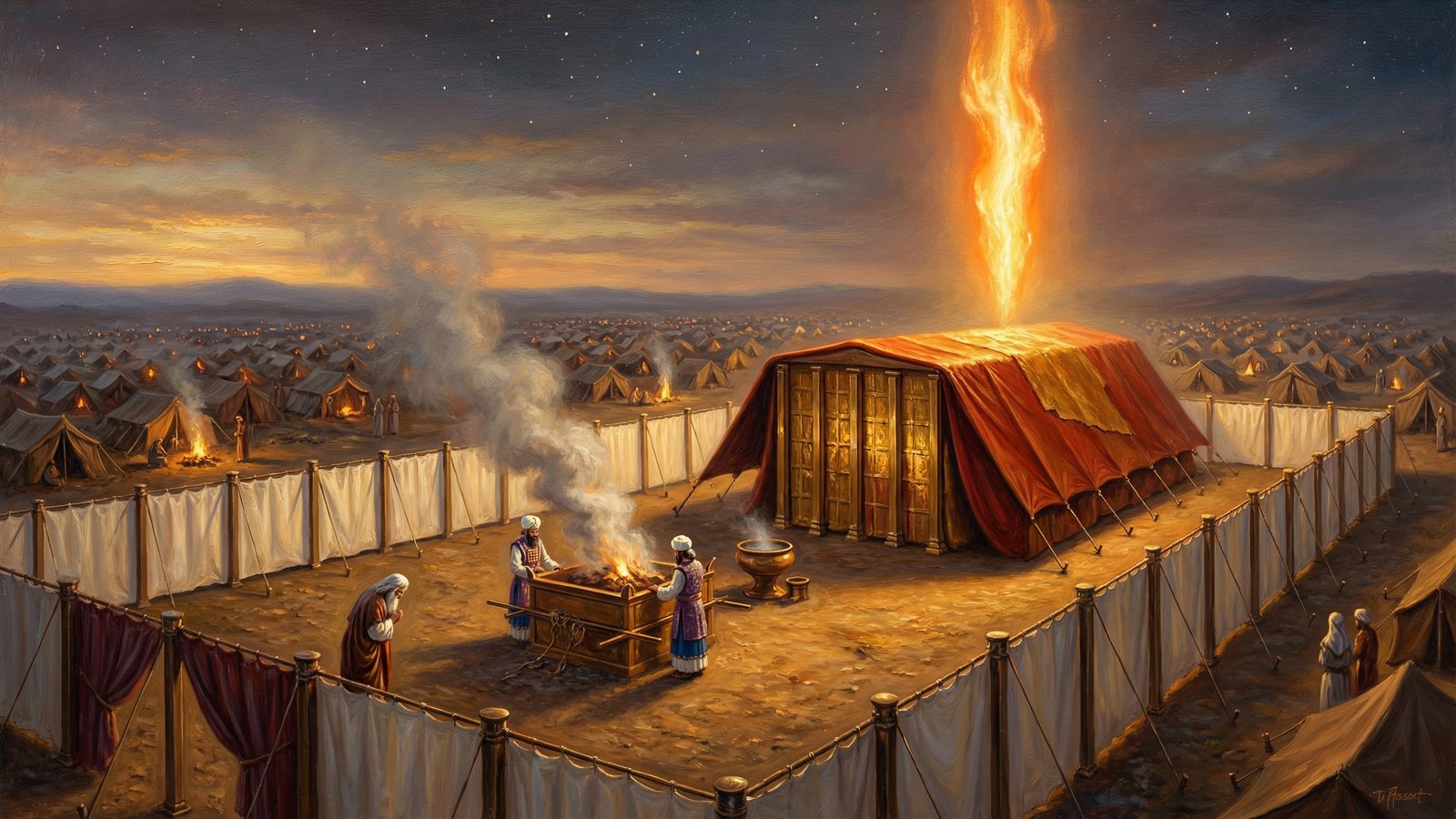
Imagine approaching the camp's center. Inside the courtyard stood the bronze altar, where offerings were presented, and the bronze basin, where priests washed before ministering (Exodus 27:1–8; 30:17–21). The altar reminds us that sin is serious and approaching a holy God is not casual. The basin joins priestly service to cleansing. Neither was an automatic machine for making a heart righteous; both belonged to the covenant worship God had commanded.
Beyond the courtyard curtain lay the Holy Place. The lampstand gave light; the table held the bread of the Presence; the golden altar of incense stood before the inner veil (Exodus 25:23–40; 30:1–10). The priestly ministry involved tending the lamps, setting out the bread, and offering incense according to God's instructions. These acts taught Israel to order its worship around God's presence and provision.
Behind the veil was the Most Holy Place, containing the ark of the covenant and its atonement cover, commonly called the mercy seat (Exodus 25:10–22; 26:31–34). The testimony of God's covenant was associated with the ark. The sanctuary proclaimed both God's holiness and His willingness to meet His people through the means He provided.
Not everyone entered every space. Priests served in the sanctuary, and the high priest's access to the Most Holy Place was specially restricted and later regulated on the Day of Atonement (Leviticus 16). The arrangement was a gift, but it also made a painful truth visible: sin had not yet been finally removed. The way into God's immediate presence was not open in the fullness later accomplished through Jesus (Hebrews 9:6–12; 10:19–22).
The Lie and the Truth: Can We Trust a God We Cannot See?
1When the people saw that Moses delayed coming down from the mountain, the people gathered themselves together to Aaron, and said to him, “Come, make us gods, which shall go before us; for as for this Moses, the man who brought us up out of the land of Egypt, we don’t know what has become of him.”
2Aaron said to them, “Take off the golden rings, which are in the ears of your wives, of your sons, and of your daughters, and bring them to me.”
3All the people took off the golden rings which were in their ears, and brought them to Aaron.
Even while Moses was on the mountain receiving the Lord's commands, the people grew impatient. They demanded that Aaron make gods to go before them. Aaron fashioned a golden calf, and the people offered sacrifices and celebrated before it (Exodus 32:1–6).
What a contradiction. The God who defeated Pharaoh, parted the sea, and fed them in the wilderness had made His power known. Yet in a moment of uncertainty, Israel turned toward something visible and controllable.
Scripture records the idolatry plainly; it does not require us to invent a direct speech from Satan behind the event. But the lie is recognizable: “If I cannot see or control God, I need another source of security.” That lie competes with the truth God had already revealed through His saving acts. He was present, faithful, and worthy of their trust.
Moses interceded for the people (Exodus 32:11–14, 30–32). The episode exposed both the seriousness of covenant rebellion and the necessity of mercy. It also warned that outward religious enthusiasm can be directed toward a false god. Worship must be governed by truth, not simply emotion or spectacle.
God's Glory Fills the Tabernacle
34Then the cloud covered the Tent of Meeting, and Yahweh’s glory filled the tabernacle.
35Moses wasn’t able to enter into the Tent of Meeting, because the cloud stayed on it, and Yahweh’s glory filled the tabernacle.
36When the cloud was taken up from over the tabernacle, the children of Israel went onward, throughout all their journeys;
37but if the cloud wasn’t taken up, then they didn’t travel until the day that it was taken up.
38For the cloud of Yahweh was on the tabernacle by day, and there was fire in the cloud by night, in the sight of all the house of Israel, throughout all their journeys.
After judgment, intercession, covenant renewal, and the people's generous contribution of materials and skilled work, the Tabernacle was constructed as the Lord commanded (Exodus 33–39). Exodus repeatedly emphasizes that the work was done according to God's instructions.
Then, at the end of Exodus, the cloud covered the tent of meeting and the glory of the Lord filled the Tabernacle (Exodus 40:34–35). Moses could not enter because of the cloud and the glory. The God who heard enslaved people in Egypt had come to dwell among them.
The cloud would lift when Israel was to journey, and rest when they were to remain. Fire appeared in it by night (Exodus 40:36–38). His presence was not a decorative addition to their religion. It was the organizing center of their life together.
But the Tabernacle's story does not end in effortless faithfulness. Leviticus and Numbers will record priestly failure, grumbling, rebellion, and the temptation to turn to other gods. Nadab and Abihu's unauthorized offering brought judgment in the wilderness priestly setting (Leviticus 10:1–3). At Baal-Peor, some Israelites joined themselves to idolatrous worship and sexual immorality (Numbers 25:1–3). Being near sacred things did not automatically make hearts faithful.
From the Pattern to the Person
1Now in the things which we are saying, the main point is this: we have such a high priest, who sat down on the right hand of the throne of the Majesty in the heavens,
2a servant of the sanctuary and of the true tabernacle which the Lord pitched, not man.
The Tabernacle teaches us to draw near on God's terms. Yet the New Testament insists that the earthly sanctuary pointed beyond itself. Jesus Christ is the greater High Priest who entered the greater and more perfect sanctuary, securing redemption through His own blood (Hebrews 9:11–14). At Moriah we saw the ram that God provided; at Passover we saw blood marking Israel's deliverance; in Jesus we meet the Lamb of God whose sacrifice addresses sin at its deepest level (John 1:29).
Under the new covenant, those who belong to Christ are welcomed as the Father's children (Romans 8:15–17). The Holy Spirit dwells in and among God's people (1 Corinthians 3:16; 6:19; Ephesians 2:19–22). We do not need to reconstruct a wilderness tent to gain access to God. Jesus has opened the way (Hebrews 10:19–22).
Still, the Tabernacle offers a beautiful pattern for remembering what it means to minister to the Lord. Thanksgiving, faith in His provision, repentance, dependence on the Spirit, fellowship, and intercession can help guide our daily Temple Prayer. These are not steps that earn His affection. We come because He has already invited us through Christ.
Temple Prayer teaches this pattern with a simple modern picture. The courtyard is like a front yard: the gate, the altar, and the basin, where we come with thanksgiving, faith in Jesus' blood, and repentance. The Holy Place is like a living room: the lampstand, the table, and the incense, where we welcome the Holy Spirit, enjoy fellowship, and intercede. The Most Holy Place is like a master suite: access through Jesus, resting, and listening. This is a teaching analogy, not biblical terminology, and not a required sequence.
And as we minister to Him in spirit and truth, He ministers to us through His word and Spirit, correcting us, strengthening us, renewing our minds, and teaching us to trust the Father. His presence is our ultimate refuge, even when the wilderness remains difficult.
The Center of the Camp
9But you are a chosen race, a royal priesthood, a holy nation, a people for God’s own possession, that you may proclaim the excellence of him who called you out of darkness into his marvelous light.
10In the past, you were not a people, but now are God’s people, who had not obtained mercy, but now have obtained mercy.
Egypt had taught Israel to live under Pharaoh's demands. Sinai taught them whose people they truly were. The Tabernacle placed God's dwelling at the center of their life.
Here is the question we carry forward: Will God's people organize their lives around His presence, or will they turn again to the familiar idols of fear, impatience, and control?
At our next stop, Shiloh, the portable sanctuary will stand in the promised land. The setting changes, but the central question remains: Will a people privileged to have God's dwelling among them also listen to His voice?
A Nation With a Calling
At Sinai a family became a nation, and God gave that nation a calling: to be His own treasured possession, a kingdom of priests, and a holy nation (Exodus 19:5–6). Israel was chosen for the sake of the world, to make the one true God known. When the people fell into the golden calf, they did not cancel that calling; they showed how much they needed God's mercy. The New Testament speaks of the Church in the same priestly words (1 Peter 2:9), yet Scripture never says Israel's calling was taken away, because the gifts and the calling of God are irrevocable (Romans 11:29).
The Place at the Center
The Tabernacle is where this idea becomes visible. God chose the place at the center of the camp and gave the pattern, the priests, and the offerings, so He governed Israel's life through ordained worship (Exodus 25:8–9; 29:45–46). The golden calf shows the alternative: a place and a worship that people design for themselves. Everything that follows tests whether God's people will meet Him on His terms.
Temple Prayer Response: Making Room for His Presence
You do not need a formula to respond to what you have just read. Here is a sample prayer to begin with. Make it your own, and keep going in your own words.
Father, thank You that You heard Your people in bondage, and that You hear me. Thank You that You redeemed first and then invited Your people to dwell with You. Forgive me for the golden calves I have reached for when I could not see or control You. Jesus, thank You that You are my High Priest, and that You have opened the way into the Father's presence. Holy Spirit, make my life a dwelling place for God. Teach me to organize my days around Your presence, and to follow where You lead. Amen.
Now be still for a moment. Ask Him what has taken the center of your camp, and invite Him to take His place.
Genesis 37–50; Exodus 1–3; 12–14; 19–20; 25–32; 33–40; Leviticus 10:1–3; 16; Numbers 25:1–3; Joshua 18:1; John 1:29; Romans 8:15–17; 1 Corinthians 3:16; 6:19; Ephesians 2:19–22; Hebrews 8:1–5; 9:6–14; 10:19–22; 1 Peter 2:5, 9.
Scripture quotations are from the World English Bible Classic (WEB), public domain (ebible.org/eng-web), and were checked against that text. Commentary is the author's own. The date and exact route of the Exodus, including identifications of Mount Sinai, remain debated. Claims about specific Saudi Arabian sites, rock formations, or archaeological features should not be presented as established identifications of biblical events. This chapter distinguishes the original wilderness covenant from its fulfillment in Christ and avoids implying that Temple Prayer is a required ritual for salvation. The front yard, living room, and master suite picture is a modern teaching analogy. The “lie and truth” framing is an editorial teaching device, not a quotation from Scripture.