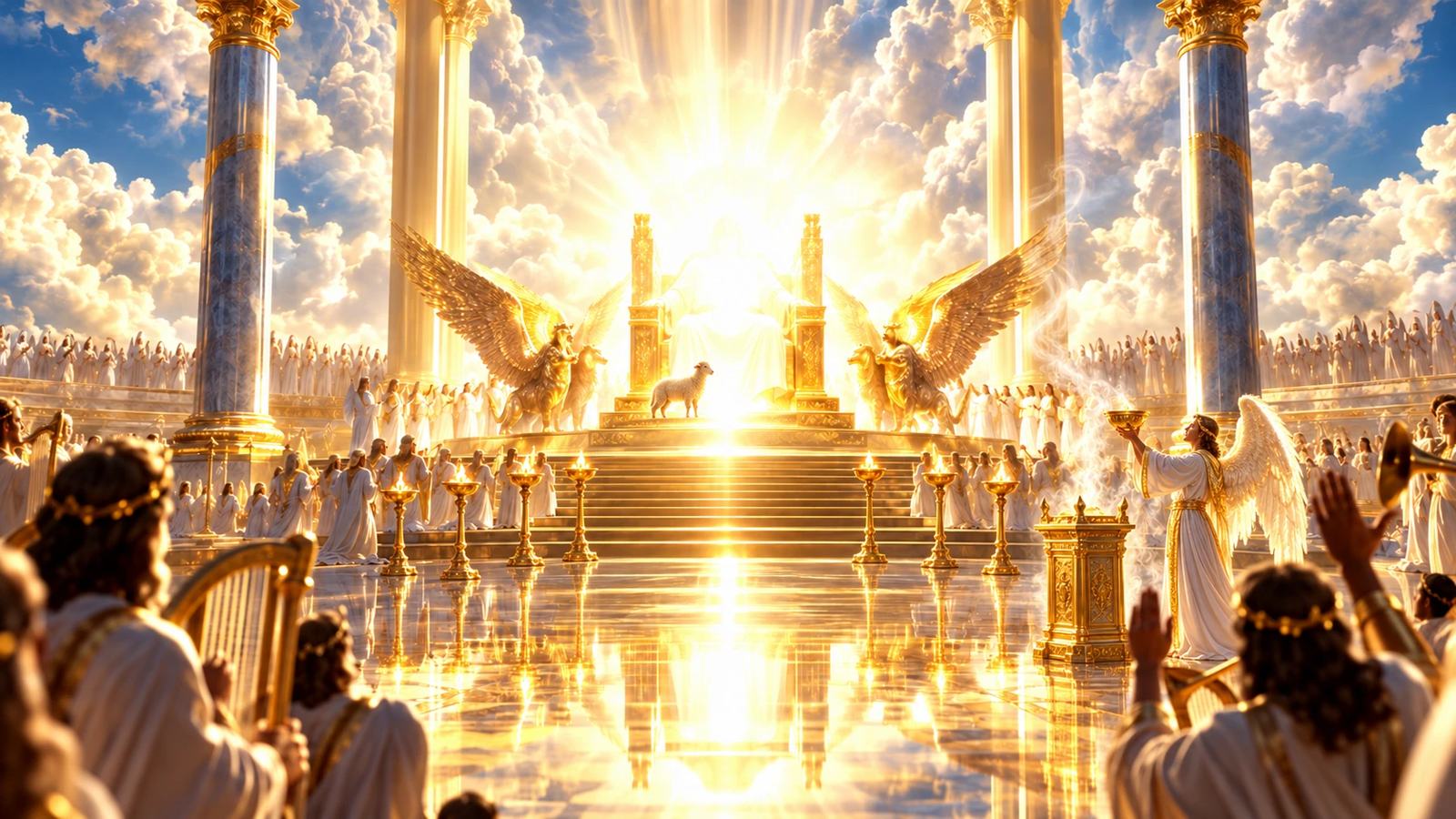
Setting: Eternity. The heavenly realities God revealed to Moses at Sinai, and later to Isaiah, Ezekiel, Daniel, and John. Primary passages: Exodus 25; Isaiah 6; Ezekiel 1; Daniel 7; Hebrews 8–9; Revelation 4–5, 21–22.
The Pattern Came from Heaven
8Let them make me a sanctuary, that I may dwell among them.
9According to all that I show you, the pattern of the tabernacle, and the pattern of all of its furniture, even so you shall make it.
Moses stood on Mount Sinai with an extraordinary assignment: build a sanctuary where the God of Israel would dwell among His people. But Moses was not invited to design it. God commanded him to make the Tabernacle and its furnishings according to the pattern He showed him (Exodus 25:8–9, 40). Why such precision? Where did the pattern come from?
Centuries later, Hebrews answers the question. The earthly priests served in a sanctuary that was a copy and shadow of heavenly things, and Moses had been warned to follow the pattern revealed on the mountain (Hebrews 8:1–5). The Tabernacle was not the original dwelling place of God. It was an earthly witness to a reality already existing in heaven.
This is our heavenly prologue, the view from which we will read the entire Bible. Before there was a tent in the wilderness or a Temple in Jerusalem, God reigned from His throne. Heaven's worship did not wait for Israel's priesthood. The earthly sanctuary witnessed to a heavenly reality. Our journey will follow God's desire to dwell with His people, welcome them as His children, and call them into priestly worship. The Temple is not a place for God to hide from us; it reveals the holy One who makes a way for His people to draw near.
The prophets and apostles did not merely speculate about that realm. Scripture records remarkable visions in which God allowed His servants to glimpse His throne, His attendants, His holiness, and His worship.
Isaiah: Holy, Holy, Holy
1In the year that King Uzziah died, I saw the Lord sitting on a throne, high and lifted up; and his train filled the temple.
2Above him stood the seraphim. Each one had six wings. With two he covered his face. With two he covered his feet. With two he flew.
3One called to another, and said, “Holy, holy, holy, is Yahweh of Armies! The whole earth is full of his glory!”
4The foundations of the thresholds shook at the voice of him who called, and the house was filled with smoke.
Isaiah saw the Lord sitting upon a throne, high and lifted up, with the train of His robe filling the Temple (Isaiah 6:1–4). Seraphim stood above Him, calling to one another about His holiness. The foundations shook and the house filled with smoke.
Here is a sanctuary beyond human invention: the King enthroned, heavenly beings worshiping, and holiness so overwhelming that Isaiah became painfully aware of his own uncleanness. Yet the vision did not end with his fear. A seraph brought a coal from the altar, and Isaiah heard that his guilt had been taken away (Isaiah 6:5–8).
Heavenly worship reveals both the glory of God and humanity's need for cleansing. Isaiah was not observing a religious performance. He was encountering the living God.
Ezekiel: The Glory Above the Living Creatures
26Above the expanse that was over their heads was the likeness of a throne, as the appearance of a sapphire stone. On the likeness of the throne was a likeness as the appearance of a man on it above.
27I saw as it were glowing metal, as the appearance of fire within it all around, from the appearance of his waist and upward; and from the appearance of his waist and downward I saw as it were the appearance of fire, and there was brightness around him.
28As the appearance of the rainbow that is in the cloud in the day of rain, so was the appearance of the brightness all around. This was the appearance of the likeness of Yahweh’s glory. When I saw it, I fell on my face, and I heard a voice of one that spoke.
Far from Jerusalem, among exiles in Babylon, Ezekiel saw a stormy vision of living creatures, wheels, brilliant light, and an expanse above which appeared the likeness of a throne (Ezekiel 1:4–28). Above it was the appearance of a human figure surrounded by radiant glory. Ezekiel fell on his face.
Later, Ezekiel again described the cherubim and the glory of the Lord (Ezekiel 10). His visions make an important point for an exiled people: God's throne was not imprisoned inside Jerusalem's walls. The Lord remained sovereign even when His people were far from their homeland and the earthly Temple was under judgment.
The vision also keeps us humble about heaven. Ezekiel does not hand us a blueprint. He reaches again and again for comparisons, the “likeness” of this and the “appearance” of that, because he is describing a glory that ordinary language can barely hold. His account is a true prophetic witness, and it is an invitation to worship rather than a diagram to draw.
Daniel: The Ancient of Days and the Son of Man
13“I saw in the night visions, and behold, there came with the clouds of the sky one like a son of man, and he came even to the Ancient of Days, and they brought him near before him.
14Dominion was given him, and glory, and a kingdom, that all the peoples, nations, and languages should serve him. His dominion is an everlasting dominion, which will not pass away, and his kingdom one that will not be destroyed.
Daniel saw thrones set in place and the Ancient of Days taking His seat. His throne was fiery, a river of fire flowed before Him, and countless attendants stood in His presence (Daniel 7:9–10). Books were opened for judgment.
Then Daniel saw one like a son of man coming with the clouds of heaven and approaching the Ancient of Days. He received dominion, glory, and a kingdom that would not pass away (Daniel 7:13–14).
Heaven is not merely a beautiful refuge from earthly suffering. It is the seat of God's righteous government. The kingdoms of the earth rise and fall, but His throne endures. For Christians, Daniel's Son of Man vision also illuminates the authority and kingship of Jesus, who repeatedly used that title for Himself.
John: Worship Before the Throne and the Lamb
8The four living creatures, each one of them having six wings, are full of eyes around and within. They have no rest day and night, saying, “Holy, holy, holy is the Lord God, the Almighty, who was and who is and who is to come!”
9When the living creatures give glory, honor, and thanks to him who sits on the throne, to him who lives forever and ever,
10the twenty-four elders fall down before him who sits on the throne and worship him who lives forever and ever, and throw their crowns before the throne, saying,
11“Worthy are you, our Lord and God, the Holy One, to receive the glory, the honor, and the power, for you created all things, and because of your desire they existed and were created!”
In Revelation 4, John sees a door standing open in heaven. He is shown a throne, brilliant splendor, twenty-four elders, four living creatures, and unceasing worship. The creatures proclaim God's holiness, and the elders lay their crowns before Him, acknowledging Him as Creator (Revelation 4:1–11).
The scene continues in Revelation 5. A scroll rests in the hand of the One on the throne, and John weeps because no one is found worthy to open it. Then the Lamb appears, standing as though slain. Heaven erupts in worship because the Lamb is worthy. The praise expands from the living creatures and elders to innumerable angels and finally to every creature giving honor to the One on the throne and to the Lamb (Revelation 5:1–14).
This is a breathtaking picture of heaven's worship: centered not on human achievement, but on God's holiness, creative power, and the redemption accomplished by Jesus Christ. The Lamb is not an afterthought to the sanctuary story. He is central to its fulfillment.
The True Sanctuary and Our High Priest
1Now in the things which we are saying, the main point is this: we have such a high priest, who sat down on the right hand of the throne of the Majesty in the heavens,
2a servant of the sanctuary and of the true tabernacle which the Lord pitched, not man.
5who serve a copy and shadow of the heavenly things, even as Moses was warned by God when he was about to make the tabernacle, for he said, “See, you shall make everything according to the pattern that was shown to you on the mountain.”
Hebrews tells us that Jesus ministers in the true Tabernacle set up by the Lord, not by man (Hebrews 8:1–2). Christ entered heaven itself to appear before God on our behalf, and His priestly work rests on His own sacrifice (Hebrews 9:11–12, 24). Revelation 11:19 adds another striking glimpse: God's Temple in heaven is opened, and the Ark of His Covenant is seen.
These passages explain why Moses' pattern mattered. The earthly sanctuary was a teaching model, a God-given witness to a greater order. Its furnishings and priestly ministry belong to later chapters of our journey. For now, we need to grasp the foundation: the heavenly reality came first, and Jesus serves as our High Priest in that reality.
Our Place, Our Calling, and the Truth We Must Believe
4Come to him, a living stone, rejected indeed by men, but chosen by God, precious.
5You also as living stones are built up as a spiritual house, to be a holy priesthood, to offer up spiritual sacrifices, acceptable to God through Jesus Christ.
Here is the truth that anchors every chapter: the God of heaven is holy, good, and worthy of our trust.
Against that truth stands a lie we will meet again and again on this journey: that God is distant, reluctant, or impossible to approach. The lie says His holiness means we are unwelcome. But the Lamb has opened the way. We do not worship to persuade God to love us.
In Christ we are more than welcomed. We are adopted. Believers have received “the Spirit of adoption, by whom we cry, ‘Abba! Father!’” (Romans 8:15). Sonship comes first; priestly service grows out of it, and by the Spirit we learn to live as His children.
Our priestly ministry begins with worship in spirit and truth: thanksgiving, surrender, repentance, obedience, intercession, and delight in Him (John 4:23–24; 1 Peter 2:9). As we minister to the Lord, He ministers to us—not as a transaction, but through His grace, correction, and transforming presence (Acts 13:2; Hebrews 4:16).
The Temple pattern will become a practical guide for returning our hearts to this fellowship; it never replaces Jesus, our High Priest.
Being Prepared for Eternal Worship
What is God's purpose in revealing these things? Not merely to satisfy curiosity about heaven's architecture. He is preparing a people to know Him, worship Him, and live in His presence.
No amount of exposure to sacred buildings or religious instruction can, by itself, create a faithful heart. Israel repeatedly resisted God's commands, and even the disciples who walked with Jesus faltered in fear. God promised something deeper: a new heart and His Spirit within His people (Ezekiel 36:26–27). At Pentecost, the Spirit empowered disciples who had once fled to bear courageous witness to the risen Christ (Acts 2).
Through Jesus we are reconciled to God; through the Holy Spirit we are being transformed. Our worship now is preparation for the eternal fellowship to come. We learn to trust, repent, obey, and adore—not to earn a place before the throne, but because the Lamb has opened the way.
The Beginning and the End Meet
22I saw no temple in it, for the Lord God the Almighty and the Lamb are its temple.
23The city has no need for the sun or moon to shine, for the very glory of God illuminated it and its lamp is the Lamb.
24The nations will walk in its light. The kings of the earth bring the glory and honor of the nations into it.
John's final vision brings the entire story to its fulfillment. God dwells with His people; the curse is removed; His servants see His face and serve Him (Revelation 21:3; 22:1–5). Most astonishingly, John sees no separate Temple in the New Jerusalem, because the Lord God Almighty and the Lamb are its Temple (Revelation 21:22–23).
The heavenly Temple visions are real witnesses to God's throne and worship. Yet the ultimate promise is greater than a sanctuary building, whether earthly or heavenly: unhindered fellowship with God Himself. The One who gave Moses the pattern is the One whose presence fills the eternal city.
This is the destination toward which every chapter of our journey points. The story begins with worship in heaven, and it culminates in God's people worshiping and reigning in His presence forever.
The Place Is Heaven
In this chapter the place is heaven itself. The throne room that Isaiah, Ezekiel, Daniel, and John saw is where God reigns and governs, and the Tabernacle was made as a copy of it (Hebrews 8:1–5). So the worship God ordained on earth was never Israel's invention. It reflected the order of heaven. From here to the New Jerusalem, every earthly sanctuary is a place where God meets His people on His own terms.
Temple Prayer Response: Come to the Father
You do not need a formula to respond to what you have just read. Here is a sample prayer to begin with. Make it your own, and keep going in your own words.
Father, thank You that Your throne is real, that heaven's worship never stops, and that You are holy, good, and worthy of my trust. Jesus, thank You that You are my High Priest in the true sanctuary and that You have opened the way for me to come. Forgive me for the times I have treated You as distant or hard to approach. Holy Spirit, teach me to worship in spirit and truth, and prepare my heart for Your presence, now and forever. Amen.
Now stay a moment. Tell Him what you saw in these visions, and what you want to say to Him.
Exodus 25:8–9, 40; Isaiah 6:1–8; Ezekiel 1:4–28; 10:1–22; Daniel 7:9–14; Hebrews 8:1–5; 9:11–12, 24; Romans 8:15; Revelation 4–5; 11:19; 21:3, 22–23; 22:1–5; Ezekiel 36:26–27; Acts 2.
Scripture quotations are from the World English Bible Classic (WEB), public domain (ebible.org/eng-web), and were checked against that text. Commentary is the author's own. The “lie and truth” framing is an editorial teaching device, not a quotation from Scripture. Faithful Christians differ on how literally to read heavenly sanctuary imagery; this chapter affirms that Scripture presents real heavenly realities while using earthly language to describe them.