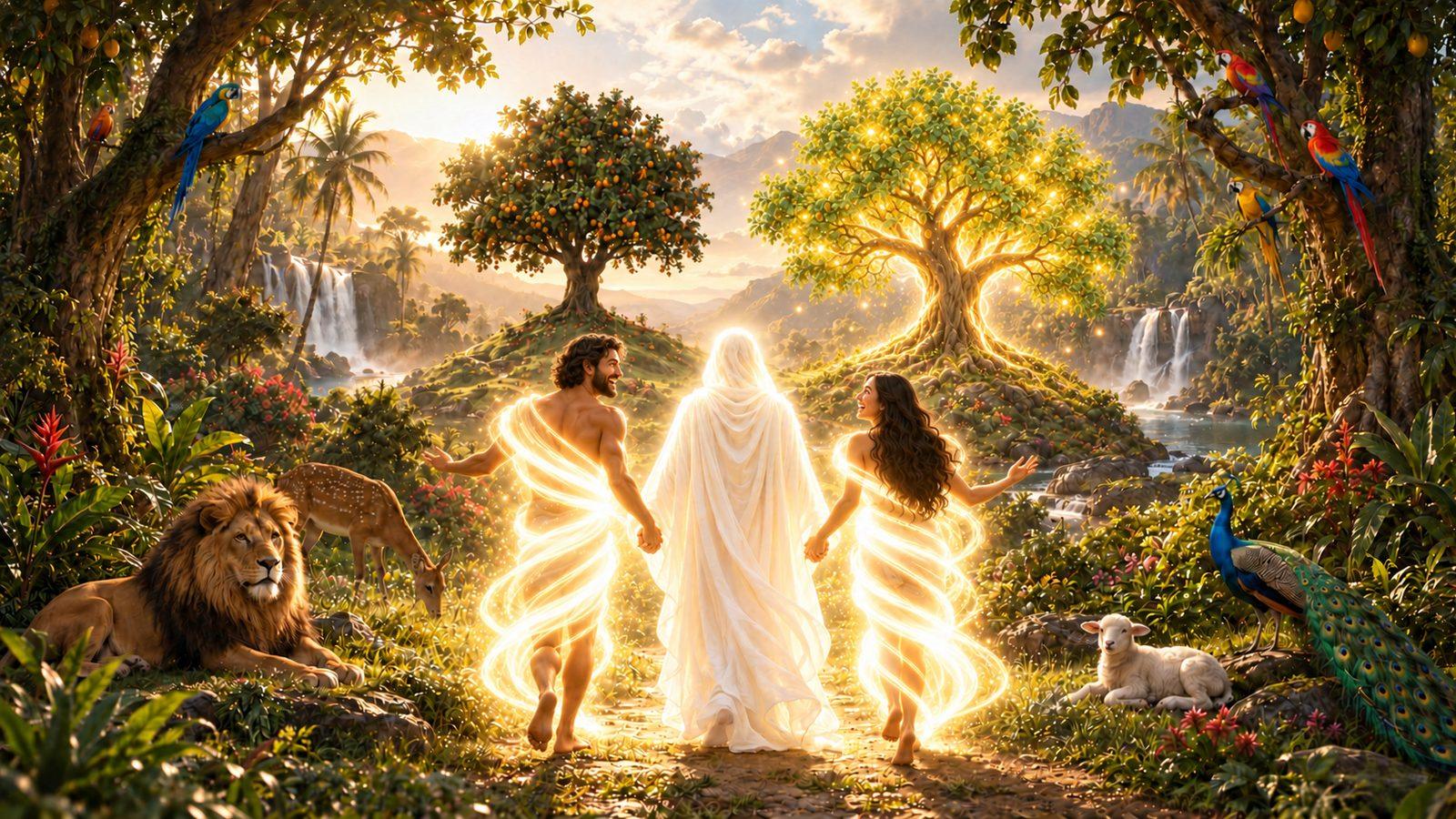
Setting: The beginning of human history. Principal figures: the first man and woman, and the serpent. Primary passages: Genesis 2–3; Romans 5; Revelation 22.
Our first stop was the heavenly prologue, where Moses received the pattern and the prophets saw God's throne. Now we return to the opening pages of Scripture and the first human home in God's presence. Outside the garden, the Bible will recount Cain and Abel, and then the Flood. Our next stop is Noah's ark; after that, the story of the altars begins with Abraham.
A Garden Prepared by God
The story of God's dwelling places begins in heaven, where Moses' Tabernacle pattern had its original reality. But where does the story of God's presence with human beings begin on earth? Not in a tent, a stone building, or a city. It begins in a garden.
Genesis tells us that the Lord God planted a garden in Eden and placed the man He had formed there (Genesis 2:8). God supplied trees pleasing to the eye and good for food. A river watered the garden. The place was beautiful, fruitful, and generous. Humanity did not build this garden to reach God. God prepared it for humanity.
Genesis does not explicitly call Eden a temple. Yet many readers recognize sanctuary themes here: God's presence, a place set apart, human beings commissioned to tend and guard it, and cherubim guarding its entrance after sin (Genesis 2:15; 3:24). Even the picture of the Lord God walking in the garden (Genesis 3:8) hints at the closeness the first couple had known. These connections help us understand Eden as a foundational picture of what the later sanctuaries would seek to express: God dwelling among His people.
The first human experience of worship was therefore not a ritual designed to earn God's attention. It was life lived before a generous Creator.
Freedom, Responsibility, and Trust
15Yahweh God took the man, and put him into the garden of Eden to cultivate and keep it.
16Yahweh God commanded the man, saying, “You may freely eat of every tree of the garden;
17but you shall not eat of the tree of the knowledge of good and evil; for in the day that you eat of it, you will surely die.”
God placed the man in the garden to work it and keep it (Genesis 2:15). Work was not originally a curse. It was part of humanity's calling to care for what God had made. The man and woman were blessed, entrusted with responsibility, and invited to live within the goodness of God's provision (Genesis 1:26–28).
But freedom included a command. God permitted the man to eat from the trees of the garden, except from the Tree of the Knowledge of Good and Evil (Genesis 2:16–17). The command was specific, and its warning was serious.
Why would God give such a boundary in paradise? At the center of the garden was a question of relationship: Would human beings trust their Creator to define what was good, or would they seize the right to decide for themselves?
This question will echo through Israel's history. At Sinai, in the wilderness, under the judges, and in the days of the kings, God's people would repeatedly face the same choice. Obedience was never simply about rule keeping. It revealed whether they trusted the One who gave the command.
The Voice That Questioned God's Goodness
1Now the serpent was more subtle than any animal of the field which Yahweh God had made. He said to the woman, “Has God really said, ‘You shall not eat of any tree of the garden’?”
2The woman said to the serpent, “We may eat fruit from the trees of the garden,
3but not the fruit of the tree which is in the middle of the garden. God has said, ‘You shall not eat of it. You shall not touch it, lest you die.’”
4The serpent said to the woman, “You won’t really die,
5for God knows that in the day you eat it, your eyes will be opened, and you will be like God, knowing good and evil.”
Genesis 3 introduces the serpent, who challenges God's instruction and distorts His words. The temptation begins with suspicion. Has God withheld something good? Is His warning trustworthy? Could disobedience actually bring greater wisdom and freedom?
The woman sees that the forbidden tree appears good for food, delightful to the eyes, and desirable for gaining wisdom. She takes its fruit and eats, then gives some to her husband, who also eats (Genesis 3:1–6). Both are responsible. Adam's later attempt to shift blame does not excuse his choice (Genesis 3:12, 17).
The tragedy is profound because it begins amid abundance. They were surrounded by gifts from God, yet accepted the suggestion that His goodness could not be trusted.
This is the root of rebellion: choosing another voice over God's word. The same pattern will appear when Israel worships the golden calf, when kings establish rival shrines, and when religious leaders resist the correction of the prophets. The surroundings change, but the human heart remains vulnerable to the same deception.
The Lie and the Truth: Is God Withholding Good?
The serpent encouraged suspicion of God's goodness. Yet the garden itself testified to His generosity: life, beauty, provision, fellowship, meaningful work, and a clear boundary. The conflict was whether humanity would believe the Creator or a competing voice. The same question follows us through every chapter. Temple Prayer invites us to return to the Father's truth, not to earn His presence but to worship Him with trust and obedience.
When Fellowship Becomes Fear
Before the disobedience, Genesis describes the man and woman as naked and unashamed (Genesis 2:25). Afterward, their eyes are opened, but not into the freedom they expected. They become conscious of their nakedness, sew coverings, and hide among the trees when they hear the Lord God in the garden (Genesis 3:7–10).
The contrast could hardly be sharper. The garden had been a place of fellowship. Now the presence of God provokes fear. Sin has damaged their relationship with Him and with one another.
God's questions expose what has happened. Adam blames the woman and indirectly points toward God who gave her to him. The woman points to the serpent. Neither response reverses the disobedience. Human beings who were entrusted with responsibility now seek to escape it.
The consequences reach beyond private guilt. Pain, conflict, hardship, and death enter the human story (Genesis 3:14–19). The ground itself becomes difficult to cultivate. The spiritual condition of humanity affects the health and welfare of the whole human community.
This is one of the great themes of our Temple journey: when people reject God's ways, the damage spreads through relationships, families, worship, and society.
Judgment, Mercy, and a Guarded Entrance
21Yahweh God made garments of animal skins for Adam and for his wife, and clothed them.
22Yahweh God said, “Behold, the man has become like one of us, knowing good and evil. Now, lest he reach out his hand, and also take of the tree of life, and eat, and live forever—”
23Therefore Yahweh God sent him out from the garden of Eden, to till the ground from which he was taken.
24So he drove out the man; and he placed cherubim at the east of the garden of Eden, and a flaming sword which turned every way, to guard the way to the tree of life.
God sends the man and woman out of Eden. He stations cherubim and a flaming sword to guard the way to the Tree of Life (Genesis 3:22–24). Access to the garden is no longer open.
Later, cherubim will appear in the imagery of the Tabernacle and Temple, including above the mercy seat (Exodus 25:18–22). The connection is striking. God's presence is holy, and humanity cannot casually reclaim what sin has broken.
Yet judgment is not the end of the story. God clothes the man and woman (Genesis 3:21). He also speaks of future conflict between the serpent and the woman's offspring (Genesis 3:15). Christians have long understood this passage as an early anticipation of the victory ultimately accomplished through Jesus Christ, while recognizing that Genesis unfolds that promise gradually.
Eden establishes the problem every later sanctuary must confront: How can sinful humanity dwell again in the presence of a holy God?
The Last Adam and the New Heart
18So then as through one trespass, all men were condemned; even so through one act of righteousness, all men were justified to life.
19For as through the one man’s disobedience many were made sinners, even so through the obedience of the one, many will be made righteous.
The New Testament presents Jesus as the one through whom Adam's failure is answered (Romans 5:12–19; 1 Corinthians 15:45–49). Where the first humans distrusted God's word, Jesus obeyed His Father, even through suffering and death. His victory is not merely an example of stronger willpower. Through His death and resurrection, He opens the way to reconciliation and new life.
And God promises more than a return to external instruction. Through Ezekiel He announces that He will give His people a new heart and put His Spirit within them, enabling them to walk in His ways (Ezekiel 36:26–27).
We should remember how deeply we need this promise. Even the disciples who lived with Jesus faltered when danger came. Their bold witness after Pentecost showed the transforming and empowering work of the Holy Spirit (Acts 2). Knowledge alone did not make them faithful; God was at work within them.
Their Story Is Also Ours
1Therefore I urge you, brothers, by the mercies of God, to present your bodies a living sacrifice, holy, acceptable to God, which is your spiritual service.
2Don’t be conformed to this world, but be transformed by the renewing of your mind, so that you may prove what is the good, well-pleasing, and perfect will of God.
The tragedy of Eden is not only an ancient account of two people who listened to a lie. We too enter a world already marked by sin, and we grow up with hearts inclined to distrust God and seek our own way. Before we have learned to recognize the Father's voice clearly, we may already have absorbed false ideas about Him, ourselves, and what will make us secure or happy. Some come from the world around us; others grow from our own fear, pride, and desires. Scripture traces the spread of sin through Adam (Romans 5:12–19) and describes the struggle of the fallen human heart (Ephesians 4:17–24).
The same question that confronted Adam and Eve confronts every generation: Will we believe what God says, or a more appealing voice? But the gospel does not leave us trapped in inherited patterns. Jesus reveals the Father and calls us to abide in His word and know the truth (John 8:31–32). Through the Holy Spirit, God renews our minds and teaches us to put off the old way of life and walk in the new (Romans 12:2; Ephesians 4:22–24). In this sense, our journey back into fellowship with the Father is a journey from believing lies to learning to live in His truth.
As believers become temples of the Holy Spirit, the question first posed in Eden remains immediate: Will we trust our Father and respond to His voice?
The Tree of Life Returns
1He showed me a river of water of life, clear as crystal, proceeding out of the throne of God and of the Lamb,
2in the middle of its street. On this side of the river and on that was the tree of life, bearing twelve kinds of fruits, yielding its fruit every month. The leaves of the tree were for the healing of the nations.
3There will be no curse any more. The throne of God and of the Lamb will be in it, and his servants will serve him.
The Bible's final chapters bring us back to the imagery of Eden. John sees the river of the water of life flowing from the throne of God and of the Lamb. On either side of the river stands the Tree of Life, bearing twelve kinds of fruit. The curse is gone, God's servants worship Him, and they see His face (Revelation 22:1–5).
What was guarded after the Fall appears again in the city of God's eternal presence. Revelation 21:3 announces God's dwelling with His people, and Revelation 21:22 reveals that the Lord God Almighty and the Lamb are its Temple.
The biblical story does not end with humanity hiding among trees. It ends with redeemed people seeing God's face.
Eden teaches us that the heart of worship is trust. We were created for fellowship with a good Father, and our attempts to define goodness apart from Him destroy that fellowship. But through Jesus Christ and the indwelling Holy Spirit, God is preparing a people who will dwell with Him forever.
The First Place
Eden is the first place where God met with human beings, walking in the garden with the man and the woman (Genesis 3:8). His government was simple and good: a clear word and a boundary set for their benefit (Genesis 2:16–17). When they questioned His word, they lost the place. The rest of the story is God making a way back to a place where He meets His people and rules among them, until the tree of life stands again in the city (Revelation 22:1–3).
Temple Prayer Response: Trusting the Father's Voice
You do not need a formula to respond to what you have just read. Here is a sample prayer to begin with. Make it your own, and keep going in your own words.
Father, thank You for the generosity of Your hand, for life, beauty, work, and the gift of knowing You. Forgive me for the times I have believed that You were withholding something good from me. Jesus, thank You that You trusted the Father where Adam did not, and that Your obedience has opened the way for me to return. Holy Spirit, renew my mind. Teach me to recognize the Father's voice, and give me a heart that trusts Him. Amen.
Now be still for a moment. Ask Him where you have been listening to a different voice, and listen for His.
Genesis 1:26–28; 2–3; Exodus 25:18–22; Ezekiel 36:26–27; John 8:31–32; Romans 5:12–19; 12:1–2; 1 Corinthians 15:45–49; Ephesians 4:17–24; Acts 2; Revelation 21:3, 22; 22:1–5.
Scripture quotations are from the World English Bible Classic (WEB), public domain (ebible.org/eng-web), and were checked against that text. Commentary is the author's own. Eden as a sanctuary is a theological reading of Genesis, not an explicit designation in the text. The “lie and truth” framing is an editorial teaching device, not a quotation from Scripture.