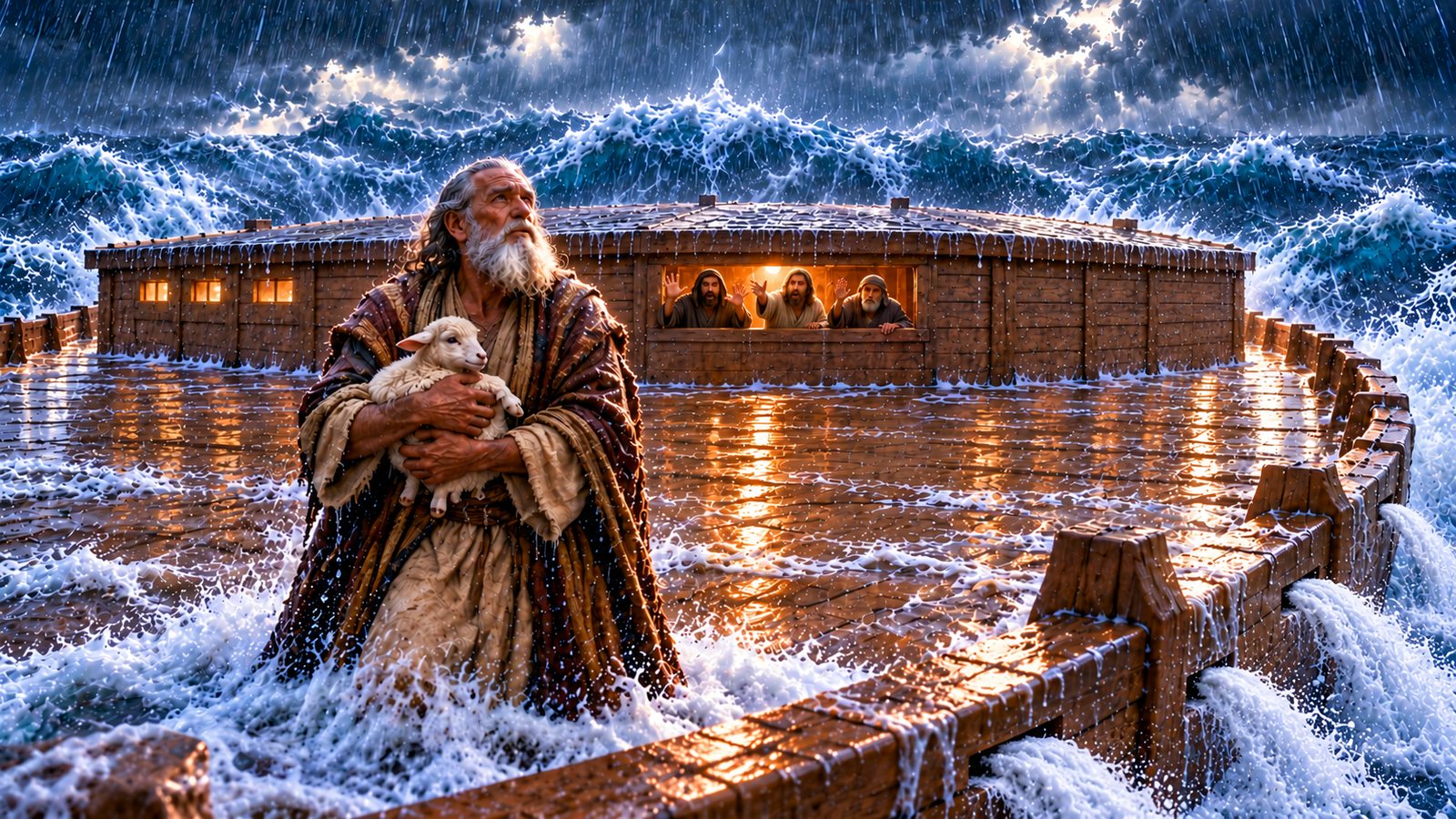
Setting: The generations between Eden and Abraham. Principal figures: Noah, his wife, their three sons, and their sons' wives. Primary passages: Genesis 6–9; Hebrews 11:7; 1 Peter 3:18–22.
At our last stop, humanity distrusted God's word and lost access to Eden. Outside the garden, sin spread through families and generations. Cain murdered Abel, and the earth eventually became filled with violence. Yet God continued His work of preserving human life and unfolding His purposes. Before we arrive at Abraham's altars, we pause at a great wooden vessel: a place of refuge built according to God's instructions.
Favor in a World Filled With Violence
8But Noah found favor in Yahweh’s eyes.
9This is the history of the generations of Noah: Noah was a righteous man, blameless among the people of his time. Noah walked with God.
Noah's story begins with God's favor and a man who walked with Him. Around Noah, the world had become corrupt and violent. Genesis describes wickedness that reached into the thoughts and intentions of the human heart (Genesis 6:5, 11–12). The problem was deeper than a few bad decisions. Human society was being shaped by persistent rebellion against its Creator.
God's judgment reveals that violence and evil matter to Him. The Lord who prepared a generous garden does not become indifferent when His creatures destroy one another. His goodness includes His opposition to the wickedness that corrupts His world.
Yet judgment is accompanied by provision. God speaks to Noah, warns him of what is coming, and gives him instructions for preserving his household and living creatures. Noah does not invent a way to make himself safe. God provides the way, and Noah must decide whether to trust Him.
The First Great Wooden Refuge
14Make a ship of gopher wood. You shall make rooms in the ship, and shall seal it inside and outside with pitch.
15This is how you shall make it. The length of the ship shall be three hundred cubits, its width fifty cubits, and its height thirty cubits.
16You shall make a roof in the ship, and you shall finish it to a cubit upward. You shall set the door of the ship in its side. You shall make it with lower, second, and third levels.
Here is the Bible's first great wooden refuge, built by divine instruction to carry a household through judgment. We usually call it Noah's Ark; the WEB calls it a ship. Its timber, rooms, protective coating, dimensions, entrance, and three levels are all addressed in God's instructions.
The details matter because Noah's response is more than admiration for an inspiring idea. He has actual work to do. Trust becomes timber cut and joined, rooms prepared, food gathered, and a household ready to enter.
This introduces a theme that will become central to our Temple journey: when God provides a pattern, His people receive it rather than replacing it with whatever seems preferable. Later, Moses will receive instructions for the Tabernacle, including another wooden chest, the Ark of the Covenant (Exodus 25:10–22). These two arks have different purposes. Noah's carries living creatures through the Flood; the covenant Ark holds the testimony and stands at the appointed place of meeting. But both belong to a larger story in which God takes the initiative and His people respond to His word.
Noah's Ark is not explicitly called a temple in Genesis. It belongs here as a place God appointed for preservation, preparing us to recognize His authority to establish the way His people live before Him.
Faith That Takes God Seriously
7By faith Noah, being warned about things not yet seen, moved with godly fear, prepared a ship for the saving of his house, through which he condemned the world and became heir of the righteousness which is according to faith.
Hebrews tells us how to understand Noah's construction project: it was an act of faith. He took God's warning seriously before he could see its fulfillment. His obedience grew from trusting the One who spoke.
Genesis 6:22 records that Noah did all God commanded him. This obedience did not turn God's favor into wages. The story begins with favor, and Hebrews identifies Noah's righteousness with faith. His actions expressed his reliance on God.
This is the same question we encountered in Eden. Whose word will govern human life? Adam and Eve accepted a competing voice. Noah trusted God's warning and acted on His instructions.
The Lie and the Truth: Can We Design Our Own Rescue?
The temptation is to assume we can dismiss God's warnings while keeping the benefits of His protection. Noah's story confronts that assumption. God's warning and His provision came together; trusting Him meant responding to both.
The truth is that the God who judges evil also provides a way of rescue. Noah's task was to receive that provision with obedient faith. For us, this begins with receiving Jesus Christ rather than trying to establish our own righteousness. The heart of faith is trust in God, and living trust changes what we do.
Shut In by the Lord
16Those who went in, went in male and female of all flesh, as God commanded him; then Yahweh shut him in.
17The flood was forty days on the earth. The waters increased, and lifted up the ship, and it was lifted up above the earth.
18The waters rose, and increased greatly on the earth; and the ship floated on the surface of the waters.
Noah could prepare the vessel, but he could not govern the waters. His family entered the refuge God had appointed, and the Lord shut him in.
The storm was real. Safety did not mean the absence of rising water or the immediate end of waiting. The ark carried them through the judgment unfolding around them. Their security rested on God's faithful provision, received through faith and obedience.
We should carry this lesson into our own lives carefully. Noah received a particular promise concerning a particular judgment. His rescue does not establish that faithful believers will escape every disaster, illness, persecution, or physical death. Hebrews 11 also honors believers who suffered and died in faith. The enduring lesson is that God is trustworthy, His warnings deserve our attention, and the salvation He provides is sufficient for the purpose He promises.
From Refuge to an Altar
20Noah built an altar to Yahweh, and took of every clean animal, and of every clean bird, and offered burnt offerings on the altar.
When Noah finally steps onto dry ground, he builds an altar. The man who received God's provision responds with worship. Preservation leads to thanksgiving, and a new beginning opens before the Lord.
God establishes His covenant with Noah, his descendants, and living creatures, promising that a flood will never again destroy all flesh (Genesis 9:8–17). The rainbow becomes the sign of that promise. The future rests on God's commitment.
Yet the Flood has not made the human heart sinless. Genesis 9 records Noah's own failure, and Babel will soon reveal renewed human pride. Humanity needs more than a fresh landscape. We need the deeper rescue and transformation God will accomplish through Jesus Christ.
A Family Preserved Before a Nation Is Called
Israel does not yet exist as a nation. Noah's household belongs to the earlier story of humanity as a whole. Through the generations after the Flood, Genesis will eventually bring us to Abram, a descendant of Shem, and to God's promise of blessing for every family of the earth (Genesis 11:10–12:3).
The ark preserves a household through which the human story continues. Within that continuing history, God will call the family through whom Israel and the Messiah will come. His purposes survive the judgment of human wickedness.
Jesus and the Greater Rescue
21This is a symbol of baptism, which now saves you—not the putting away of the filth of the flesh, but the answer of a good conscience toward God—through the resurrection of Jesus Christ,
22who is at the right hand of God, having gone into heaven, angels and authorities and powers being made subject to him. 1
Immediately before these verses, Peter recalls the eight people preserved through water in Noah's day. He then connects that event with baptism, directing our attention to the resurrection of Jesus Christ. The saving reality rests in the risen Lord.
We need not assign a hidden meaning to every plank to recognize the connection Scripture gives us. God preserved Noah's household through judgment. Through the death and resurrection of Jesus, He brings believers into reconciliation with Himself and new life. Our hope rests in the Savior God has provided.
A Refuge Under His Word
The ark was a place God appointed for a household to be preserved. Noah walked with God before he entered it, obeyed God while preparing it, and worshiped God after leaving it. The building mattered because God had instructed him to build it. The relationship was always with the living God.
This prepares us for the sanctuaries ahead. The central question will keep returning: Will God's people trust His word and receive His provision on His terms?
Temple Prayer Response: Trusting the Refuge God Provides
You do not need a formula to respond to what you have just read. Here is a sample prayer to begin with. Make it your own, and keep going in your own words.
Father, thank You that Your mercy provides what I could never provide for myself. Forgive me for treating Your warnings lightly or trusting my own plans more than Your word. Jesus, thank You for bringing me to God through Your death and resurrection. Holy Spirit, teach me to respond with obedient faith. Help me care for the people You have entrusted to me, remain faithful while I wait, and turn every experience of Your provision into thanksgiving. Amen.
Now be still for a moment. Ask Him where trust needs to become obedience, and thank Him for the salvation He has provided in Jesus.
Genesis 6–9; 11:10–12:3; Exodus 2:1–10; 25:10–22; Hebrews 11:7, 32–40; 1 Peter 3:18–22.
Scripture quotations were checked against the World English Bible Classic: Genesis 6, Genesis 7, Genesis 8, Hebrews 11, and 1 Peter 3. Commentary is the author's own. Noah's Ark and the Ark of the Covenant are distinct objects; the Hebrew designations also differ. The ark's connection to the sanctuary theme is an editorial theological connection, not an explicit designation of the vessel as a temple. The illustration's railing, sheltered walkway, and placement of Noah and his sons are artistic details, not details specified in Genesis.