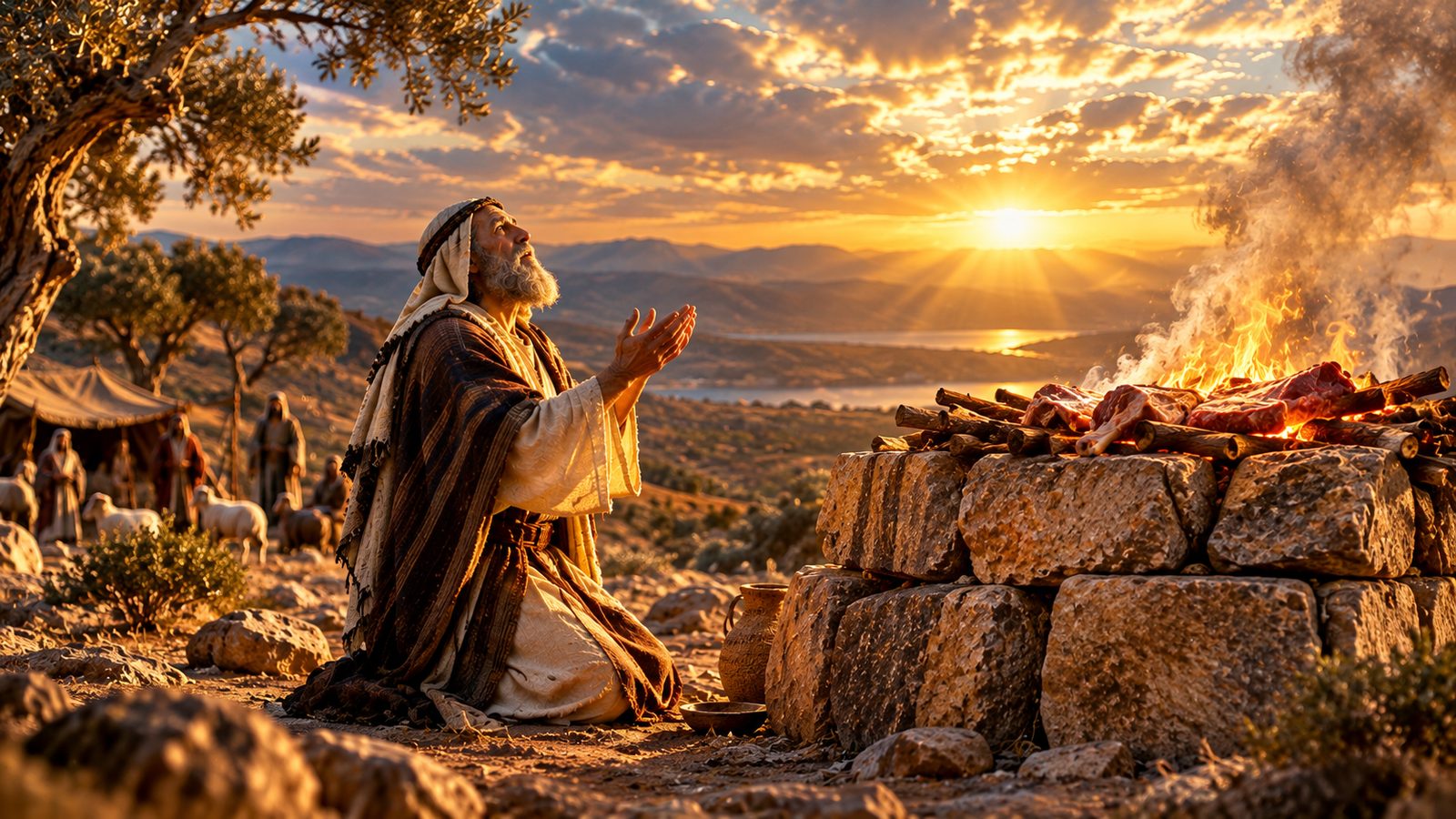
Setting: The patriarchal era, traditionally placed in the second millennium BC, with precise dating debated. Principal figures: Abraham, Isaac, and Jacob. Primary passages: Genesis 12–35.
At our previous stop, Noah's ark, God judged a violent world through the Flood while preserving Noah and his family (Genesis 6–9). Human pride did not end with the Flood, and the builders of Babel soon sought a name for themselves (Genesis 11). Now, in Genesis 12, God calls Abram and begins unfolding covenant promises through a family destined to bless the nations. This chapter surveys altars across Genesis 12–35; our next stop will return to the pivotal episode at Mount Moriah in Genesis 22.
A New Beginning with One Family
The altars of Genesis introduce a question that will follow us through all 40 chapters: What do we do when God speaks? In Eden, the first humans accepted a competing voice and lost their home in the garden. Now, after generations of violence, judgment, and human attempts to make a name for themselves, the Lord begins again with a promise to one family. He does not first hand Abram a building plan or a priestly uniform. He calls him into a relationship of trust.
When God Speaks, People Respond
Long before Moses received the heavenly pattern for the Tabernacle, long before the priests served in Jerusalem, God met men and women in the ordinary places of their lives. Across hillsides, grazing lands, and encampments, the patriarchs learned that the living God could call, promise, correct, protect, and guide.
They did not possess a permanent Temple. They had no central sanctuary or elaborate system of priestly service. Instead, Genesis repeatedly shows simple altars marking moments when God made Himself known and people responded in worship.
An altar was not a device for summoning God. The order of events matters: God spoke; the person believed and responded. The altar became a visible reminder that the place, the promise, and the worshiper belonged to Him.
These encounters also reveal the condition of the human heart. The patriarchs demonstrated remarkable faith, but they were not consistently courageous or obedient. Their stories are neither portraits of perfect saints nor tales of people who saved themselves by religious effort. They are accounts of God's faithfulness amid human weakness.
Abraham: A Promise and an Altar at Shechem
1Now Yahweh said to Abram, “Leave your country, and your relatives, and your father’s house, and go to the land that I will show you.
2I will make of you a great nation. I will bless you and make your name great. You will be a blessing.
3I will bless those who bless you, and I will curse him who treats you with contempt. All the families of the earth will be blessed through you.”
4So Abram went, as Yahweh had told him. Lot went with him. Abram was seventy-five years old when he departed from Haran.
God called Abram to leave his country and family and travel to a land He would show him. With that call came promises of descendants, a land, a great name, and blessing that would extend to all families of the earth (Genesis 12:1–3).
Abram went. His obedience began before he knew the destination in full. When he arrived near Shechem, at the oak of Moreh, the Lord appeared and promised the land to his offspring. Abram built an altar there to the Lord who had appeared to him (Genesis 12:6–7).
Notice what the altar recorded: not Abram's discovery of God, but God's initiative. The Creator had spoken a promise, and Abram answered with worship.
Ancient Shechem is commonly associated with Tell Balata near modern Nablus. The geography helps us locate the biblical narrative, though no surviving altar can be securely identified as Abram's own. Our confidence in the story's spiritual meaning rests on Scripture, not on an archaeological claim that has not been demonstrated.
Calling on the Name of the Lord
7Yahweh appeared to Abram and said, “I will give this land to your offspring.” He built an altar there to Yahweh, who had appeared to him.
8He left from there to go to the mountain on the east of Bethel and pitched his tent, having Bethel on the west, and Ai on the east. There he built an altar to Yahweh and called on Yahweh’s name.
9Abram traveled, still going on toward the South.
Abram moved on toward the hill country between Bethel and Ai, pitched his tent, built another altar, and called upon the name of the Lord (Genesis 12:8). The tent and altar form a striking picture: Abram lived as a traveler, but worship traveled with him.
His possessions and location could change. God's promise remained the anchor of his identity. There is an early lesson here about our place in God's presence: Abram's tent could be moved, but the Lord who called him was not confined to a particular hilltop. The altar did not make God present; it marked Abram's response to the God who had already drawn near.
Yet Genesis refuses to flatter Abram. When famine struck, he went to Egypt and acted out of fear, presenting Sarai as his sister in a way that placed her at risk (Genesis 12:10–20). The man who trusted God enough to leave home could still fail to trust Him when danger approached.
Later, after returning to the land, Abram revisited the place of his earlier altar and called on the Lord again (Genesis 13:3–4). Worship was not reserved for flawless people. It was a place of return, dependence, and renewed trust.
At Hebron, after another divine promise concerning the land, Abram built an altar by the oaks of Mamre (Genesis 13:14–18). Again, God's word preceded the worshiper's response.
The Lie and the Truth: Must We Make God's Promises Happen?
The recurring temptation in these households was to believe that God's promise needed human manipulation, fear-driven compromise, or impatient shortcuts to succeed. The truth God kept revealing was that He could be trusted with the future He promised. Abraham's altars, Isaac's worship, and Jacob's return to Bethel all point beyond religious landmarks to a living response: trust the One who speaks, and let that trust govern ordinary choices. For believers today, worship is our first priestly ministry, not merely a song or ceremony. We seek the Father first and allow His Spirit to correct and strengthen us as we respond to Him (Matthew 6:33; John 4:23–24).
Faith Is More Than a Religious Landmark
5Yahweh brought him outside, and said, “Look now toward the sky, and count the stars, if you are able to count them.” He said to Abram, “So your offspring will be.”
6He believed in Yahweh, who credited it to him for righteousness.
An altar could mark an encounter, but a pile of stones could not create an obedient heart. Abraham's life illustrates both the strength and the struggle of faith.
Genesis 15 records God's covenant promises, including descendants beyond counting. Abram believed the Lord, and his faith was counted to him as righteousness (Genesis 15:5–6). The decisive issue was trust in the God who promised, not confidence in a religious monument.
The promise also demanded patience. Abraham and Sarah waited many years for Isaac. Along the way they attempted to secure an outcome through their own plans, with painful consequences for their household (Genesis 16). God's faithfulness did not erase the human cost of impatience.
The story teaches a lesson that will recur throughout Israel's history: knowing what God has said is not identical to trusting Him enough to wait and obey. Altars are valuable signs of remembrance, but faith must shape the decisions made away from them.
Isaac: Worship in the Next Generation
24Yahweh appeared to him the same night, and said, “I am the God of Abraham your father. Don’t be afraid, for I am with you, and will bless you, and multiply your offspring for my servant Abraham’s sake.”
25He built an altar there, and called on Yahweh’s name, and pitched his tent there. There Isaac’s servants dug a well.
The covenant did not end with Abraham. God reaffirmed His promises to Isaac, instructing him not to go down to Egypt during famine and promising His presence (Genesis 26:1–5).
Isaac too faced fear. In Gerar, he misrepresented Rebekah as his sister, repeating a failure familiar from his father's story (Genesis 26:6–11). Spiritual inheritance does not automatically remove human weakness.
Later, at Beersheba, the Lord appeared and reassured Isaac that He was with him. Isaac built an altar, called on the name of the Lord, and pitched his tent there (Genesis 26:23–25).
The pattern is beautifully simple: God's promise, human worship, daily life. Isaac's altar stood near his tent, connecting the sacred response to the place where his family actually lived. And notice the truth that answered Isaac's fear: the Lord promised to be with him (Genesis 26:24). God's presence, not Isaac's ability to control events, was his deepest security.
Jacob: The God Who Meets a Fugitive
15Behold, I am with you, and will keep you, wherever you go, and will bring you again into this land. For I will not leave you until I have done that which I have spoken of to you.”
16Jacob awakened out of his sleep, and he said, “Surely Yahweh is in this place, and I didn’t know it.”
17He was afraid, and said, “How awesome this place is! This is none other than God’s house, and this is the gate of heaven.”
Jacob's early life was marked by conflict, manipulation, and flight. Leaving home under the shadow of his brother's anger, he stopped for the night and dreamed of a stairway reaching toward heaven, with angels ascending and descending. The Lord stood above it and reaffirmed the covenant promises (Genesis 28:10–15).
Jacob awoke astonished by God's presence. He set up the stone that had been beneath his head as a pillar and named the place Bethel, meaning house of God (Genesis 28:16–22). This was a memorial pillar rather than an altar of sacrifice, but it expressed the same foundational truth: God had revealed Himself, and Jacob had to respond.
Years later, Jacob returned to Canaan and built an altar near Shechem, naming it in honor of the God of Israel (Genesis 33:18–20). But his household still needed purification. God instructed Jacob to go to Bethel and build an altar; Jacob told his household to put away foreign gods, purify themselves, and change their garments (Genesis 35:1–7).
Here the connection between worship and obedience becomes unmistakable. A family cannot claim to honor the Lord at an altar while comfortably keeping rival gods in its tents. Jacob's return to Bethel required more than revisiting a meaningful place. His household had to surrender the competing loyalties it carried. The lie was that they could keep their idols and still worship the Lord without compromise. God's call was to return to Him with undivided devotion.
The Family Is Part of the Sanctuary Story
These patriarchal encounters shaped more than private spirituality. God's promises concerned descendants, land, nations, and blessing for the world. Worship had consequences for marriages, children, servants, neighbors, and future generations.
The patriarchs' families also experienced jealousy, deceit, favoritism, and division. Their altars did not guarantee that every relationship was healthy. Instead, the stories show God's patient work through deeply imperfect households.
The lesson for God's people today is direct: religious activity cannot substitute for trust, repentance, truthfulness, and obedience. The health of a worshiping community is revealed in how its people live together, not merely in what they build. Our fallen habits can teach us to rely on appearances, control, or inherited religious routines. God's truth calls us back to living faith.
The patriarchs were not yet members of the new-covenant royal priesthood, but their response to God's revelation helps us understand the worshipful trust that should characterize His children today.
From Altars to the Greater Mediator
7Know therefore that those who are of faith are children of Abraham.
8The Scripture, foreseeing that God would justify the Gentiles by faith, preached the Good News beforehand to Abraham, saying, “In you all the nations will be blessed.”
9So then, those who are of faith are blessed with the faithful Abraham.
The patriarchs were responding to promises whose fulfillment lay far beyond their own lifetimes. In the New Testament, God's promise of blessing to the nations is understood through Jesus Christ (Galatians 3:6–14). Jesus is also the mediator through whom believers draw near to the Father (Hebrews 4:14–16).
We should not imagine that Abraham's altar, Isaac's altar, or Jacob's altar was itself the heavenly sanctuary. Each was an earthly response to God's revelation. The heavenly throne remains the greater reality, and Christ's priestly ministry is the fulfillment toward which the wider biblical sanctuary story moves.
God's purpose goes beyond teaching people where to worship. The prophets would later promise a new heart and God's Spirit within His people (Ezekiel 36:26–27), and after Jesus' resurrection the New Testament identifies believers as God's Temple (1 Corinthians 3:16; 6:19). This is a greater privilege than the patriarchs could yet fully understand. Through Christ, we are welcomed as the Father's children and called to priestly worship (Romans 8:15–17; 1 Peter 2:9).
Temple Prayer is not an altar we build to make God notice us. It is a way of intentionally ministering to Him through thanksgiving, faith, repentance, obedience, and intercession, trusting the Spirit to teach and transform us as we draw near (John 4:23–24; Hebrews 4:16).
A Place to Remember, a Life to Surrender
An altar was a testimony: God spoke here. God provided here. God kept His promise here. But the patriarchal stories ask a deeper question: Did the person who worshiped at the altar continue to trust God when the journey became frightening, confusing, or costly?
Abraham, Isaac, and Jacob were all learning that lesson. So are we.
In the next chapter, Abraham will face one of the most searching tests of trust in all of Scripture. On a mountain in the land of Moriah, the question will become intensely personal: Can he trust the God who gave the promise when obedience seems to place that very promise in jeopardy?
Israel Begins as a Man
Israel begins as a man. At the Jabbok God renamed Jacob “Israel” (Genesis 32:28) and confirmed the name at Bethel (Genesis 35:10). His twelve sons became the tribes, and the promise God gave Abraham, a nation, a land, and blessing for every family on earth (Genesis 12:1–3), began to grow inside this one household. God would later call the nation He formed His firstborn son (Exodus 4:22). And everyone who shares Abraham's faith is counted among his children (Galatians 3:7–9), welcomed into that family and never in place of it.
A Place as Small as an Altar
Here the place is as small as an altar and a tent. Wherever God spoke, Abraham, Isaac, and Jacob built an altar and called on His name, and that spot became a meeting point between God and a family (Genesis 12:7–8; 26:25; 28:16–17). God was already governing His people by His word: He spoke, and they answered with worship, not with a ritual of their own design. Later the same God will give a whole nation one appointed place.
Temple Prayer Response: Trusting the God Who Speaks
You do not need a formula to respond to what you have just read. Here is a sample prayer to begin with. Make it your own, and keep going in your own words.
Father, thank You that You speak first, and that You called me before I ever came looking for You. Forgive me for the times I tried to make Your promises happen by my own schemes, or kept a rival god in my tent. Jesus, thank You that You are the mediator who brings me near, and the One in whom every promise is fulfilled. Holy Spirit, show me where I need to return to You, and teach me to trust the Father with the future He has promised. Let my worship go with me into my ordinary days. Amen.
Now be still for a moment. Ask Him what He has spoken that you still need to trust, and what you need to put away.
Genesis 12:1–20; 13:3–18; 15:1–6; 16; 26:1–25; 28:10–22; 33:18–20; 35:1–7; Matthew 6:33; John 4:23–24; Romans 8:15–17; 1 Corinthians 3:16; 6:19; Galatians 3:6–14; Hebrews 4:14–16; 1 Peter 2:9; Ezekiel 36:26–27.
Scripture quotations are from the World English Bible Classic (WEB), public domain (ebible.org/eng-web), and were checked against that text. Commentary is the author's own. Patriarchal chronology and the identification of individual altar sites are uncertain. The later altar on Mount Ebal belongs to Joshua's era, not the patriarchal period. The “lie and truth” framing is an editorial teaching device, not a quotation from Scripture.