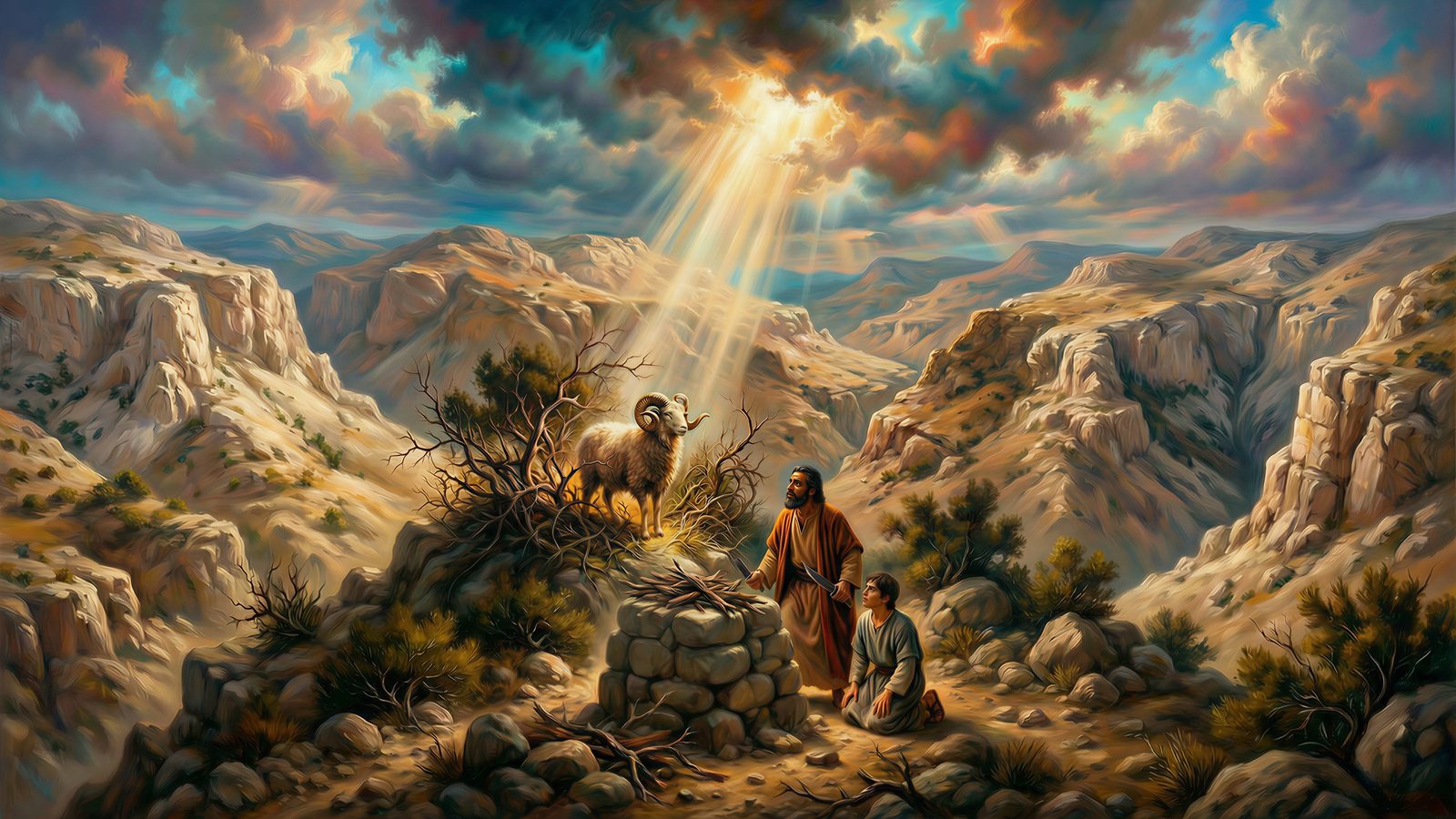
Setting: The patriarchal era, with precise dating uncertain. Principal figures: Abraham and Isaac. Primary passage: Genesis 22.
At our last stop we surveyed the altars of Abraham, Isaac, and Jacob across Genesis 12–35. Now we return to a single episode within Abraham's life, after the long-awaited birth of Isaac (Genesis 21). The promised son has finally arrived. But Genesis 22 brings a test that appears to place God's own promise in jeopardy. After Moriah, our journey will move forward several generations to Moses, who meets the Lord at the burning bush and leads Israel out of Egypt (Exodus 3–4), and then to the Tabernacle revealed at Sinai (Exodus 25–40). We are deliberately pausing here because this mountain teaches something essential about God's provision and our trust.
The Promise That Made the Test So Difficult
Abraham had heard God's voice before. He had left his homeland at God's command, pitched tents in unfamiliar country, and built altars wherever the Lord revealed Himself. He had waited through years of uncertainty for the child God promised. Isaac was not simply a beloved son; he was the son through whom God said His covenant promises would continue (Genesis 17:19; 21:12).
Then came the command recorded in Genesis 22:1–2. Scripture explicitly tells the reader that God was testing Abraham. Abraham himself, however, had to walk through the test without knowing how it would end. The Lord instructed him to take Isaac, his beloved son, to the land of Moriah and offer him as a burnt offering on a mountain God would show him.
We must not rush past the shock of those words. The command confronted Abraham with an apparent contradiction between God's promise and what God now required. Isaac was the child of promise. How could the promised future survive if Isaac died?
Genesis does not present child sacrifice as a normal act of faithful worship. The story reaches its decisive moment when God stops Abraham's hand and provides a ram instead. Elsewhere the Law explicitly condemns offering children in sacrifice (Leviticus 18:21; Deuteronomy 12:31). The event is a singular test in the patriarchal narrative, not an instruction for parents or worshipers to imitate its outward actions.
The Journey of Three Days
5Abraham said to his young men, “Stay here with the donkey. The boy and I will go over there. We will worship, and come back to you.”
6Abraham took the wood of the burnt offering and laid it on Isaac his son. He took in his hand the fire and the knife. They both went together.
7Isaac spoke to Abraham his father, and said, “My father?” He said, “Here I am, my son.” He said, “Here is the fire and the wood, but where is the lamb for a burnt offering?”
8Abraham said, “God will provide himself the lamb for a burnt offering, my son.” So they both went together.
Early the next morning, Abraham prepared his donkey, took two servants and Isaac, cut wood for the offering, and set out (Genesis 22:3). The account offers no speech about Abraham's feelings. That restraint makes the journey more haunting. Each step toward the mountain carried the weight of a promise he could not yet see fulfilled.
On the third day Abraham saw the place from a distance. He told the servants that he and the boy would go to worship and then return (Genesis 22:4–5). The New Testament's reflection in Hebrews 11:17–19 interprets Abraham's faith as confidence that God was able even to raise Isaac from the dead. Genesis itself does not spell out all of Abraham's reasoning, so we should distinguish the later inspired interpretation from imagined details about his inner thoughts.
Isaac carried the wood. Abraham carried the fire and knife. As they walked together, Isaac noticed what was missing: there was fire, and there was wood, but where was the lamb for the offering (Genesis 22:6–7)?
Abraham answered that God would provide the lamb (Genesis 22:8). He could not explain how. He had learned enough of the Lord's faithfulness to keep walking without a complete explanation.
The Lie and the Truth on the Mountain
What false conclusion might a fallen human heart draw in a moment like this? That God's commands cannot be trusted. That obedience must mean the destruction of His promise. That if we cannot understand the outcome, we must seize control ourselves.
Genesis does not say Satan spoke these thoughts to Abraham. We should not invent a conversation the Bible does not record. But the tension between fear and faith is unmistakable, and it reaches into our own lives.
The truth Abraham had to hold was deeper than his understanding of the circumstances: the God who made the promise remained faithful. His character had not changed between the day He promised Isaac and the day He called Abraham to Moriah. Faith was not pretending the command made sense. It was entrusting the unresolved outcome to the Lord.
This is the heart of the worship we are learning to practice. Worship is not merely singing when life feels secure. It is acknowledging who God is when the next step is difficult. It is bringing our fear, questions, and desires into His presence rather than allowing them to become another voice we obey.
The Lord Will Provide
11Yahweh’s angel called to him out of the sky, and said, “Abraham, Abraham!” He said, “Here I am.”
12He said, “Don’t lay your hand on the boy or do anything to him. For now I know that you fear God, since you have not withheld your son, your only son, from me.”
13Abraham lifted up his eyes, and looked, and saw that behind him was a ram caught in the thicket by his horns. Abraham went and took the ram, and offered him up for a burnt offering instead of his son.
14Abraham called the name of that place “Yahweh Will Provide”. As it is said to this day, “On Yahweh’s mountain, it will be provided.”
At the appointed place, Abraham built an altar, arranged the wood, bound Isaac, and laid him on the altar (Genesis 22:9–10). The narrative reaches the instant of greatest danger, and the angel of the Lord calls from heaven, stopping him. Abraham is not permitted to harm his son. The test reveals Abraham's reverence for God (Genesis 22:11–12).
Abraham then sees a ram caught in a thicket. He offers the ram instead of Isaac (Genesis 22:13). The substitution matters. The story is not about a God who delights in the death of a child. It is about a God who intervenes and provides.
Abraham names the place in testimony to the Lord's provision (Genesis 22:14). The mountain becomes a place of remembrance, like the altars from our previous chapter, but with a lesson that reaches beyond any one family. God is worthy of trust, and His provision is not limited to what we can foresee.
The Lord reaffirms His covenant promise, including the blessing that will extend to the nations (Genesis 22:15–18). The future Abraham feared losing is placed once more in God's hands.
The Ram Becomes the Lamb
29The next day, he saw Jesus coming to him, and said, “Behold, the Lamb of God, who takes away the sin of the world!
30This is he of whom I said, ‘After me comes a man who is preferred before me, for he was before me.’
31I didn’t know him, but for this reason I came baptizing in water, that he would be revealed to Israel.”
On Moriah, Isaac asked where the lamb was for the offering. Abraham answered that God would provide (Genesis 22:7–8). What appeared in the thicket was a ram, and Isaac was spared. The story leaves us remembering both the question and the provision.
Many centuries later, John the Baptist saw Jesus and identified Him as the Lamb of God who takes away the sin of the world (John 1:29). The ram did not literally become the Lamb; the earlier provision gives Christian readers a vivid anticipation of the greater one. On Moriah, a son was spared because God supplied a substitute. In the gospel, the Father gives His beloved Son as the Lamb of God, who willingly lays down His life and is raised again (John 10:17–18; Romans 8:32). Isaac could walk down the mountain because the ram died in his place. Through Jesus Christ, sinners are offered reconciliation with God and a place in His family (2 Corinthians 5:18–21; Galatians 4:4–7).
The lesson is not that Abraham understood every detail of Calvary. It is that the God who provided on the mountain would reveal the fullness of His saving provision in Jesus. The question that echoed on Moriah, where is the lamb?, finds its fullest Christian answer in the Lamb of God.
From Moriah to Jerusalem
1Then Solomon began to build Yahweh’s house at Jerusalem on Mount Moriah, where Yahweh appeared to David his father, which he prepared in the place that David had appointed, on the threshing floor of Ornan the Jebusite.
2He began to build in the second day of the second month, in the fourth year of his reign.
Many generations later, 2 Chronicles 3:1 identifies Mount Moriah in Jerusalem as the place where Solomon began building the house of the Lord, at the site associated with David's preparations. This creates a remarkable biblical connection between Abraham's mountain and the later Temple.
Genesis 22 describes the land of Moriah and a mountain shown to Abraham; 2 Chronicles 3:1 names Mount Moriah as the Temple site. The precise relationship between the mountain of Abraham's offering and the later Temple's exact footprint is not independently established by archaeology. We can honor the scriptural association without claiming more geographic certainty than the sources allow.
Consider the progression. Abraham builds an altar where God provides a substitute. Centuries later, Solomon builds a Temple associated with that same named region, where Israel's worship includes sacrifice and priestly ministry. And still later, the New Testament announces that Jesus Christ has accomplished what repeated sacrifices could never finally accomplish: He gives Himself for our redemption (Hebrews 9:11–14; 10:11–14).
The text of Genesis does not say Abraham understood the cross in all its future detail. But Christians reading the whole Bible can recognize a powerful correspondence: the beloved son, the costly obedience, the question of the lamb, and the Lord's provision. The comparison must preserve the differences. Isaac is spared; Jesus willingly gives His life and is raised. God's saving work in Christ is not simply a repetition of Abraham's experience.
Our Place, Our Father, Our Ministry
31What then shall we say about these things? If God is for us, who can be against us?
32He who didn’t spare his own Son, but delivered him up for us all, how would he not also with him freely give us all things?
The Temple story is ultimately about God's desire to dwell with His people. The safest place for His children is not necessarily the easiest circumstance; it is belonging to the Father whose love in Christ cannot be taken from us (Romans 8:38–39). Abraham did not yet possess the full revelation of new-covenant adoption or the Spirit's indwelling, but his story gives us an early portrait of the trust that characterizes a living relationship with God.
Through Jesus we are welcomed as children of the Father, and by the Holy Spirit we learn to approach Him with confidence (Romans 8:15–16; Hebrews 4:14–16). As His priestly people, our first ministry is to worship Him in spirit and truth (John 4:23–24; 1 Peter 2:9). That ministry includes bringing Him our obedience, gratitude, repentance, and trust. We do not use worship to force an answer from God. We seek Him first because He is good, whether or not we can yet see His provision (Matthew 6:33).
And as we minister to Him, He ministers to us. Sometimes He brings reassurance; sometimes correction; sometimes the courage to continue waiting. His Spirit teaches us to recognize the lies we have believed and return to what the Father has actually said.
An Altar of Trust
17By faith, Abraham, being tested, offered up Isaac. Yes, he who had gladly received the promises was offering up his only born son,
18to whom it was said, “Your offspring will be accounted as from Isaac,”
19concluding that God is able to raise up even from the dead. Figuratively speaking, he also did receive him back from the dead.
At Eden, the serpent invited humanity to doubt God's goodness. At the patriarchal altars, Abraham's family learned to respond when God spoke. At Moriah, trust becomes painfully costly, and God's provision becomes unmistakable.
What do we do when fear insists that God's way will destroy what we love? We do not silence honest questions or manufacture certainty about outcomes God has not promised. We remember His character, hold fast to His word, and refuse to make fear our master.
Abraham came to the mountain with a promise he could not reconcile with the command before him. He left knowing the Lord had provided. The altar testified not to Abraham's power to solve the impossible, but to the faithfulness of the God who met him there.
A Place God Chooses
Moriah is a mountain God Himself chose. Abraham did not pick the place or the offering; God directed both, and then God provided. The same name appears in 2 Chronicles 3:1, where Solomon builds the Temple on Mount Moriah. A place God chooses and worship God directs are exactly what the Temple will be built to preserve.
Temple Prayer Response: Trusting the Father Who Provides
You do not need a formula to respond to what you have just read. Here is a sample prayer to begin with. Make it your own, and keep going in your own words.
Father, thank You that You see what I cannot, and that You provide what I could never supply for myself. Forgive me for the times I have let fear speak louder than Your promise. Jesus, thank You that You are the Lamb of God, given for me, and that because of You I can walk down the mountain free. Holy Spirit, teach me to trust the Father when I do not understand, and to worship Him in the hard places. I place in Your hands what I fear to lose. Amen.
Now be still for a moment. Name the one thing you are holding too tightly, and place it in the Father's hands.
Genesis 17:19; 21:1–12; 22:1–19; Leviticus 18:21; Deuteronomy 12:31; 2 Chronicles 3:1; Matthew 6:33; John 1:29; 4:23–24; 10:17–18; Romans 8:15–16, 31–32, 38–39; 2 Corinthians 5:18–21; Galatians 4:4–7; Hebrews 4:14–16; 9:11–14; 10:11–14; 11:17–19; 1 Peter 2:9.
Scripture quotations are from the World English Bible Classic (WEB), public domain (ebible.org/eng-web), and were checked against that text. Commentary is the author's own. The Genesis 22 narrative is a unique test, not a model for child sacrifice or harmful conduct. Moriah's exact archaeological location and the precise patriarchal chronology are uncertain. The connections to Christ are retrospective Christian theological readings. The “lie and truth” framing is an editorial teaching device, not a quotation from Scripture.