Primary passages: Revelation 11:1–3; Daniel; Matthew 24; 2 Thessalonians 2.
A temple in the gap
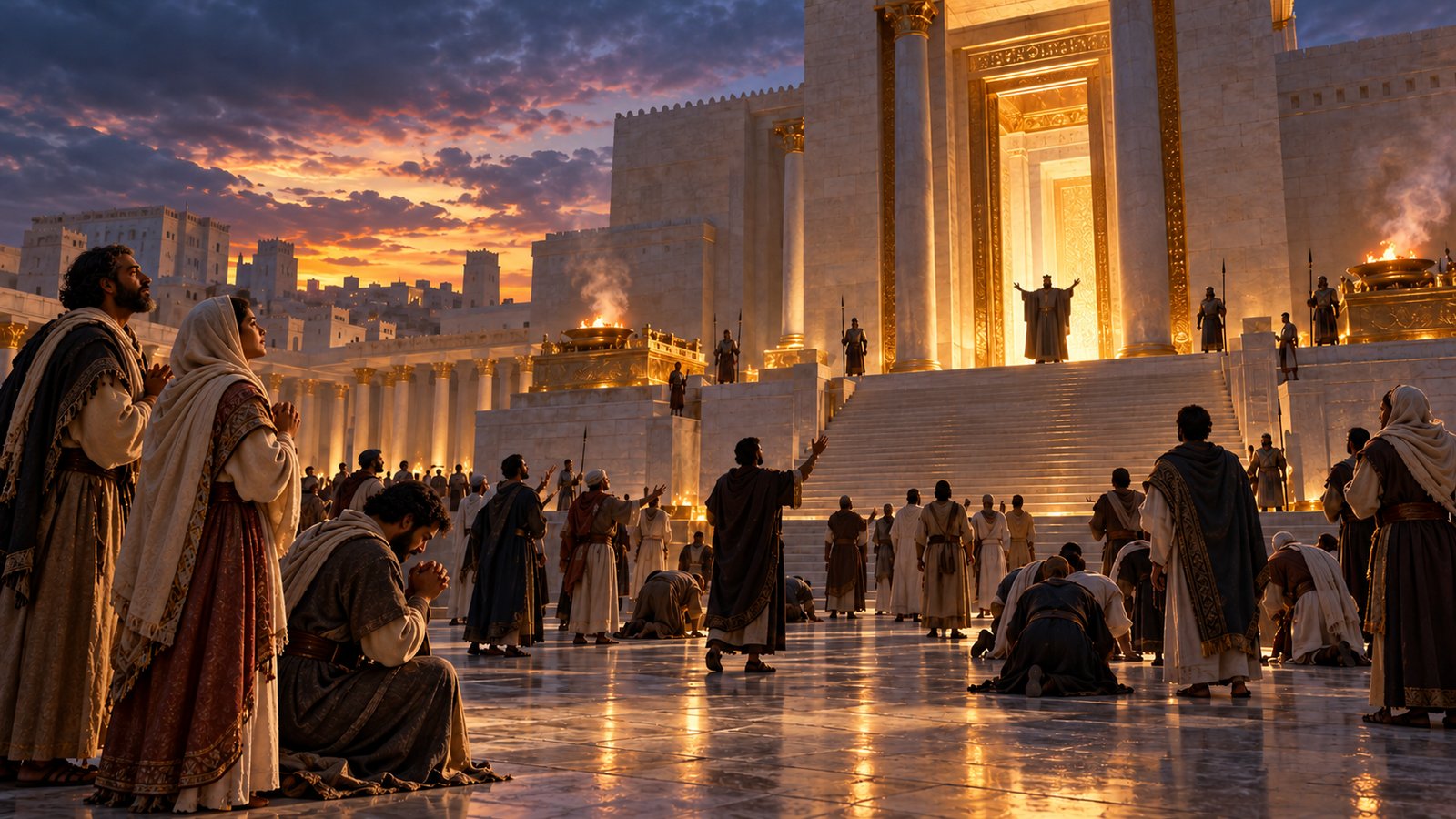
The Second Temple fell in AD 70. Jesus has risen, the Spirit has been poured out, and God is forming a living temple from believing Jews and Gentiles. Yet several prophetic passages bring a sanctuary, sacrifice, desecration, and Jerusalem into view. Many Christians understand them to point to another physical temple before Christ returns.
That is the mystery this chapter explores. Within the futurist reading followed here, a rebuilt third temple becomes the Tribulation Temple: a sanctuary where restored worship is violated by the ruler commonly called the Antichrist. But the Bible does not supply a passage titled “The Third Temple,” a construction date, or an undisputed architectural plan explicitly assigned to that building. The conclusion is assembled from several passages, and the connections must be shown rather than assumed.
This chapter presents that expectation seriously while identifying interpretive questions. Mystery is permission to study carefully, not permission to make uncertainty sound like revelation.
1A reed like a rod was given to me. Someone said, “Rise and measure God’s temple, and the altar, and those who worship in it.
2Leave out the court which is outside of the temple, and don’t measure it, for it has been given to the nations. They will tread the holy city under foot for forty-two months.
3I will give power to my two witnesses, and they will prophesy one thousand two hundred sixty days, clothed in sackcloth.”
First, keep the Church and national Israel distinct
The Church is already God’s temple. The Spirit dwells in believers individually and corporately, and believing Jews and Gentiles have access to the Father through Jesus (1 Corinthians 3:16; 6:19; Ephesians 2:18–22). This does not depend on the approval of a government, the availability of a building site, or the restoration of animal offerings.
Modern Israel’s national restoration is a separate historical development with theological significance. Its establishment in 1948 did not inaugurate the Church or create another means of salvation. Jewish people, like Gentiles, are reconciled to God through Jesus the Messiah. Romans 11 nevertheless forbids Gentile boasting and directs our attention to God’s faithfulness toward Israel.
A proposed future sanctuary in Jerusalem must therefore be discussed without replacing either reality: the Church’s present indwelling by the Spirit or Israel’s continuing place in the biblical story. A future building cannot improve upon Jesus’ finished sacrifice.
Daniel: Sacrifice interrupted and the sanctuary profaned
Daniel 9:24–27 places Jerusalem and the holy city within the prophecy of seventy weeks. Verse 27 describes a covenant associated with one week and the interruption of sacrifice and offering halfway through it. Many futurist interpreters understand this as a final seven-year period associated with the Antichrist. Others understand the covenant, its maker, and the chronology differently.
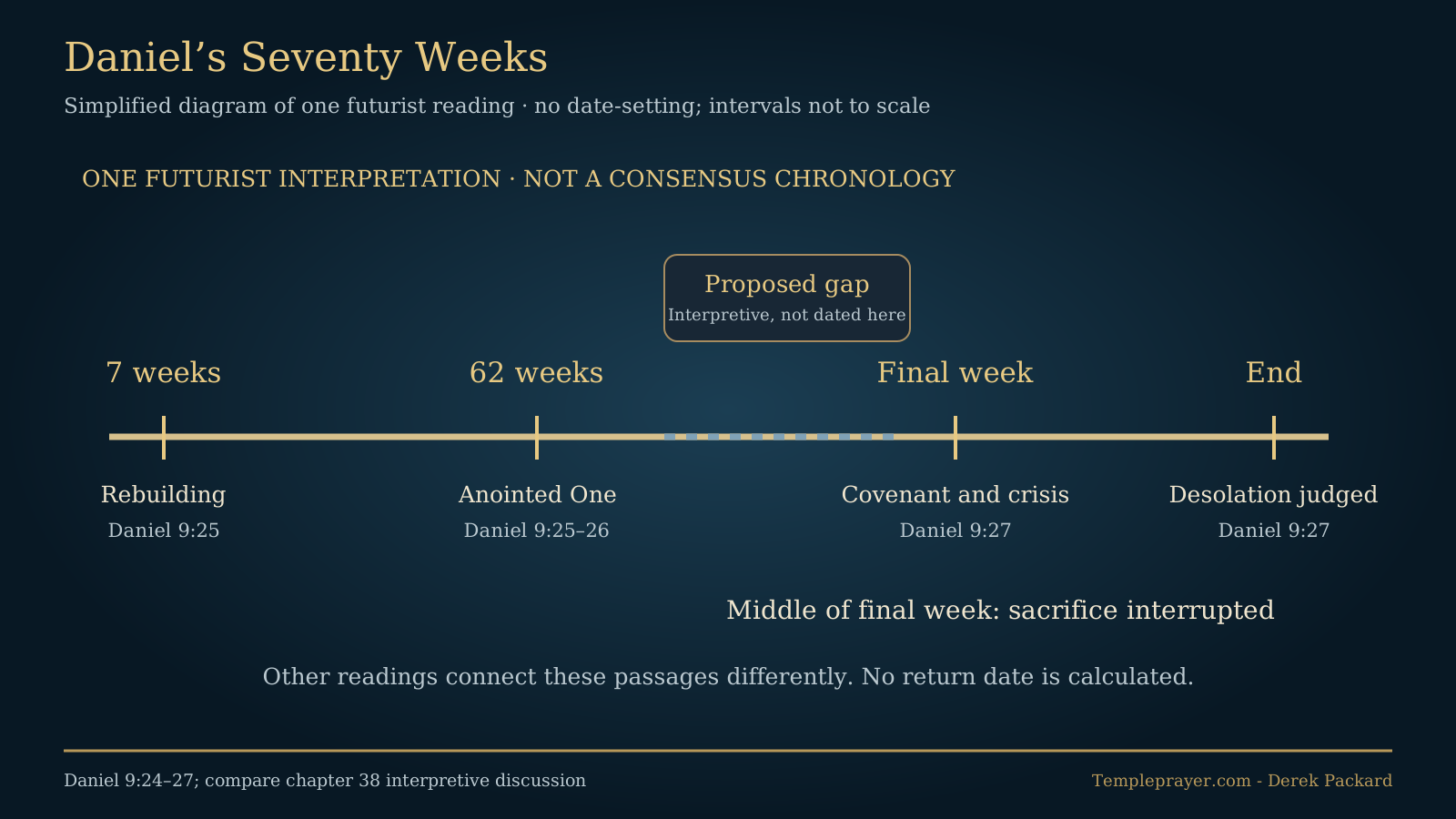
The future-temple argument reasons that sacrifices must be operating before they can be stopped. That supports an expectation of renewed sacrificial worship within this reading; it does not, by itself, specify a completed building or its dedication date. Sacrificial worship and a fully finished temple are not identical, as the rebuilt altar before Zerubbabel’s completed temple already showed us.
Daniel 11:31 and 12:11 also speak of interrupted worship and desecration. Antiochus IV provides a historical instance of sanctuary profanation, considered in chapter 31. The question is how that history relates to the further fulfillment Jesus tells His disciples to watch for. We should explain the relationship rather than erase the historical setting.
Daniel 7 and 12: Persecution ends before God’s throne
Daniel 7:21–27 portrays an arrogant power making war on the saints until divine judgment brings its dominion to an end. The one like a son of man receives an everlasting kingdom, and the saints receive the kingdom under God’s authority. Read alongside Revelation 13, this provides an important prophetic background for the final beast’s opposition to God and His people. The identification and arrangement of the kingdoms must still be explained within the interpretation being used.
Daniel 12:1–3 adds extraordinary distress, deliverance, and resurrection. The chapter’s later references to interrupted sacrifice and measured periods should be studied in that setting of ultimate hope. They are not permission to calculate a date from the most recent war. God’s people are called to wisdom and faithfulness because their future belongs to Him.
Zechariah 13:1, 8–9 adds cleansing and the refinement of a people who call upon God. Zechariah 14:1–9 adds Jerusalem’s crisis and the Lord’s intervention. These passages help frame the movement from conflict to divine kingship, developed in chapter 39. Their remnant language should not be turned automatically into a claim that only a spiritually superior portion of the Church will be gathered to Christ.
Jesus: Watch for the abomination of desolation
In Matthew 24:15–22, Jesus directs His hearers to Daniel and warns about the abomination of desolation standing in the holy place. His instructions concern urgent flight from Judea and an hour of extraordinary distress. In verses 29–31, He speaks of His coming and the gathering of His elect after that tribulation.
Christians differ over how these warnings relate to Jerusalem’s destruction in AD 70 and the final return of Jesus. Some emphasize a first-century fulfillment; others understand an ultimate future fulfillment, sometimes alongside an earlier pattern. In the futurist reading, the holy place is central to a final desecration in Jerusalem. The exact building and construction sequence remain inferred.
Jesus’ purpose is practical as well as prophetic: recognize deception, heed His words, and remain faithful. He does not give permission to turn each new headline into an announcement that the final countdown has begun.
Paul: A man claims the place that belongs to God
Second Thessalonians 2:1–12 links the coming of Jesus and our gathering to Him with a warning about deception. Paul describes the man of sin or lawlessness exalting himself and taking his seat in the temple of God, presenting himself as God. He also describes the Lord Jesus bringing this enemy to an end at His appearing.
Many futurist interpreters identify this figure with the Antichrist and the beast of Revelation 13. A literal sanctuary in Jerusalem provides a coherent setting for his blasphemous claim. Other interpreters understand Paul’s temple language corporately or symbolically. The passage does not use the phrase “third temple,” so we should distinguish Paul’s wording from the proposed identification.
The heart of the offense is the seizure of worship. A creature claims divine authority and demands the allegiance that belongs to God. The temple pattern has always taught us to approach the Lord on His terms; this ruler attempts to replace those terms with himself.
Revelation 11: A measured temple and two witnesses
John is told to measure the temple of God, the altar, and its worshipers, while the outer court is left out and the holy city is trampled for forty-two months. A futurist reading sees a sanctuary associated with Jerusalem during the final conflict. Other readers understand the measuring as symbolic protection or identification of God’s people. Prophetic measurement can carry symbolic meaning, so the measuring rod alone does not settle the debate.
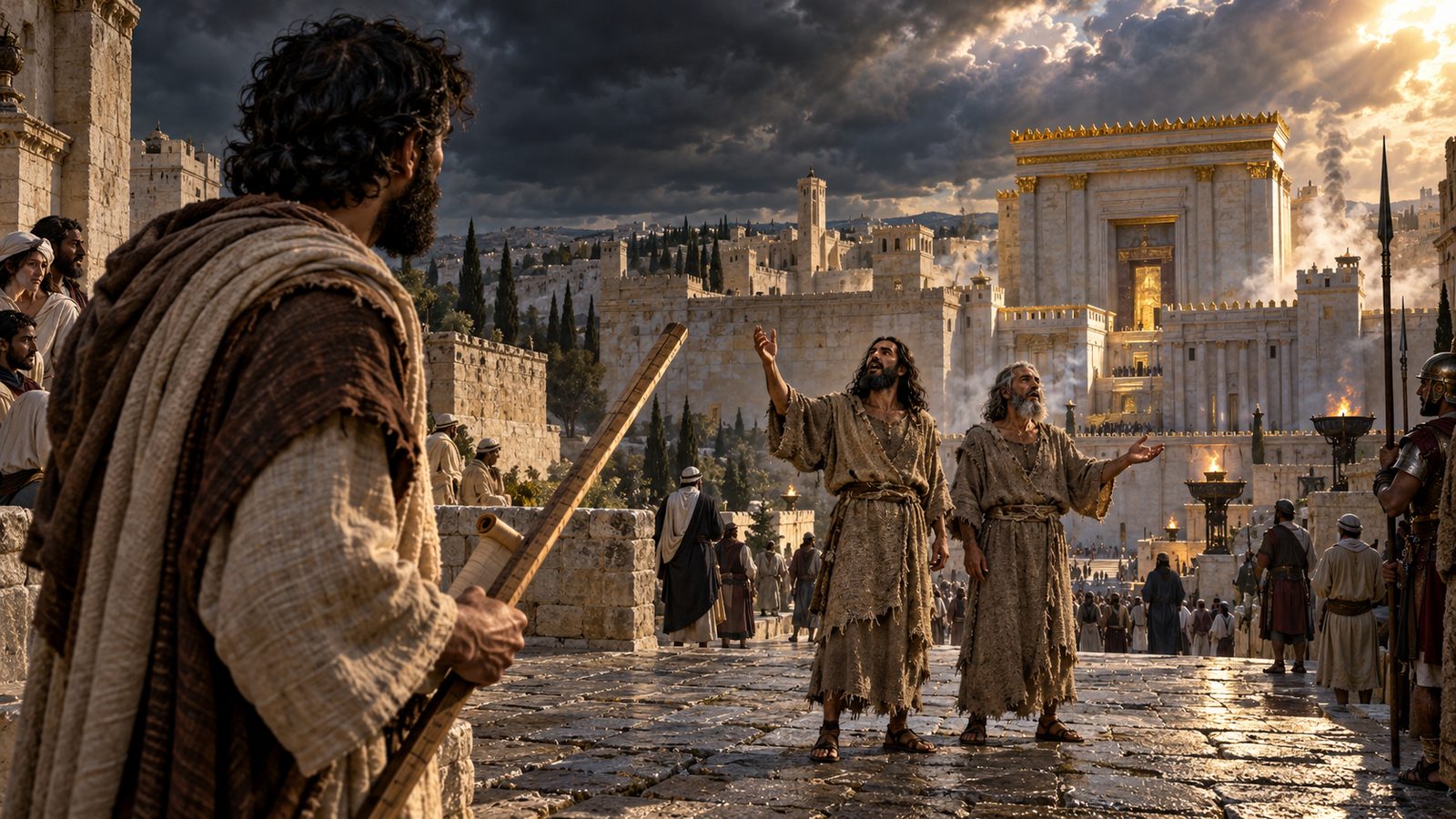
The same chapter introduces two witnesses who prophesy for 1,260 days. The beast kills them; their bodies lie in the city associated with the Lord’s crucifixion; God restores them to life and calls them upward. Their witness places God’s testimony in direct confrontation with the beast’s power.
Their names are not supplied. Identifications with Moses, Elijah, or Enoch are proposals, not statements made by Revelation. Nor does the chapter explicitly say that they conduct all their ministry inside the temple or that their death marks the exact midpoint of a seven-year period. Their relationship to the forty-two months must be explained as part of an interpretive chronology.
The 144,000: Sealed servants belonging to the Lamb
Revelation 7 identifies 144,000 sealed servants from the tribes of Israel. Revelation 14 depicts 144,000 with the Lamb on Mount Zion, marked by divine ownership and faithfulness. In the futurist reading used here, they are commonly understood as a Jewish remnant preserved for God’s purposes. Other Christians understand the number and tribal imagery symbolically.
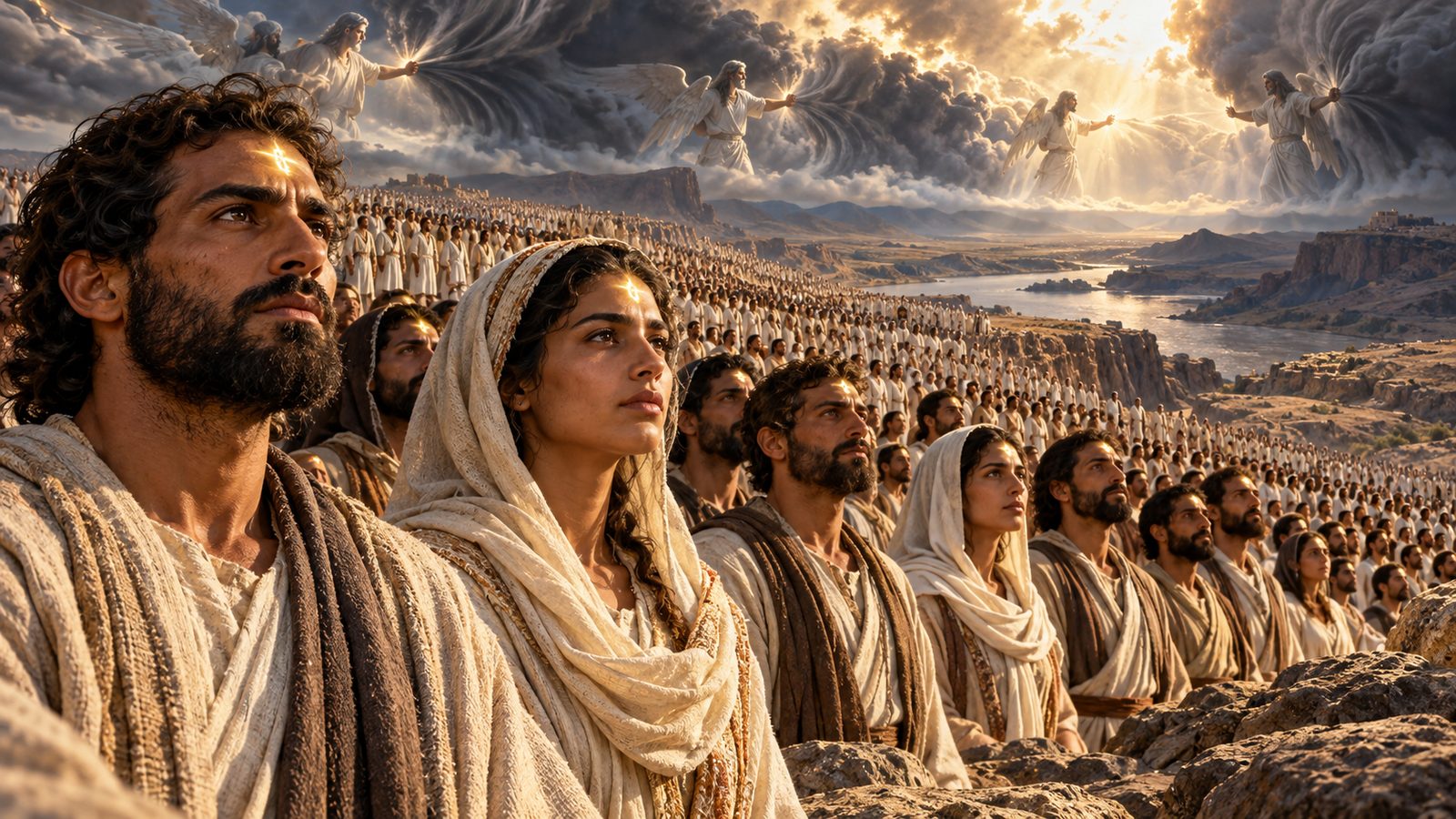
The passages do not explicitly call them temple priests, identify them as the two witnesses’ assistants, or say they are 144,000 traveling evangelists. Those descriptions go beyond what is stated. Revelation 7 also shows a great multitude from every nation coming out of the great tribulation. Together, these scenes direct attention to God’s ownership, salvation, and the Lamb’s victory, not merely to the dimensions of a sanctuary.
Will Christians experience the Tribulation?
Revelation plainly portrays people who belong to Jesus enduring persecution. The disputed question is how those believers relate to the Church’s gathering to Christ, and how the relevant events should be ordered. First Thessalonians 4:13–18 promises resurrection and gathering to the Lord; Christians disagree about its timing in relation to the final Tribulation.
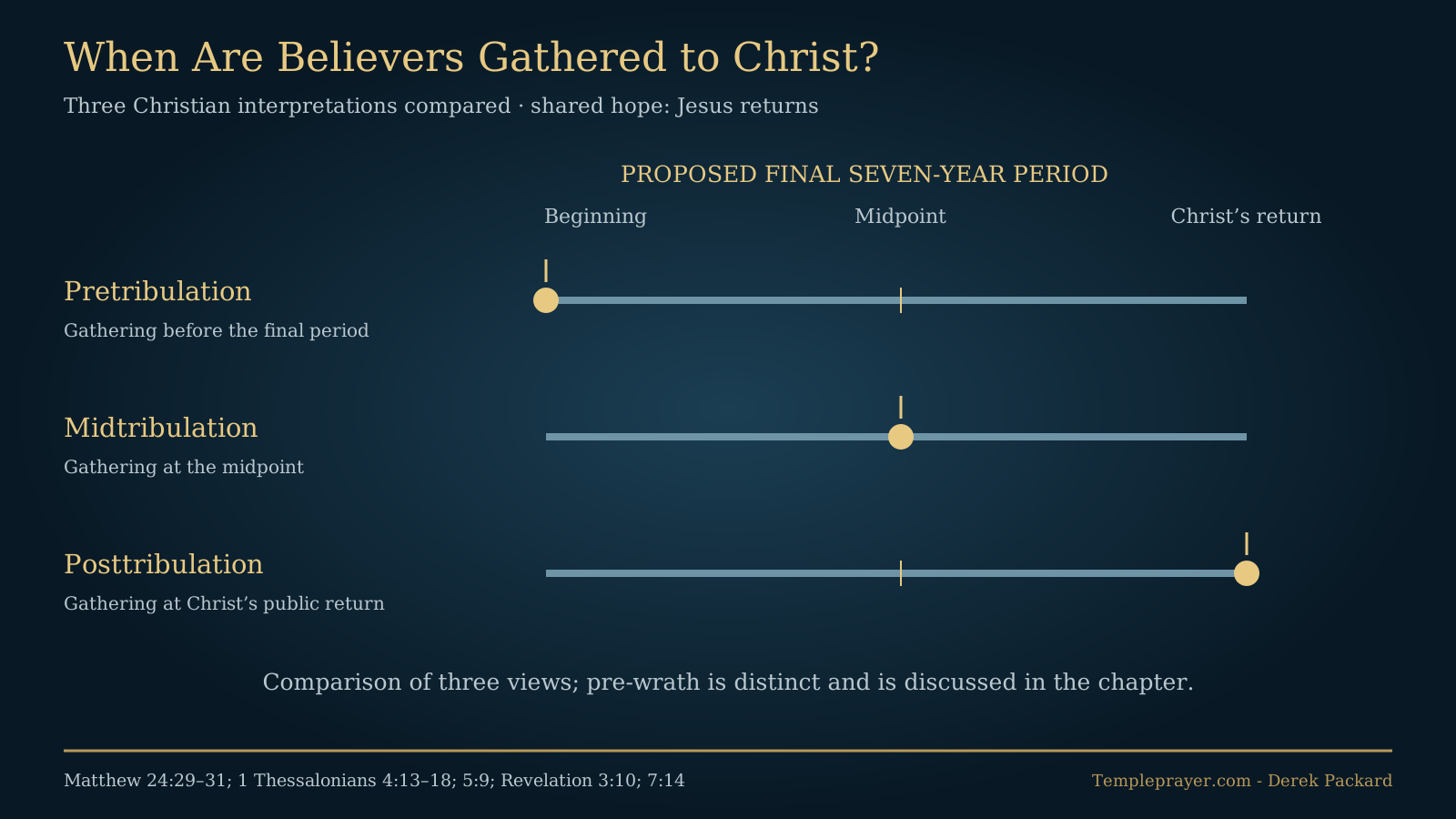
Before the Tribulation
Pretribulation interpreters expect the Church to be gathered before the final seven-year period. They generally understand believers present afterward as people converted during that period, including Jewish and Gentile believers. The absence of the Church as they define it does not mean that no Christians or followers of Jesus exist during those events.
During the final period
Midtribulation interpreters place the gathering near the midpoint. Pre-wrath interpreters distinguish the persecution associated with the great tribulation from the outpouring of divine wrath and place the gathering before that wrath. These positions are not identical. Both expect the Church to experience some final persecution, though they differ over its extent and chronology.
At Christ’s return
Posttribulation interpreters expect believers to endure the final Tribulation and be gathered to Jesus at His public return. They often emphasize Matthew 24:29–31 and the relationship between Christ’s coming and our gathering in 2 Thessalonians 2. Other Christian traditions organize these passages without adopting a separate future seven-year scheme.
What about a remnant of Christians?
Scripture’s language about a remnant must be read in context: a Jewish remnant, persecuted saints, and the Church are not automatically interchangeable terms. Some teach that only watchful believers are taken while other Christians remain; this partial-rapture proposal is disputed and should not be treated as an established category. We should not imply that every Christian who suffers has been spiritually rejected.
Whatever timing we hold, Jesus commands watchfulness and faithfulness. We are promised His presence, resurrection, and final victory, not exemption from every form of suffering. The doctrine of His return should produce holiness, courage, and comfort rather than contempt for believers who read the sequence differently.
Could a temple be built soon?
Preparations are real: the Temple Institute publicly describes work on sacred vessels, priestly garments, and education intended to support a future temple. Those preparations demonstrate the commitment of a particular movement; they do not establish agreement among all Jews, a national construction decision, or a divine timetable. [1]
Changes involving Iran, Hezbollah, Hamas, Israeli-Palestinian relations, and wider diplomacy may alter the political environment. But military setbacks for opponents do not resolve the mount’s religious administration, legal and diplomatic obstacles, disagreements within Israel, or the danger of regional conflict. A major political change could come unexpectedly; Scripture does not authorize us to name the year. [2]
“The stage may be changing” is an assessment of conditions. “God has revealed construction this year” is a claim of revelation. The first can be examined; the second must never be smuggled in through confident speculation.
Could a shared mount become a promise of peace?
Some Christians propose that a future sanctuary might coexist with the Dome of the Rock through an internationally celebrated peace arrangement. Within a futurist reading, they connect that possibility with Daniel 9:27 and the later seizure of worship described in 2 Thessalonians 2 and Revelation 13. The proposed connection is speculative: these passages do not name the Dome, prescribe a shared-mount arrangement, or describe the agreement’s participating religions.
A related proposal identifies the Antichrist or his ally with the Mahdi expected in some Islamic traditions. “Imam” is a title for a religious leader; beliefs about the Mahdi vary, and in Twelver Shi‘ism he is identified with the awaited twelfth Imam. The New Testament does not name the Mahdi or establish that identification. We may examine the comparison as an interpretive proposal, but cannot present it as revealed fact. The biblical anchor is the warning against deception and the usurpation of worship—not certainty about the future ruler’s religious label.
Worship belongs to Jesus
A future sanctuary would not establish another saving covenant alongside the gospel. Hebrews 10:1–14 directs us to the once-for-all offering of Jesus. Restoration of sacrifices could be historically and prophetically significant without providing atonement beyond His blood. The builders’ desire to restore worship and the Antichrist’s desire to seize worship are different motives. We must not assign his future blasphemy to Jewish people collectively. Scripture calls us to intercede for Israel and to bear witness to the Messiah with truth and mercy. This is also a chapter about God’s government: false authority is exposed and judged, Christ preserves His people, and the pretender’s reign ends. We will next consider the Millennial Temple within the expectation of Jesus’ reign, distinguishing that interpretation of Ezekiel from the proposed Tribulation sanctuary. The story finally leads to the New Jerusalem, where God Almighty and the Lamb are its temple.
Temple Prayer Response
Lord Jesus, keep our allegiance wholly Yours. Wash away our love of sensational claims and give us hunger for Your Word. Strengthen believers who suffer now and those who will face persecution in the future. Preserve a faithful witness among Jews and Gentiles, protect the vulnerable, and make us ready to endure, serve, and welcome You. You are our Temple, our High Priest, and our coming King. Amen.
Daniel 9:24–27; 11:31; 12:1–12; Matthew 24:15–31; 2 Thessalonians 2:1–12; Revelation 7:1–17; 11:1–13; 13:1–18; 14:1–5; 20:4–6; 1 Thessalonians 4:13–18; 5:1–11; Hebrews 10:1–14; Romans 11:1–2, 17–29.
- Which statements in these passages are explicit, and which connections depend on a prophetic framework? How does the distinction between persecution and divine wrath affect the different gathering timelines? How can we pray for Israel and study a possible future temple while keeping Jesus’ finished sacrifice central? What would faithful readiness require of us if our preferred timetable were mistaken?
The chapter follows a futurist, premillennial approach while identifying disputed conclusions. Scripture summaries above are explanations, not verbatim Bible quotations. The passages below allow readers to examine the wording in context. L: [1] Temple Institute — Stated preparations and sacred vessels | https://templeinstitute.org/home-page/ L: [2] Associated Press — Changes to Hamas and its regional support network (2025) | https://apnews.com/article/13cf31a9d1b0fa9d14af2fc64e7f1041 L: Daniel 9 — World English Bible | https://ebible.org/eng-web/DAN09.htm L: Matthew 24 — World English Bible | https://ebible.org/eng-web/MAT24.htm L: 2 Thessalonians 2 — World English Bible | https://ebible.org/eng-web/2TH02.htm L: Revelation 7 — World English Bible | https://ebible.org/eng-web/REV07.htm L: Revelation 11 — World English Bible | https://ebible.org/eng-web/REV11.htm L: Revelation 14 — World English Bible | https://ebible.org/eng-web/REV14.htm L: Mahdi — Historical reference on Islamic expectations; traditions differ | https://en.wikisource.org/wiki/1911_Encyclop%C3%A6dia_Britannica/Mahdi L: Imam — Definition and differing uses of the title | https://en.wikisource.org/wiki/1911_Encyclop%C3%A6dia_Britannica/Im%C4%81m